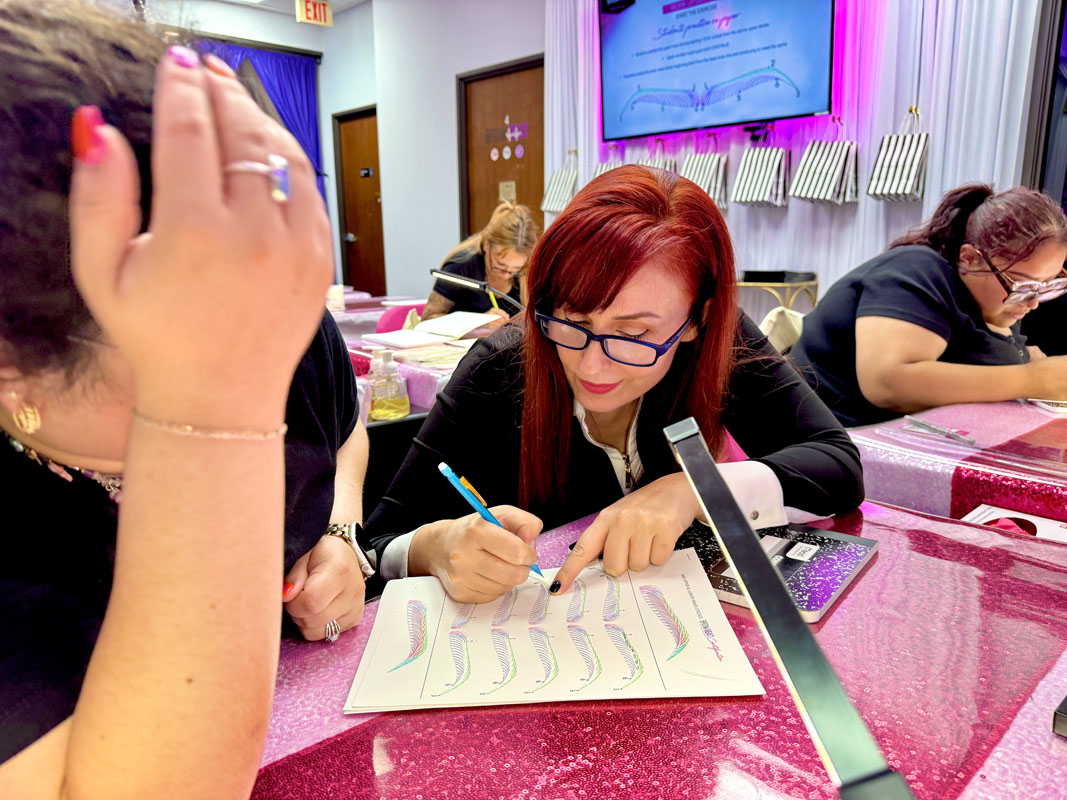
At BrowBeat Studio Dallas Microblading Certification and Training Academy, our focus is on teaching artists the basic stroke pattern in a way that is repeatable, clean, and reliable. From there, we show how all the “fancy” patterns—Asian, feathered, spinal variations, upper stroke variations, lower stroke variations—are just extensions, tweaks, or rearrangements of that same core pattern. In other words, you do not need to learn twenty completely different systems. You need to deeply understand one, then learn how to adapt it.
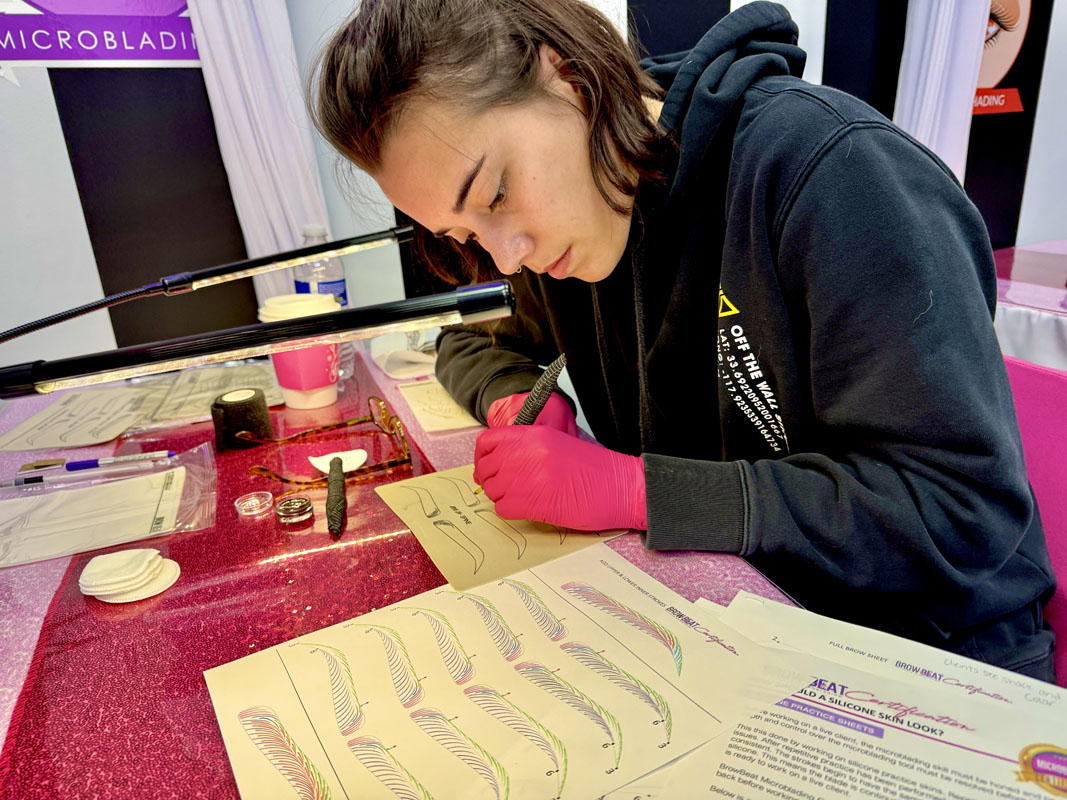
If your goal is to build a long-term career, not just collect techniques, this perspective changes everything about how you approach training, practice, and your future clients.
The Obsession with Advanced Stroke Patterns
Microblading lives in a very visual world. Social media is full of zoomed-in photos of stroke work, diagrams with color-coded lines, and time-lapse videos of complex patterns coming to life. It is natural for artists to become obsessed with the “next” pattern: a different head variation, more intricate inner strokes, and different spines of the brow.
There is nothing wrong with wanting to learn advanced work. Curiosity is a good thing. The problem comes when you start chasing pattern after pattern without mastering the basics. You might jump from one teacher’s style to another, copying diagrams without a deep understanding of why the strokes flow the way they do. This creates confusion in your hands and inconsistency in your results.
Many artists do not realize that each new pattern they attempt introduces more variables into an already complex treatment. You are not just working with a new stroke layout—you are working with different hair growth patterns, different skin types, different pressure levels, different pigment behaviors. When your base pattern is not deeply solid, adding more variations simply multiplies your chances of making mistakes.
This is especially important to understand when you are still in the early years of your career. Learning a little bit of everything does not automatically make you advanced. It can actually make you feel less confident, because you are never doing the same pattern often enough to refine it. Instead of building muscle memory, you are constantly starting from scratch.
What Clients Actually See (And What They Don’t)
While you are busy worrying about whether to use one stroke pattern or another, your client is thinking about very different things. Most clients will not be able to articulate the difference between one spine variation and another. They are looking at the overall impression.
Clients notice:
- Whether the brows are even and symmetrical enough for their face.
- Whether the color looks natural or harsh once healed.
- Whether the shape feels like “them,” only better.
- Whether any part of the brow feels too heavy, too light, too high, or too low.
- How you communicated with them before, during, and after the procedure.
- How comfortable they felt in your chair.
- Whether you cared about their aftercare and follow-up.
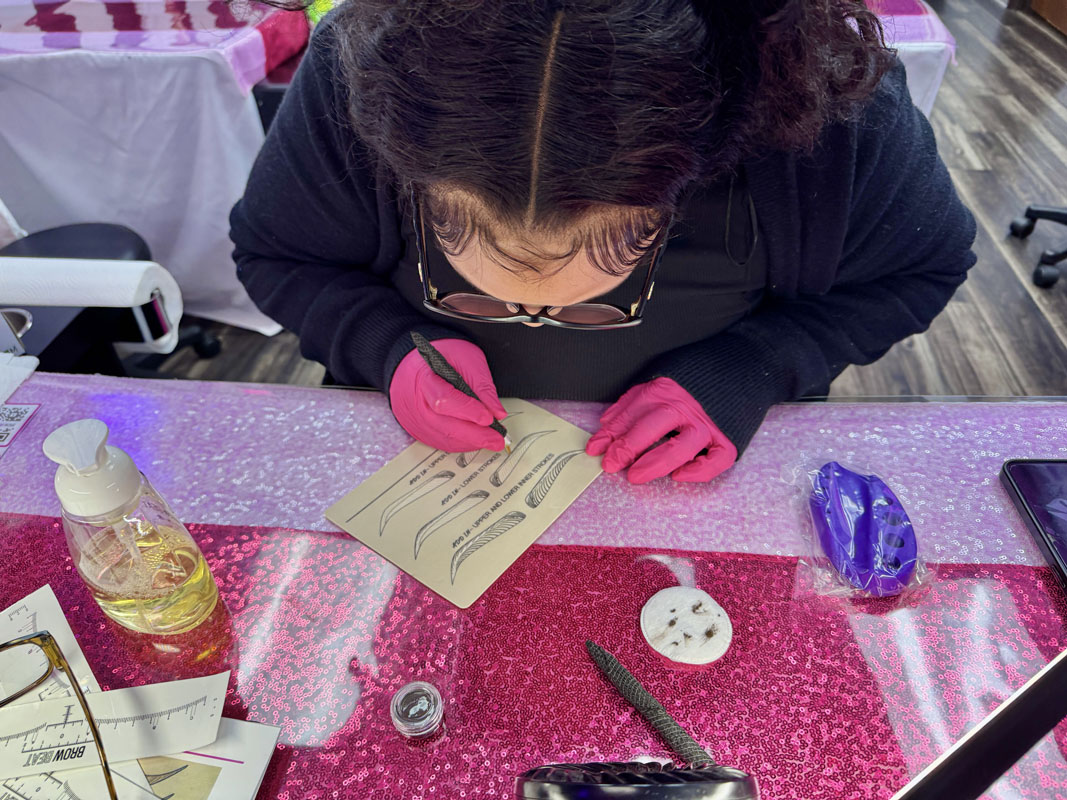
Clients do not lie awake at night thinking, “Did my artist use an upper stroke variation or a lower stroke variation in the tail?” They think, “Do I like how I look?” This is not an argument against learning technique. It is a reminder of what truly matters. Stroke patterns are tools to help you build a balanced shape and a believable texture, not trophies for your collection.
When you simplify your priorities and focus your learning on the skills that directly affect how the brow looks and heals—mapping, pressure, stroke direction, color choice, and aftercare—you become the kind of artist clients remember and recommend.
Too Many Hands in Too Many Pies
There is a saying in artistry and in business: when you try to be great at everything at once, you become average at all of it. The same applies to microblading stroke patterns. Trying to learn every pattern style at the same time easily turns into having too many hands in too many pies.
Each pattern you learn requires:
- Understanding how the pattern flows from head to tail.
- Memorizing the direction and angle of each stroke group.
- Practicing the spacing between strokes.
- Adjusting the layout for different brow shapes and hair growth patterns.
- Seeing how the pattern heals on different skin types.
When you spread your practice across ten different patterns, you are not giving yourself enough repetition in any one of them to truly master it. Your brain and hands never get a chance to relax into something familiar. Every set of brows feels like starting over.
This is why more learning can sometimes equal more mistakes. It is not because more knowledge is bad—it is because unstructured, scattered knowledge does not automatically turn into skill. Skill is built by repeating a small number of things many times, with feedback and refinement, until they feel natural.
In a structured training environment, like a formal Microblading Certification program, you are guided to focus on one core pattern first, then shown how to adapt it once you have control. This protects you from drowning in technique before you have learned to swim.
The Basic Stroke Pattern: The Foundation of Everything
Every advanced pattern you see online is built from a basic foundation. There is always a core layout, a main direction for the spine, a flow of strokes moving from the head to the arch and then to the tail. In our course at BrowBeat Studio Dallas Microblading Certification and Training Academy, this is what we call the basic stroke pattern.
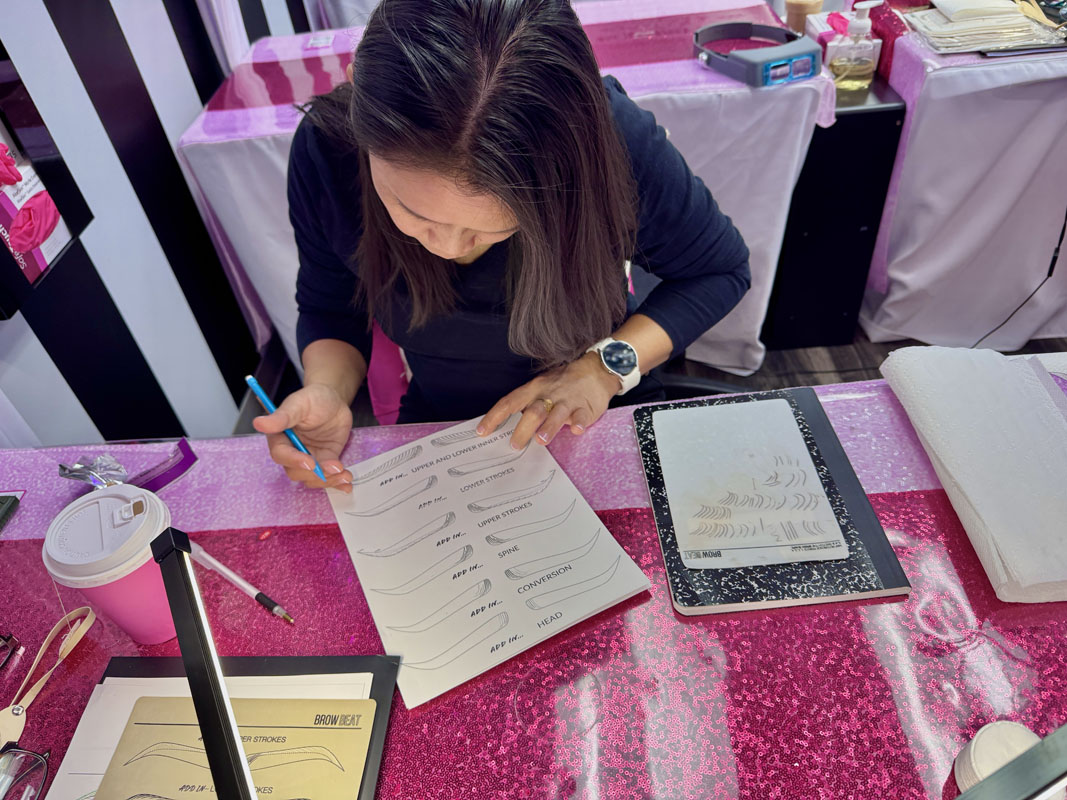
The basic stroke pattern teaches you:
- How to build the head strokes.
- How the spine flows through the center of the brow.
- How upper strokes and lower strokes interact.
- Where the conversion is.
- How to maintain consistent spacing between strokes without creating gaps or clumping.
Once you understand this core pattern and can draw it consistently, every variation becomes easier. You are no longer copying a shape from a diagram; you are modifying a structure you already know. You can shorten, lengthen, soften, or layer strokes based on what the brow needs. The basic pattern is the language; variations are just different sentences built from the same vocabulary.

How Many Stroke Patterns Are Out There?
There are as many stroke patterns as there are trainers and artists who decide to name them. Some are entirely new systems; others are small tweaks wrapped in fresh branding. It can feel like the industry is constantly announcing yet another pattern that you “must” learn if you want to keep up.
Among the most commonly mentioned pattern families are:
- Asian patterns
- Feathered patterns (ultimately more space between the strokes making it wispy)
- Spinal variations
- Upper stroke variations
- Lower stroke variations
Asian patterns are similar to the basic stroke pattern, but the lower strokes fall sooner making the brow shape flat. Feathered patterns emphasize space and have less strokes that make the brow weight appear light, (not all clients will be attracted to this). Spinal variations adjust the central column of strokes to change how the brow carries its weight. Upper stroke variations change the way the upper inner strokes are filled, and lower stroke variations shift how the brow density sits along the bottom, often allowing a set of staggered strokes mimicking the one stroke in the basic stroke pattern, a lot of strokes, not good for thick and oily skin.
These can all be interesting and useful for the right client. But here is the key: they are not completely separate universes. They are all built on the same basic principles of stroke direction, spacing, and flow. They are branches off the same main tree.
The Truth: All Stroke Patterns Come From One Basic Pattern
When you look closely at enough patterns, you begin to see the similarities more than the differences. Almost every pattern you will learn is, at its heart, a variation of a basic stroke layout.
More Learning, More Mistakes? Only If It’s Unstructured
Learning is always good. The problem is not that artists are learning too much, but that they are learning in a scattered way. When you collect patterns without a foundation, you give yourself more ways to be uncertain.
Unstructured learning often looks like this:
- Trying a new pattern on almost every client.
- Switching systems mid-course because a new video looked exciting.
- Changing head strokes frequently instead of refining one style.
- Not tracking how different patterns heal over time.
- Blaming the pattern instead of refining your pressure, depth, or mapping.
The result is a pile of experience without coherence. You have “seen” a lot, but you have not truly mastered anything. Your work feels inconsistent, and your confidence can suffer.
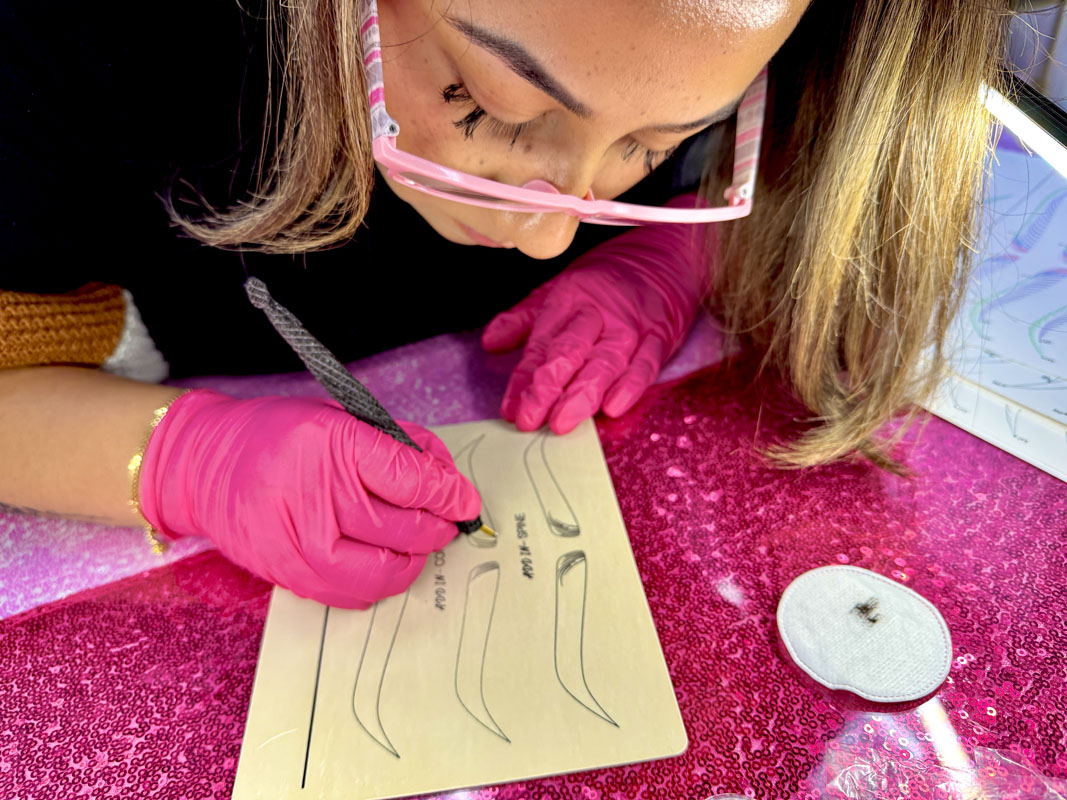
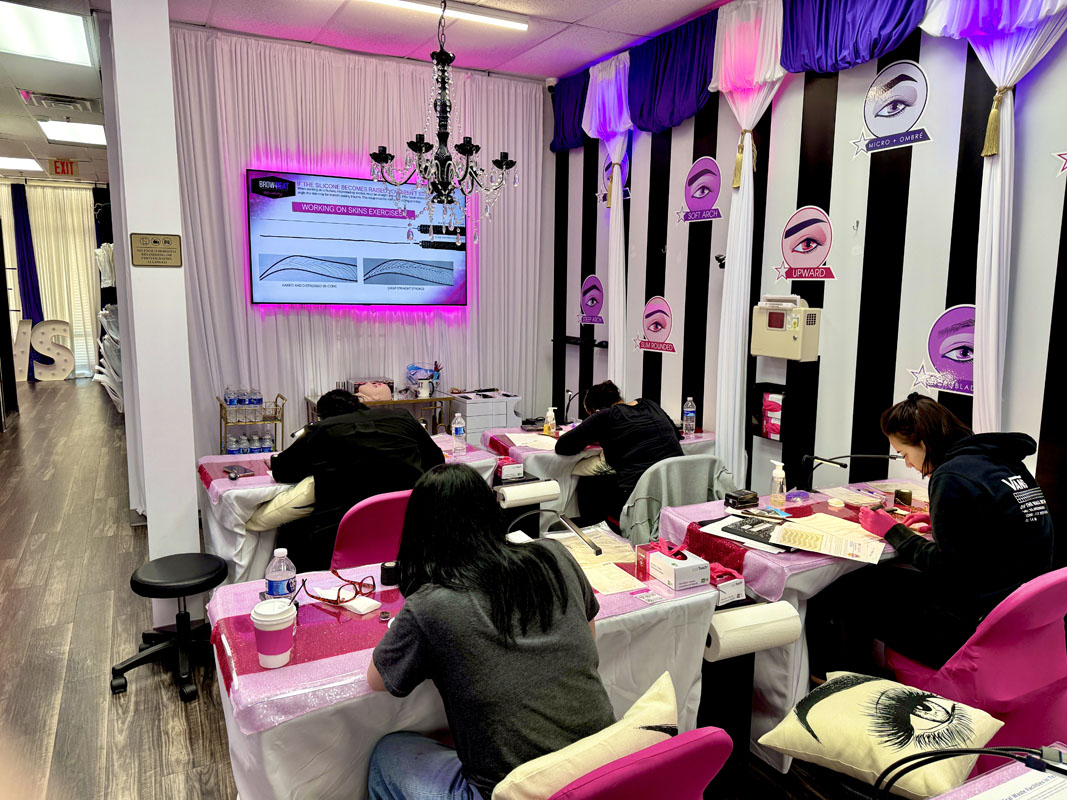
Structured learning, on the other hand, looks very different. In a guided environment, you are encouraged to commit to one basic pattern, repeat it often, and evaluate the healed results. You practice on silicone, on simulation exercises, and within a course that gives you feedback. Only after you show competence and control does it make sense to add variations.
This is the approach we take in our training at BrowBeat Studio Dallas Microblading Certification and Training Academy. By focusing on a core pattern and refining it with repetition, artists are able to build real skill. When they later decide to learn an Asian pattern or a feathered variation, it sits on top of something stable.
What Your Clients Really See and Feel
When your client walks out of your studio, they are not thinking about the technical name of the pattern you used. They are thinking about the experience they had and how they feel about their new brows.
They notice:
- Whether they feel more confident than when they walked in.
- Whether the brows feel like a match for their personality.
- Whether the color and shape make their face feel more balanced.
- Whether the healing matched what you told them to expect.
- Whether you supported them during the healing process.
That last point is important. Follow-up is often more important to a client’s memory than which pattern you chose. Checking in, answering questions, and helping them understand each stage of the healing leaves a stronger impression than technical choices they cannot see.
Skill vs Money: What Is Your Real Goal?
Many artists start their journey with a mix of motivations. There is nothing wrong with wanting to earn a good income from your skill. But if money becomes the only goal, it often leads to shortcuts in training: rushing through courses, chasing quick certifications, and collecting techniques faster than you can master them.
When your goal shifts to skill first, everything changes. You view each new pattern as a tool, not a badge of honor. You understand that mastering one basic stroke pattern to a high level will do more for your long-term career than dabbling in ten advanced ones. You become less reactive to trends and more grounded in your own competency.
Skill-based artists:
- Invest in structured training rather than random clips.
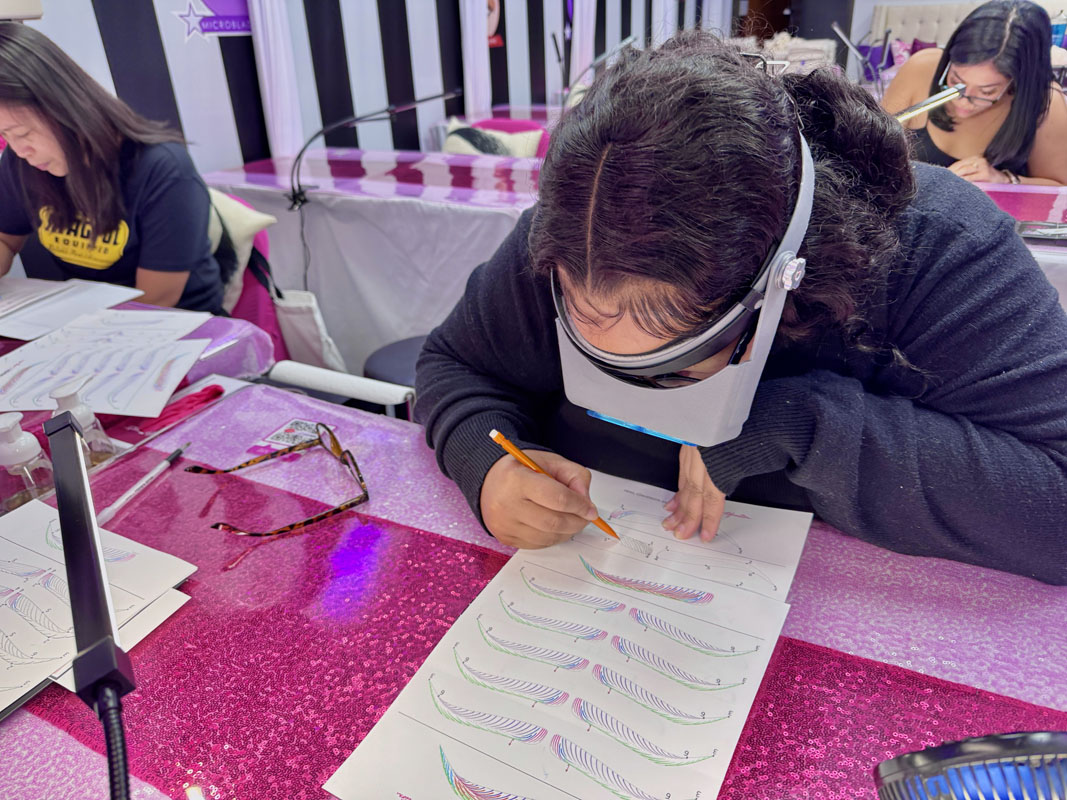
- Practice the same layout repeatedly until it feels natural.
- Care about healed results, not just fresh photos.
- Prioritize follow-up and client satisfaction.
- Build their kit and tools around a solid workflow instead of novelty.
Over time, this approach actually leads to more income and more demand, because clients trust artists whose work is consistent. Learning stroke patterns in a structured way—starting with the basic pattern taught in courses like our Ombré Powder Brow Certification and microblading curriculum—helps you stand apart as a professional, not just a collector of techniques.
Building Stroke Mastery with the Right Tools and Training
Technique and tools work together. If your tools are unreliable or mismatched with what you are trying to learn, practicing stroke patterns becomes more frustrating than it needs to be. A well-designed kit that supports both your microblading and shading practice can simplify your training journey.
Having consistent blades, pigments, and practice materials allows you to focus on your stroke pattern instead of constantly adjusting to new products. When you learn with one setup—on silicone, on simulation exercises, and in your live work—you give your hands and eyes a chance to really learn the pattern instead of constantly adapting to new variables.
That is why we created a comprehensive microblading and lip blushing kit to support our students. It is designed to complement the way we teach basic stroke patterns and shading techniques. The more aligned your tools are with your training, the faster your stroke skills can grow.
When to Add Advanced Stroke Variations
Advanced stroke work has its place. There will come a time in your career when it makes sense to add an Asian pattern, a more intricate feathered pattern, or specialized spinal and upper/lower stroke variations into your skill set. The key is timing.
A good moment to begin adding variations is when:
- You can draw your basic pattern from memory, with consistent spacing and flow.
- You have seen multiple healed results from your basic pattern and understand how it behaves.
- You can identify how changes in pressure and depth affect the strokes.
- You feel confident explaining healed results to your clients.
When you reach this stage, learning new variations no longer feels like starting over. Instead, you can look at a pattern and instantly see how it relates to what you already know: perhaps the spine is slightly more curved, or the heads are softer, or the lower strokes taper differently near the tail. You can choose when and why to use each variation based on real client needs instead of using them just because they are new.
The difference is intention. You are adding patterns in a way that serves your clients.
Stroke Patterns as Part of a Bigger Picture
Stroke patterns matter. They contribute to how natural, detailed, and refined your brows look. But they are one piece of a larger puzzle that also includes mapping, color theory, pressure control, pigment selection, and healing education.
When you view stroke patterns in this bigger context, they stop feeling like the only thing that defines your artistry. You can relax into the truth that mastering one core pattern, combined with strong mapping and color skills, will do more for your career than constantly chasing the latest pattern trend.
Choosing a Training Path That Supports Real Mastery
If you want to move from scattered learning into real mastery, the training path you choose matters. A strong program will not just show you many patterns; it will help you understand the logic behind them and give you a basic pattern to anchor everything else.
At BrowBeat Studio Dallas Microblading Certification and Training Academy, our focus is on teaching microblading artists how to build a reliable, repeatable stroke pattern first. From there, we introduce variations in a way that makes sense, showing how they connect back to that foundation. Instead of overwhelming you with dozens of options from day one, we help you get good at doing things one way, then gradually expand your toolkit.
If you are ready to take your stroke work seriously and build a skill set that can grow with you, explore our core Microblading Certification course, deepen your shading and brow-structure knowledge with our Ombré Powder Brow Certification, and equip yourself with additional business tools in our business solutions section.
Learning every stroke pattern in the world is not the goal. Building a clear, stable foundation that lets you serve clients beautifully, confidently, and consistently—that is what will carry your semi-permanent makeup career forward.