
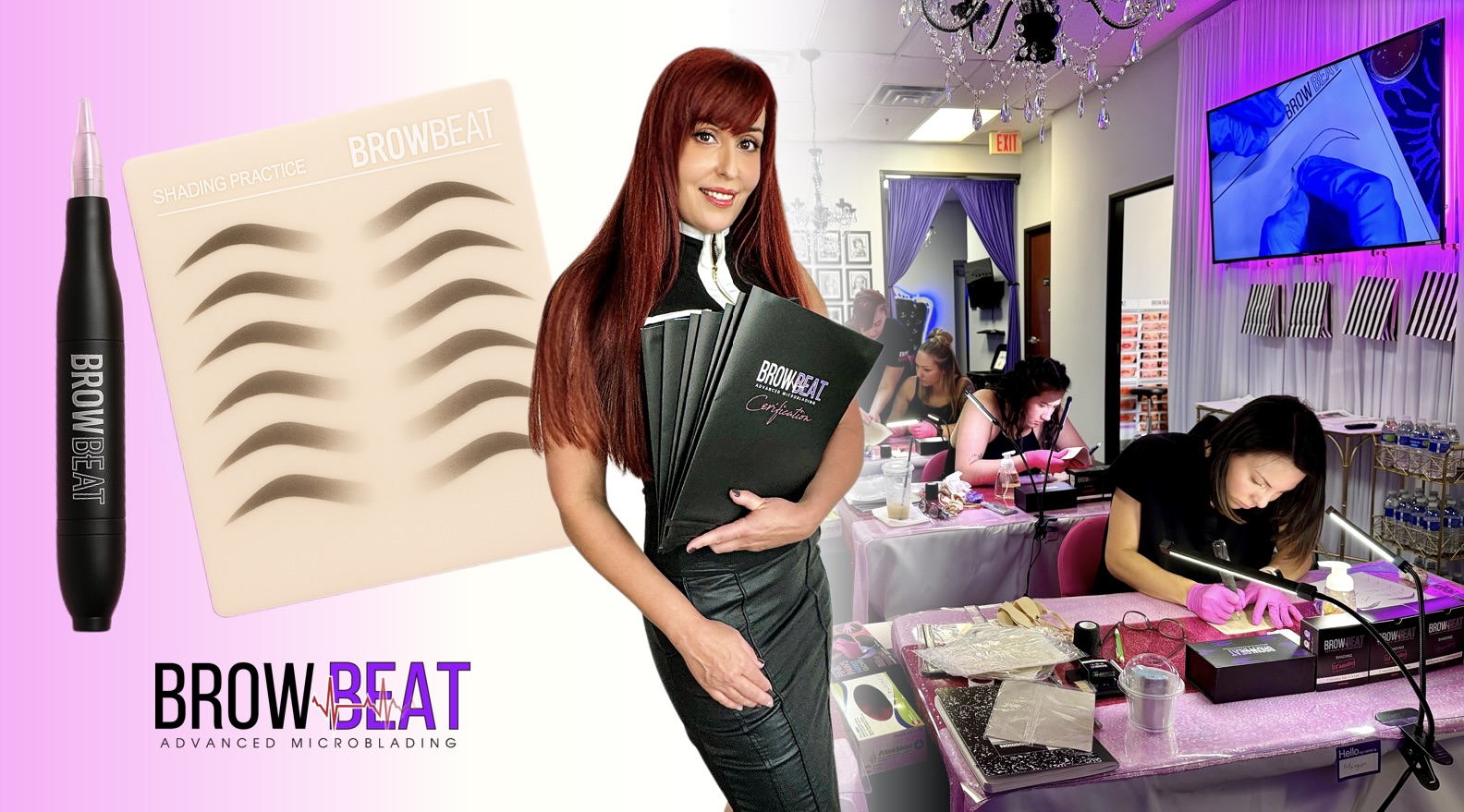
At its core, nano brows are not a new universe. They are a variation. They sit inside the same family of skills you already recognize: lines and dots. Strokes and shading. Whether you call it nano, machine strokes, pixel brows, or ultra-fine shading, the fundamentals underneath are the same. You still need to understand mapping. You still need to understand direction and flow. You still need to understand depth, pressure, and color.
At BrowBeat Studio Dallas Microblading Certification and Training Academy, we teach artists to see through the buzzwords and focus on the two big building blocks of semi-permanent brows: lines and dots. Once you understand these, every new term becomes easier to place. Microblading, nano, powder, ombré, microshading, micropowder brows, micropigmentation — they stop feeling like separate worlds and start feeling like variations on a theme you already know.
What Does “Nano” Actually Mean?
Nano, in plain language, means small. In semi-permanent makeup, that translates to small needles, small punctures, and small pigment deposits. Instead of larger groupings, nano needles are designed to be very fine, often used for delicate work where precision really matters.
When artists talk about nano brows, they usually mean one of two things:
- Machine shading created with very fine pixel dots (tiny “nano” points of color).
- Machine strokes — hair-like lines created with a PMU machine using a nano needle.
Both methods rely on the same idea: small, controlled deposits of pigment placed with a PMU machine. In one case, those deposits look like dots that build a shaded effect. In the other, they look like strokes that mimic hair. Because the industry is full of creative artists, language tends to evolve. Different trainers emphasize different aspects, and the word nano gets pulled in multiple directions.
For you as an artist, this means one important thing: do not let the term nano intimidate you. It does not represent a completely separate profession. It is a label attached to work you will eventually understand as part of your broader PMU skill set. Once you know how to create lines (strokes) and dots (shading) with control, nano becomes simply a finer, more delicate way of doing what you already know.
Industry Buzzwords and Why Nano Sounds Bigger Than It Is
Artists are creative, and creative people like naming things. New angles, new aesthetics, new ways of describing old techniques — these all show up as the industry grows. Sometimes a technique genuinely advances. Other times, a new name is simply a way to package familiar concepts in a fresh way.
Nano is one of those words that has grown beyond its original definition because it sounds advanced. Clients hear it and think “new technology.” Artists hear it and think “next-level skill.” Both can be true, but only if you understand what lies underneath. If you strip away the name, you still find:
- Lines made with a machine (machine strokes).
- Dots made with a machine (pixel shading / powder work).
When you remember this, the pressure around nano fades. Buzzwords will continue to come and go. What does not change is the need for strong fundamentals: mapping, movement, depth, stretch, and pigment control. Artists just like you are the ones creating new language; you do not have to be overwhelmed by it. You are allowed to step back and say, “What is this really?” and then bring it back to basics.
What Is a Nano Brow Machine?
A nano brow machine is not a completely different device from a PMU machine — it is usually the same category of tool, often using specific cartridges or settings that support ultra-fine detail. In many cases, the term nano brow machine simply refers to a high-quality PMU device that can safely and effectively run very fine single needles or tight needle groupings suitable for detailed brow work.
A nano-capable PMU machine typically allows you to:
- Use very fine cartridges designed for precision work.
- Adjust speed to match the technique (strokes vs shading).
- Control depth more predictably through hand motion and stretch.
- Build color in layers instead of depositing it all at once.
In other words, a nano brow machine is a PMU machine that is used in a specific way: with small needles and deliberate technique to create detailed brow effects. The power is not in the device alone — it is in how you use it.
This is why jumping straight into nano without understanding fundamentals can feel overwhelming. The machine is only as effective as the artist’s control. The more you know about skin, pressure, direction, and pigment, the more nano becomes a natural extension of your skills rather than a separate mystery.
Lines and Dots: The Real Skills Behind Nano Brows
No matter what the latest trend name is, all brow work comes back to two core motions:
- Lines (strokes)
- Dots (shading)
Microblading builds lines with a manual blade. Machine shading builds dots with a PMU device. Nano brows simply play at the refined edge of this spectrum — smaller lines, smaller dots, more delicate placement. The skill you really need is not “nano.” The skill you need is the ability to create both lines and dots with intention.
When you train through a structured pathway, such as the Microblading Certification and Ombré Powder Brow Certification at BrowBeat Studio Dallas Microblading Certification and Training Academy, you learn these building blocks in a logical order. Strokes first. Shading second. Combination work next. Nano-level precision naturally follows once your hands are already familiar with movement, mapping, and flow.
Over time, depth control also grows. Going deeper, in the right way and for the right reasons, comes with practice and experience. You do not have to force it on day one. You are allowed to build.
Nano Brows: Strokes, Shading, or Both?
One of the reasons nano feels confusing is that if you ask ten artists to define nano brows, you may get ten slightly different answers. For some, nano brows mean:
- Hair strokes drawn with a PMU machine using a nano needle.
For others, nano brows mean:
- Very fine pixelated shading done with a small needle, creating a soft, powdery effect.
Both are valid uses of the word. Both live in the same family of techniques. The common thread is that the work is done with a machine, using fine needles, to create detailed brow results. To some, nano brows are simply machine brows done with extra refinement. To others, they are machine strokes specifically. What matters is not which definition you prefer — what matters is understanding what you are actually doing on the skin.
When you understand that nano brows can be either fine strokes, fine shading, or a combination of both, the term stops feeling rigid. Instead of worrying about matching someone else’s definition, you focus on creating good work. You remember that clients do not walk in asking which needle configuration you used. They ask if the brows suit their face, if the color is right, and if the healed result looks beautiful.
What Artists Need to Know to Use a Nano Brow Machine
While nano is not something to be afraid of, it does require responsibility. A nano brow machine magnifies both your strengths and your weaknesses. The finer the needle, the more precise your movements need to be. Learning to use a nano-capable machine means building confidence in several areas:
Understanding Needles and Cartridges
You need to know:
- Which needle diameters are considered nano-level fine.
- How single needles behave differently from larger groupings.
- How cartridge choice impacts the type of effect (stroke vs shade).
- How to maintain hygiene and needle safety at all times.
This knowledge keeps your work predictable. It allows you to choose the right cartridge for the job instead of guessing. It also keeps your focus where it belongs — on technique, not on uncertainty about your tools.
Speed and Movement
Nano work demands controlled speed. Too fast and you may not implant enough pigment. Too slow and you may overwork small areas. You need to:
- Match your machine speed to your hand speed.
- Develop rhythm so your dots or strokes look even and deliberate.
- Practice consistent passes without rushing.
This is learned through repetition, not theory. The more you practice on silicone and simulation exercises, the more your body learns what consistency feels like.
Pressure and Depth
Tiny needles still need the right depth. You have to:
- Avoid pressing too hard and turning fine detail into heavy saturation.
- Avoid going so light that nothing holds in the skin.
- Recognize how nano deposits sit and heal at different depths.
Depth mastery is not instant. It grows with time and healed result observation. Each set of brows you do becomes feedback. Over many months and clients, your understanding deepens alongside your work.
Stretch and Stability
Nano precision requires a clean canvas. You must:
- Stretch the skin effectively so the needle meets a stable surface.
- Keep your hand steady even at small scale.
- Support your wrist and anchor your fingers for balance.
Without good stretch and stability, nano work can look shaky. With them, your small deposits look intentional and professional.
Design Awareness
Knowing how to use the machine is not enough. You also need:
- Clear mapping skills.
- Understanding of head, body, and tail structure.
- Awareness of how strokes and shading support each other.
This is where foundational training, such as the Microblading Certification and Ombré Powder Brow Certification, becomes so important. Nano is not a shortcut around fundamentals; it rests on them.
When to Learn Nano: After Fundamentals, Not Instead of Them
It can be tempting to skip straight to what looks advanced. Nano, as a buzzword, sounds like something only top-tier artists know. But in reality, nano methods become much easier to learn once you already understand the basics of:
- Microblading stroke flow.
- Basic machine shading for ombré or powder brows.
- Mapping and face balance.
- Pressure and stretch control.
Nano is not inherently “better” than microblading or powder brows. It is simply more specific. Artists who have already mastered foundational microblading and shading find that nano becomes a natural next step. They can see where small refinements will help and where they are not necessary. They can make choices based on client needs instead of trends.
For this reason, it is often best to think of nano as a secondary layer of education, not a first step. You learn to walk (strokes and shading), then you learn to dance (nano).
How Clients See Nano (Spoiler: They Mostly See Results)
Clients rarely walk in saying, “I want nano brows specifically.” They come in with phrases like:
- I want my brows to look fuller.
- I want something natural but noticeable.
- I love this picture — can you make mine look like this?
They may have heard words like nano, ombré, microshading, or powder brows online, but what they really pay attention to is the before and after. They focus on shape, saturation, and how the brows align with their own features.
Your job is to translate their language into technique. Nano can absolutely be part of that. You might use nano strokes to refine areas where hair is missing. You might use nano shading to soften or refine previous work. You might combine nano-level dots with broader shading passes. But the client does not need to understand every detail. They need to trust that you do.
This is another reason not to panic about nano terminology. Clients respond to clarity, not jargon. When you understand your tools and explain options calmly, you build trust no matter which technique label you use.
Being Ahead of the Game Without Being Overwhelmed
Nano brows represent a direction the industry is moving: more precision, more control, more fine detail. Artists who learn to work with nano needles and machine techniques are absolutely ahead of the curve. They can offer services that meet evolving expectations for softness, layering, and customization.
But being ahead of the game does not mean chasing every new term. It means building strong, adaptable skills. If you learn strokes and shading thoroughly, you will be able to incorporate nano without feeling lost. If you understand how PMU machines behave, you will be able to use nano cartridges intelligently. If you understand how semi-permanent makeup fades over time, you will be able to design work that not only looks good now, but also refreshes well later.
Long-term careers are built on exactly that: good initial work and smart refreshes. Clients come back because their brows have softened gracefully and they trust you to adjust them. Whether you use nano strokes, nano shading, or a combination, you are always building on your own foundation.
Tools That Support Your Nano Journey
As with any advanced skill, nano work grows faster when you have the right tools to practice. A structured kit that includes reliable pigments, practice mediums, and supporting equipment allows you to experiment without stress. The Microblading and Lip Blushing Kit supports both stroke practice and machine-based work, giving you a way to refine both lines and dots over time.
Every set of lines and every field of dots you place on silicone teaches your hands something. Over time, you start to see consistency where there used to be hesitation. That is when nano stops feeling like a buzzword and starts feeling like part of your normal workflow.
So, What Do Artists Really Need to Know About Nano Brows and Nano Machines?
You do not need to be afraid of nano. You do not need to memorize every definition you see online. You do not need to rush to claim a term that still shifts from artist to artist. What you need is understanding.
You need to know that:
- Nano means small — small needles, small deposits, refined work.
- Nano can refer to both strokes and shading, depending on who you ask.
- Nano brows are a variation, not a separate universe.
- All artists benefit from mastering both lines (strokes) and dots (shading).
- Depth, control, and comfort with the machine come with time, not overnight.
- Buzzwords might shift, but core techniques stay.
With that mindset, a nano brow machine becomes just another tool in your hands — a powerful one, yes, but still part of the same framework you have been building from the moment you learned your first microblading stroke. The more calmly and clearly you approach it, the more it will reward you with flexibility, creativity, and confidence.
In the end, clients remember how they feel in your chair and how their brows look when healed. Artists remember the joy of learning new tools in a way that supports their craft rather than overwhelms it. Nano brows and nano machines can absolutely be part of that joy — as long as you remember that behind every new word are the same timeless skills: lines, dots, and the care you bring to every face.
Advanced Nano Brow Artist Development: Going Beyond the Buzzword
Nano begins as a concept — small, precise, refined — but it develops into an art form only when the hands behind it evolve. This is where true nano training lives: in repetition, in hand control, in tuning your senses until movement becomes music. Nano is not a technique you memorize. It is a skill you embody. Artists who grow from microblading into machine work learn to feel rhythm, energy, drag, saturation, and balance in a way no diagram can teach. This is the stage where your artistry deepens.
To move confidently into nano-level machine performance, artists progress through three growth phases:
- Phase 1: Understanding Lines — microblading teaches structure, flow, head strokes, upper/lower transitions, and mapping.
- Phase 2: Understanding Dots — powder/ombré shading teaches tone distribution, pixel spacing, color saturation, and layering.
- Phase 3: Precision Nano Execution — combining both skill families to create refined detail using a machine.
Nano mastery is not sudden — it is built. Artists who give themselves time to develop hand sensitivity and muscle intelligence become unstoppable. They do not rush. They refine. They evolve. And in that evolution, nano becomes easy.
Nano does not replace microblading — it expands possibility. The artist who can perform both is two artists inside one body. They can serve more people, design more shapes, adapt to more skin types, and create more lasting results. Adaptation is what keeps an artist relevant.
Practice Pathway: How to Train Your Hands for Nano Success
Every brow artist can build nano skill. It is not reserved for the gifted — it is reserved for the persistent. Precision arrives through one simple truth: practice creates rhythm.
A nano training routine may look like this:
- 10–15 minutes of slow dot gradients on silicone for pixel spacing.
- 10 minutes of nano stroke pulls — short, controlled, pressure-balanced.
- Layering exercises to build depth gradually rather than aggressively.
- Machine angle drills — wrist anchored, machine hovering at consistent incline.
Over weeks and months, something shifts — pressure steadies, saturation evens, and your machine becomes an extension of your hand instead of a tool you operate. This is how nano stops feeling technical and starts feeling fluid.
Nano vs Powder vs Ombré: Understanding Without Overthinking
Nano brows often get grouped with powder brows and ombré brows, and that connection makes sense — all three are machine-based. The difference lies in scale, spacing, opacity, and intensity. Nano tends to be finer, lighter, more pixel-based. Powder tends to be fuller and more airbrushed. Ombré flows from light to deep across the brow gradient.
But under all three techniques live the same questions:
- How much color should this area hold?
- How soft should the head appear?
- How defined should the tail be?
- Does this client want natural or noticeable?
Technique names matter less than intention. The artist who listens and designs intentionally will always outperform the artist who memorizes terminology but cannot interpret a face.
The Future of Nano: Where the Industry Is Heading
Trends are shifting — not away from microblading, but toward machine fluency. Artists that can create realism when it is requested, makeup drama when it is desired, and hybrid results when the client wants both.
The future of brows is not “nano only.”
The future is **artists who can do all of it.**
Lines + dots
Microblading + machine
Natural + defined
Buildable + refreshable
Versatility is power — and nano is one piece of that power.