Why Mapping Comes Before Every Brow Technique
Semi-permanent makeup is permanent enough that mistakes matter. Microblading strokes, ombré shading, combo brows, nano work—none of it is easily undone. When a brow is placed too high, too low, too close together, or with an arch in the wrong location, no amount of beautiful stroke work or shading can hide the fact that the structure is off.
Mapping is what protects you from those errors. Instead of drawing brows “by feel” or copying whatever the client is used to, you use consistent reference points on the face to determine where the brows belong. You then use those points to create upper and lower lines that define thickness, balance, and flow from head to tail. When the mapping is correct, every technique you layer on top—microblading, shading, or a combination—looks more intentional and more professional.
The mapping system you are about to learn uses six key actions, broken into six steps. It is designed to be repeatable, so you can use it on a mannequin in training, then on a partner, and finally on your clients in real treatments. The goal is not just to memorize the steps, but to understand why each one exists and how they work together.
Step 1: Find the Middle of the Face
Every mapping sequence begins with the same question: where is the true center of the face? If this first decision is off, everything else will be slightly crooked, and you will fight asymmetry all the way through the treatment.
To find the middle of the face, you look at the bridge of the nose and visually divide it into equal halves. You are not guessing; you are training your eye to recognize balance. Once you identify this middle line, you mark it as your central reference. This middle mark becomes the axis the brows will mirror across. Even if a client’s features lean slightly left or right, this center line gives you an anchor.
In training, working on a mannequin helps you get used to spotting this center quickly. On real clients, the center of the face may not always line up with what the client “expects.” Part of your job is to gently show them how their natural symmetry works and why starting from the true middle creates the most harmonious brow result.
Once the middle is marked, every other step refers back to it at some point. It is the spine of your mapping system.
Step 2: Establish the Brow Ending Point (Tail Point)
After finding the center of the face, the next question is: where should the brow end? Tails that drag too far down can make eyes look tired. Tails that are too short can look unfinished. You need a consistent way to define the tail point based on the client’s anatomy, not just their preference.
To find the brow ending point, you take pigmented string and run it from the crevice of the nose (the side of the nostril) to the outer corner of the eye, where the lash line meets the waterline. Where that line intersects the brow zone is your tail reference point. This point tells you where the brow should end in a way that aligns with the client’s bone structure, eye shape, and natural proportion.
In training, you practice this over and over until it becomes automatic. On a mannequin, it teaches you to respect geometry instead of guessing. On a partner or client, it gives you confidence that your tails are neither too long nor too short, but perfectly in line with the natural flow of the face.
This tail point will later be used to connect your upper and lower lines, so establishing it early is crucial.
Step 3: Define the Brow Starting Point (Head Width and Placement)
Once the center and tail are located, it is time to determine where the brows should begin and how thick the head of the brow should be. This is where many inexperienced artists make mistakes—if the heads are too close, the client can look stern or heavy; too far apart, and the face can look disconnected.
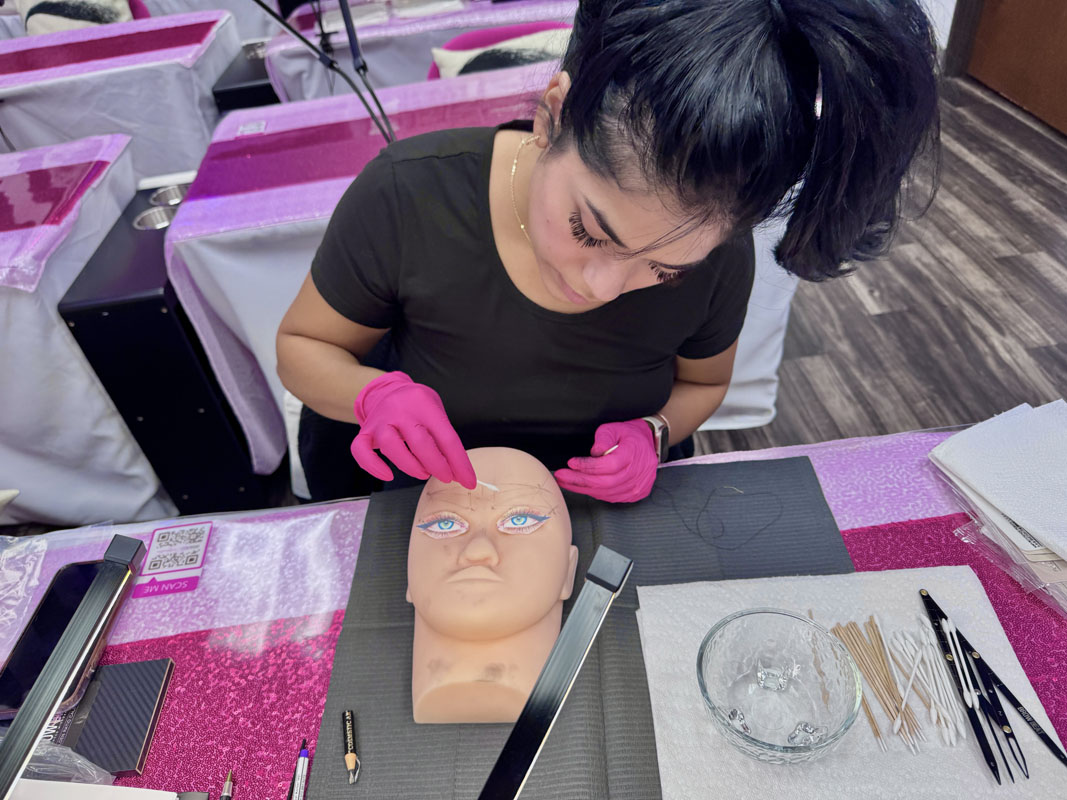
To define the starting point of each brow, you use your calipers and eyes together. First, position the calipers so that points 1 and 2 line up at the whites of the eyes. Then, flip and use the other side of the calipers (points 2 and 3) to reveal the correct head width measurement. You rest this measurement on the central marker you placed in Step 1, then mark where the heads of the brows should begin nearest the nose.
Once your pencil marks are placed, you use pigmented string to pull those marks into a straight vertical line. This creates a clear visual of where the brows start and ensures both heads line up correctly across the center of the face. During training, sharpening your pencil and drawing with precision matters; these small details are what separate clean mapping from messy outlines.
This step gives you not only the starting location but also the reference for the thickness between Point 1 and Point 4 later on. It is here that you establish one of the most important ratios in the brow: the head thickness compared to the thickness of the arch. If you get this wrong, the brows can feel unbalanced even if everything else is technically “correct.”
Step 4: Locate the Arch Placement
With the brow heads and tails located, the next major decision is where to place the arch. Many outdated mapping systems run a line directly through the center of the pupil, but that often creates an arch that is too central and too steep. Your goal is to design brows that flow, not brows that look surprised.
To locate a more natural arch point, you pull your pigmented string from the nose through the iris—but specifically halfway between the pupil and the outer edge of the iris. The iris is the colored part of the eye, and this halfway mark results in a more flattering, modern arch that follows the structure of the eye instead of exaggerating it.
Where this line crosses your brow zone is where the highest point of the brow should sit. This becomes your arch reference. In your mapping sequence, this is often referred to as your “top point” in the arch area. It tells you where the brow should gently peak before flowing down into the tail.
On a mannequin, this step trains your eye to love balanced arches rather than dramatic spikes. On real clients, it helps you move away from harsh, outdated arch placement that can age the face instead of lifting it.
Step 5: Mark the Lower Brow Line and Tail Alignment
Now that you have the center, heads, tails, and arch placement, you can start shaping the lower structure of the brows. The lower line defines how strong, soft, or heavy a brow will look, and it has a huge impact on how the face reads emotionally. A clean, well-placed lower line supports natural, balanced brows.
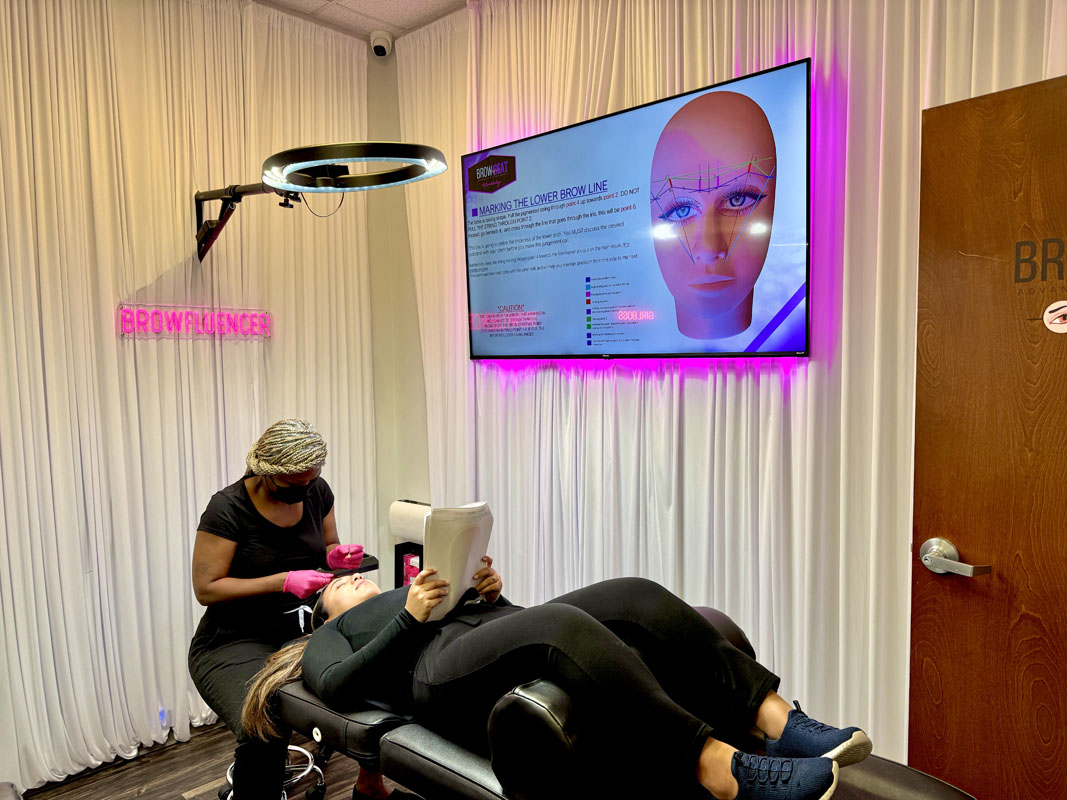
When marking the lower line, you hold the pigmented string taut so it does not roll. You use it to locate the lowest part of the brow near the base of the arch, sometimes referred to as Point 4 in your mapping system. This is the point that defines the bottom of the brow’s thickness at its arch area. From here, you stretch the string sideways to confirm where the tail should sit, making sure the lower line stays in alignment with the center and tail markers you have already placed.
This step does two things at once: it identifies the lowest structural point of the brow and confirms that both tails are in harmony with the rest of the framework. By finishing this lower structure on both sides, you give yourself a clear guide for later shaping, strokes, and shading.
During training, it becomes very clear that rushing this step leads to tails that do not match and arches that feel off. Taking the time to pull clean, straight lower lines with string—without letting it twist or curve—is one of the simplest ways to improve your brow outcomes immediately.
Step 6: Mark the Upper Brow Line and Complete the Brow Body
With the lower line established, the final structural step is to define the upper line of the brow. This step determines the full thickness of the brow from top to bottom and locks in the brow’s overall shape, including the flow from arch to tail.
To mark the upper line, you pull pigmented string through your arch markers and your central and tail references. When marking the top line near the arch, the string must stay straight and pass through the markers that signify the highest point of the brow. This helps you decide how thick the brow will be over the arch area and how that thickness compares to the head of the brow.
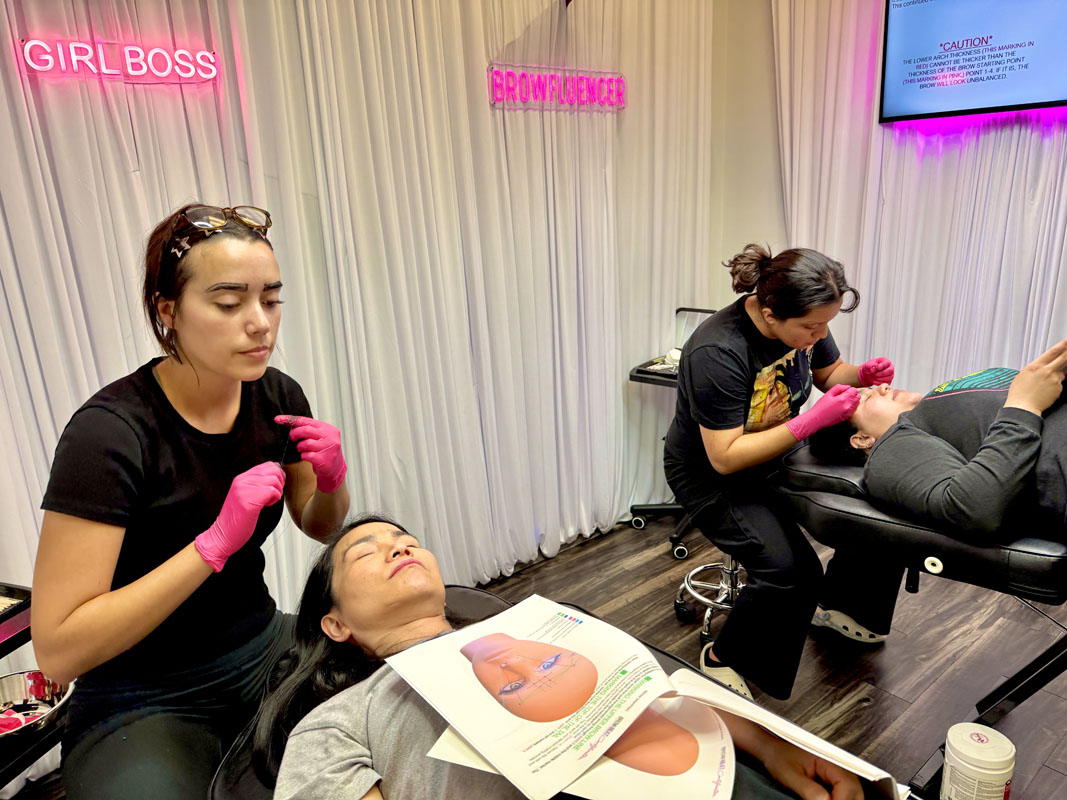
When you complete this step on both sides, the brows finally take shape. At this point, you are not guessing. You have mapped a structure based on the client’s facial center, eye shape, nose position, and natural balance. Now, and only now, are you ready to add techniques like microblading strokes or shading.
From Mannequin to Partner to Client: Why Mapping Practice Matters
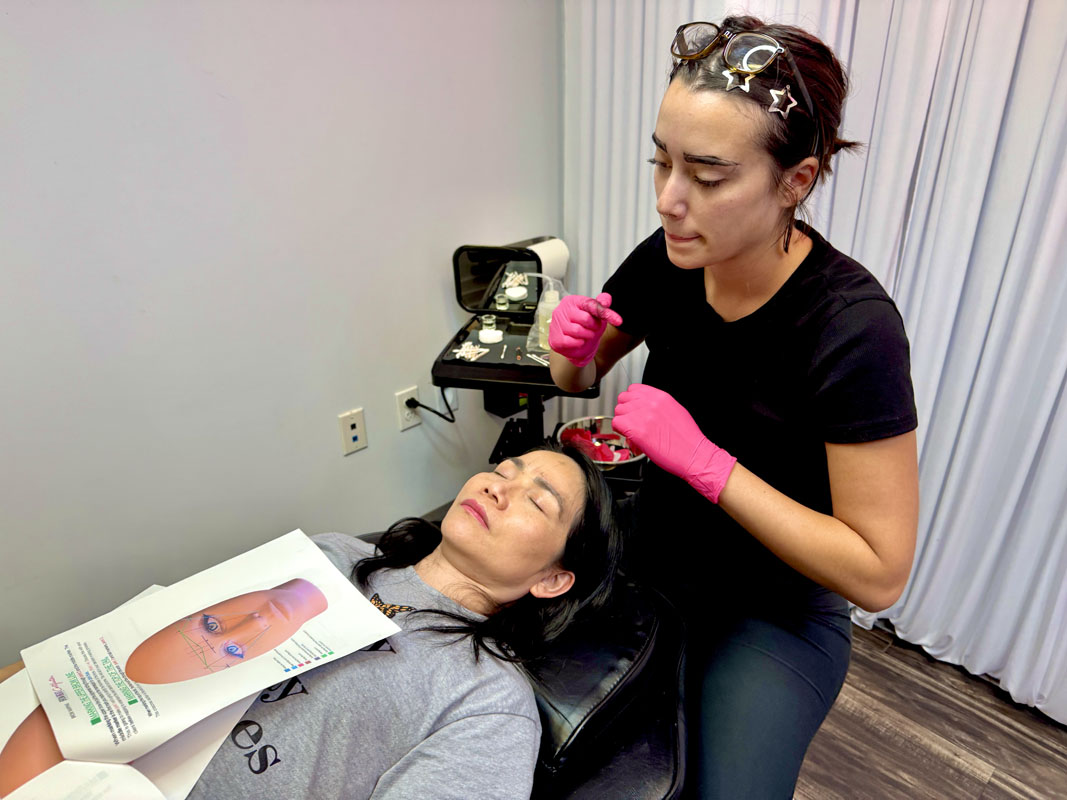
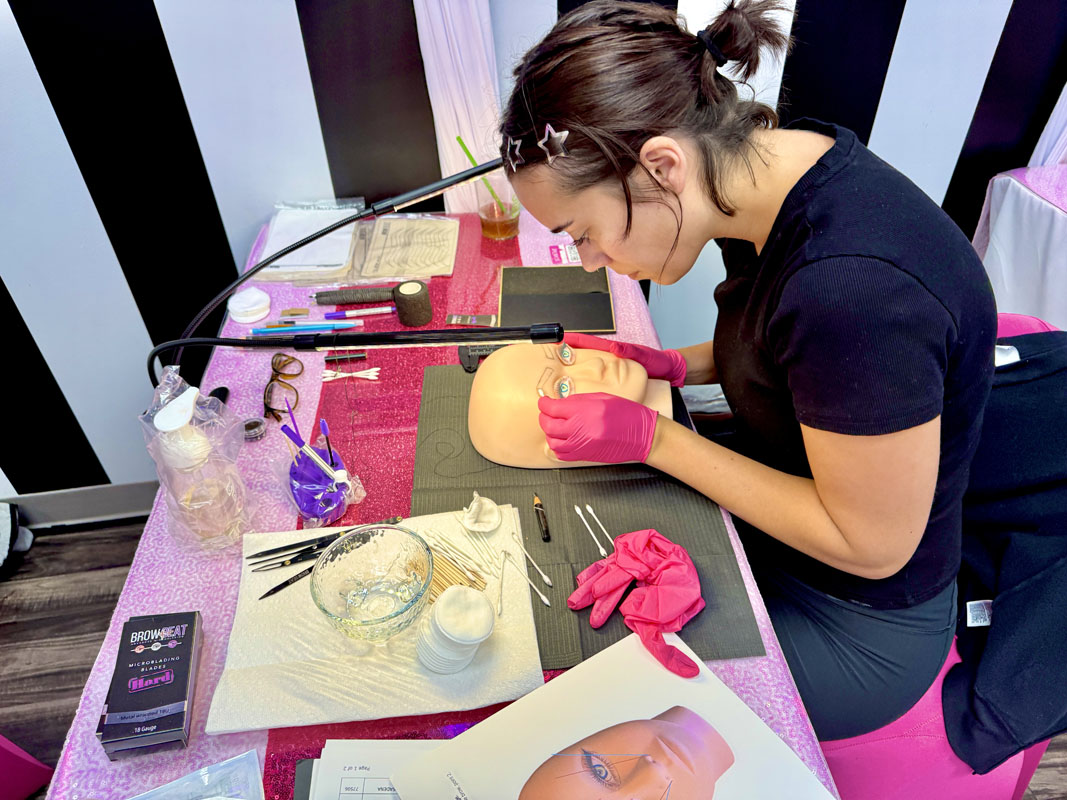
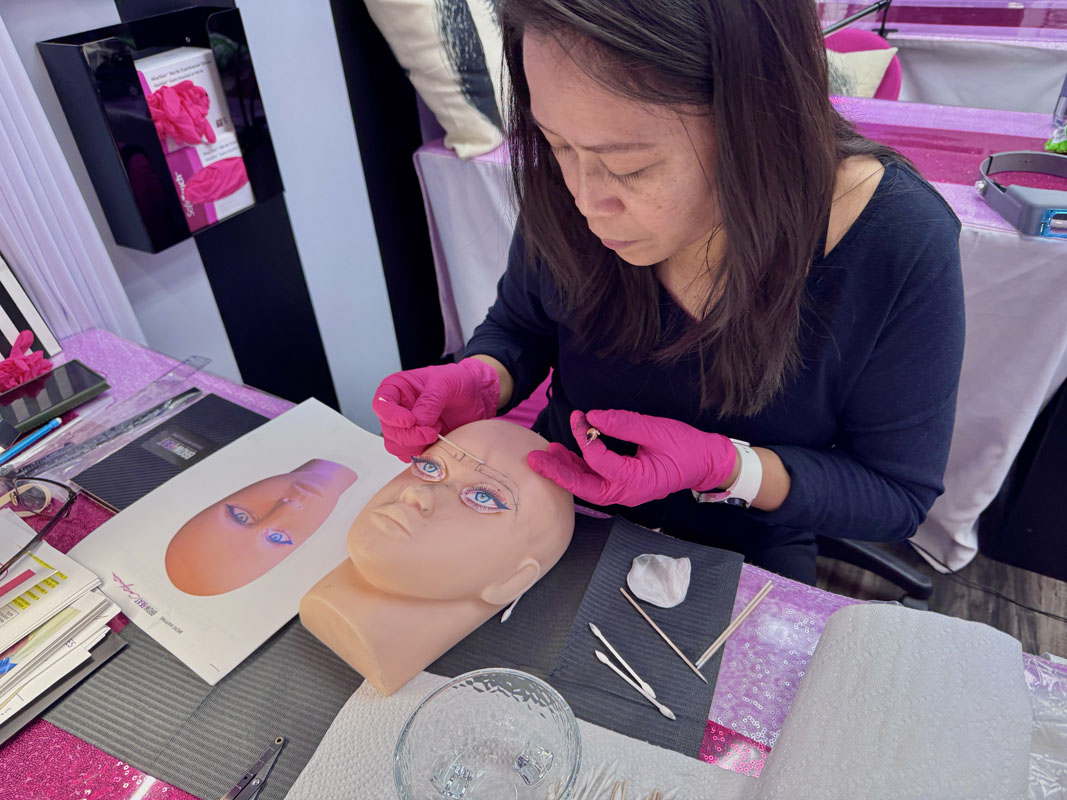
Learning mapping in a certification setting is very different from trying to piece it together on your own. When you practice on a mannequin first, you are able to focus purely on the technical side—string tension, caliper positioning, pencil precision—without the pressure of working on a live face. This allows you to build muscle memory and visual confidence.
Once the mannequin mapping becomes more fluid, mapping on a partner in training pushes you into the next level of reality. Human faces are not perfectly symmetrical. Noses can be slightly off-center, eyes may be different shapes or depths, and previous brow grooming can create illusions of symmetry that are not truly there. Practicing on partners gives you a safe way to learn how to apply a strict mapping system to the variations of real faces.
By the time you are working on paying clients, the six mapping steps are no longer overwhelming—they are simply “how you start” every brow. You are faster, cleaner, and more confident. Clients see this and feel reassured. They can sense when you have a clear method versus when you are improvising.
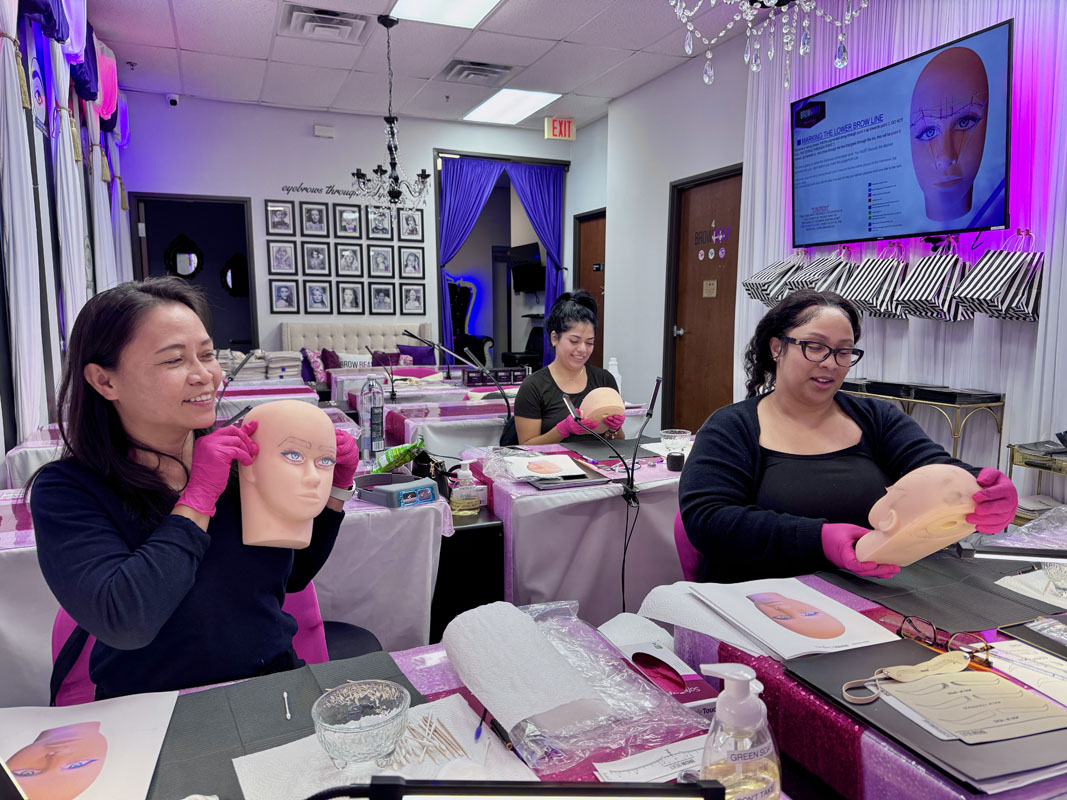
At BrowBeat Studio Dallas Microblading Certification and Training Academy, mapping is not a quick demo. It is a practiced, repeatable system that flows through the entire curriculum, supported by technical training, simulation exercises, and a structured approach to building each brow from the first mark to the final pass. This is also why we include process-based training inside the Business Solutions resources, so that mapping becomes part of your service structure, not just a technical habit.
How Mapping Supports Every Technique You Learn Later
Whether you go on to specialize in microblading, ombré powder brows, combo brows, or nano techniques, mapping supports all of it. When your mapping is consistent, you can layer different techniques in different parts of the brow without losing the overall balance.
For example, you might use microblading strokes in the head and transition into shading through the body and tail. The techniques change, but because the mapping is solid, everything sits exactly where it should. Your design still follows the same center, same tails, same heads, and same arch placement. Mapping allows you to be creative with your technique while staying disciplined with your structure.
Good mapping also saves you time. When brows are mapped accurately, you spend less time trying to “correct” things with strokes or shading later. You avoid overworking the skin and reduce the stress of constantly adjusting while the client lies there wondering what is happening. You simply follow the structure you have already built.
In advanced work, such as corrections or working over previous semi-permanent makeup, mapping becomes even more critical. You may decide to keep some of the client’s old shape, or you may need to correct it. Either way, you will use your mapping skills to decide where the new structure should live relative to the old pigment.
Why Mapping Is a Career Skill, Not Just a Beginner Skill
Many artists assume that mapping is something they will “outgrow.” In reality, the opposite is true. The longer you work in semi-permanent makeup, the more you appreciate the foundation that mapping gives you. Experienced artists still map meticulously—they are simply faster and more intuitive about it because they have repeated the process hundreds of times.
Mapping also becomes more important as your client base becomes more diverse. As you work on mature clients, medium and high-melanin clients, clients with asymmetries, or clients with scar tissue or old tattooing, the ability to see and design a balanced brow shape using clear steps is what keeps you grounded. Without a mapping system, you are left guessing on some of the most complex faces you will encounter.
As a certification student, understanding that mapping is a long-term skill shifts your mindset. You no longer rush through it just to get to the strokes. Instead, you treat mapping as the first, essential layer of your artistry—one that you will carry throughout your entire career.
Tools That Support Effective Mapping
Every artist has their favorite tools, but the basics remain the same: pigmented string, a precise brow pencil, calipers, and a clean, well-lit work area. In training, you learn to pair these tools with your eye for symmetry and the six mapping steps.
A well-designed kit that includes the right mapping tools, along with pigments and core accessories, can make practice smoother and more efficient. Instead of piecing together random supplies, you can focus on the skill itself. This is why our training programs are supported by a microblading and lip blushing kit that aligns with what you are learning in class. The tools you practice with are the tools you can carry into your professional environment.
Ultimately, mapping is not about having the fanciest equipment—it is about using simple tools consistently and correctly. The system is what matters. Once you understand it, those tools become extensions of your decisions.
Bringing It All Together: Mapping as Your First Professional Standard
When you think about what makes a semi-permanent makeup artist truly professional, it is rarely just the final photo. It is the way they walk a client through the process, the calm confidence in their decisions, and the consistency in their results. Mapping sits at the center of all of that.
A client who sees you carefully measuring, marking, and confirming their brow structure feels reassured. They can see that you have a method. They understand that their face is not a canvas for improvisation, but a structure you are respecting and enhancing. That experience builds trust, and trust is what builds long-term clients.
As you continue your journey in semi-permanent makeup, mastering brow mapping is one of the smartest investments you can make in yourself. It improves your results, reduces your stress, and gives you a framework that can grow with you as you add more advanced techniques.
Next Steps: Build Your Mapping Skills Inside a Structured Certification Program
If you are serious about building a professional career in semi-permanent makeup, mapping is one skill you cannot leave to chance. Learning it properly inside a structured, step-by-step training environment allows you to make mistakes in practice, refine your technique, and build repeatable habits before you ever touch a paying client.
At BrowBeat Studio Dallas Microblading Certification and Training Academy, our curriculum is designed to move you from mannequin to partner to real-world confidence. The six brow mapping steps become second nature as you practice them across different faces and scenarios, supported by clear guidance and technical demonstrations.
To deepen your mapping and microblading skills, begin with our comprehensive
Microblading Certification program. Finally, equip yourself with a professional-level tool set through our microblading and lip blushing kit, so the way you practice and the way you work on clients stay aligned.
When mapping becomes your first standard, everything else you learn in semi-permanent makeup becomes easier. You are no longer guessing where the brows should go—you are building them with purpose, precision, and a clear, repeatable system.