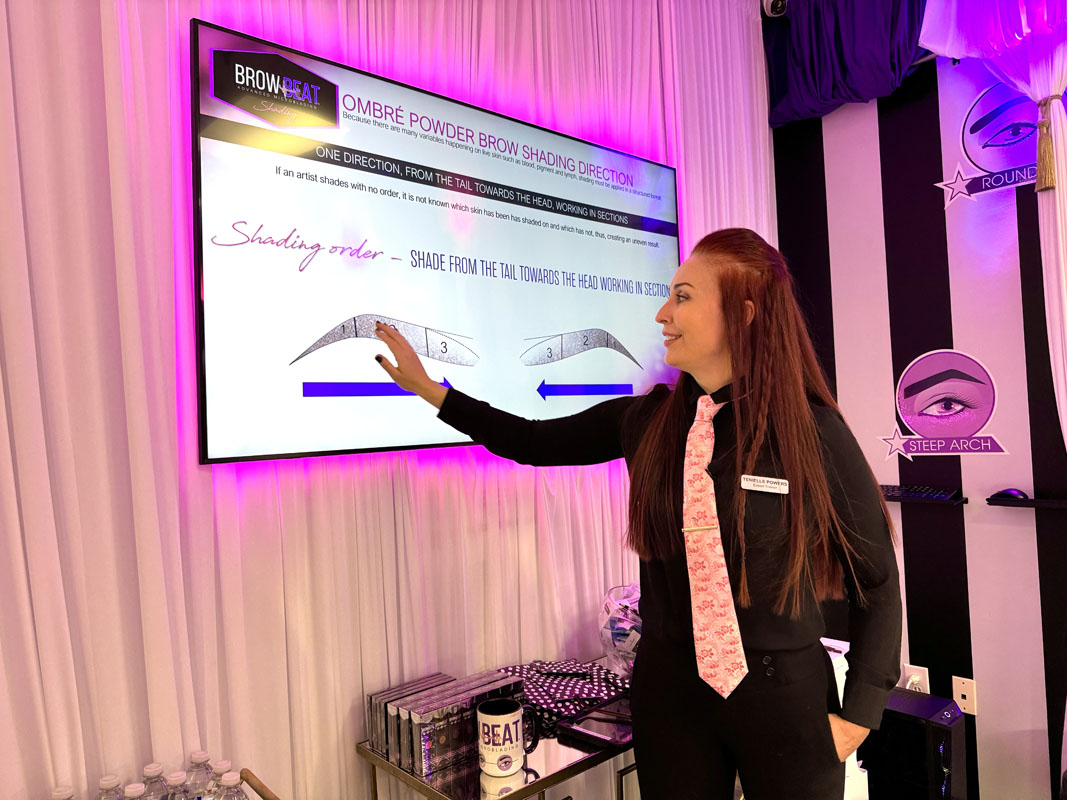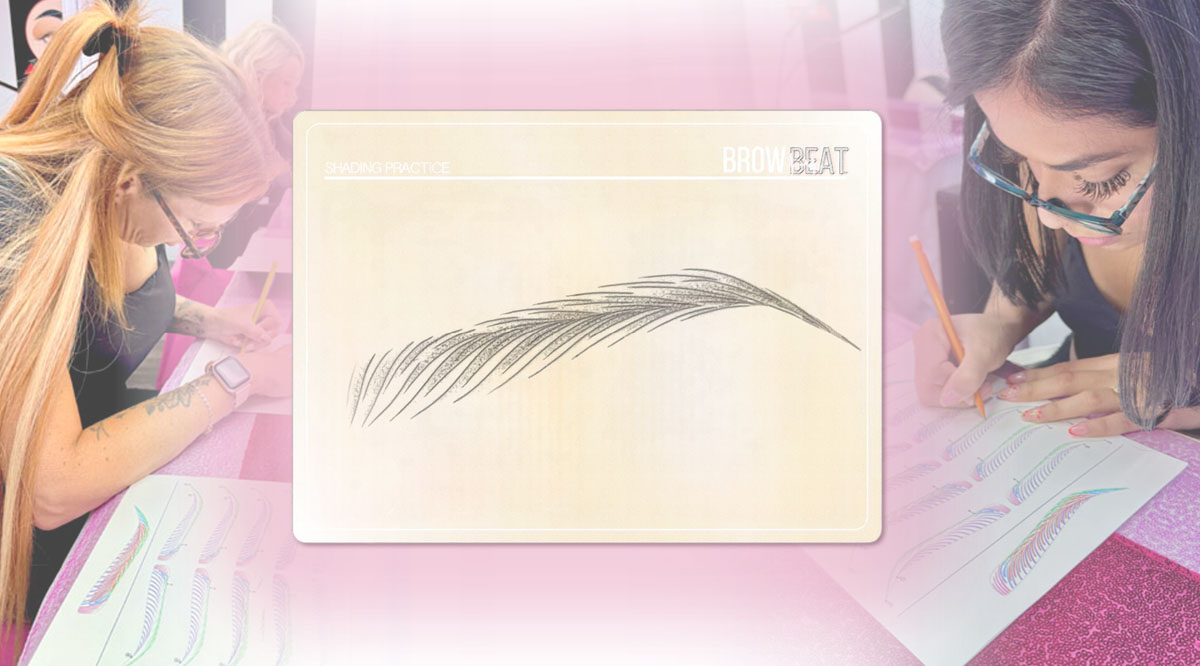
BEGINNER'S GUIDE TO MICROBLADING TRAINING
You do not need to know how to Microblade before you begin learning Microblading. BrowBeat Certification’s foundational brow education is designed to teach students who are new to the manual hair-stroke technique, including people who have never performed permanent makeup before.
Being a beginner does not mean the technique will feel effortless. Microblading asks the student to develop several abilities at the same time: understanding brow design, recognizing hair-stroke patterns, improving hand-eye coordination and learning to control a manual tool with increasing consistency. Those skills develop through instruction and practice rather than appearing immediately because someone understands the theory.
BrowBeat teaches beginners through structured, step-by-step processes so they have something more useful than guesswork to rely on. Students learn what they are trying to accomplish, work through the skill progressively and receive feedback while the movements and concepts are still unfamiliar.
The goal of beginner training is not to make a new student look or work like an experienced Microblading artist by the end of class. It is to establish a strong foundation the student understands well enough to continue practicing and developing afterward.
Can Beginners Learn Microblading?
Yes. Microblading is a learnable manual technique, and BrowBeat’s foundational training does not require students to arrive already knowing how to create Microblading strokes.
Beginners do, however, need realistic expectations about the learning process. Understanding an instructor’s explanation and physically reproducing the technique are different stages. A student may understand exactly what a stroke is supposed to do and still need repetition before the hand produces that result consistently.
This is normal when learning a detailed manual skill. The student is developing visual understanding and physical coordination together, and those abilities do not necessarily progress at exactly the same speed.

LEARN
Microblading
You do not need prior beauty experience to begin beginner microblading training. This course is designed for structured skill development. Microblading is not talent-based — it is process-based. When beginners are taught through repeatable systems, guided correction, and clear visual frameworks, progress becomes measurable. Skill is built through structure and repetition.
by
Step
Microblading training for beginners follows a defined sequence. Students are not improvising strokes. They are following a structured workflow that eliminates overwhelm. Each concept builds on the last, allowing muscle memory to develop logically. This systematic approach ensures students understand not just how to create strokes, but why each movement matters.


do
It
Learning microblading basics begins with guided visual presentation. Students observe blade angle, pressure control, and stroke direction before practicing themselves. Seeing the pattern demonstrated clearly reduces confusion and builds confidence. Instructor-led education ensures beginners understand form and flow before attempting execution.
the
Head
The head of the brow teaches direction, spacing, and pressure control. Beginners learn how to place strokes consistently without overcrowding. This section builds discipline and sets the tone for the rest of the pattern. Control at the head improves overall balance.


the
Conversion
The conversion area connects the head to the body of the brow. Students learn how to change stroke direction smoothly without creating visual breaks. Proper transition prevents chaotic patterns and uneven healing. This step strengthens flow and cohesion within the design.
the
Spine
The spine acts as the structural guide for stroke placement. Beginners learn how this central line controls alignment and symmetry. When the spine is disciplined, upper and lower strokes follow predictably. This section reinforces precision and balance.


upper
Strokes
Upper strokes provide elevation and natural fullness. Students learn spacing discipline and directional control to prevent crossing or overcrowding. This phase teaches restraint — not every space requires a stroke. Controlled lift produces clean healed results.
lower
Strokes
Lower strokes stabilize the overall pattern. Beginners learn how these strokes support shape and prevent bottom-heavy designs. This section reinforces balance between density and openness. Structured placement prevents uneven healing and distortion.


inner
Strokes
Inner strokes refine the pattern and create natural fullness. Students learn micro-adjustments in angle and spacing to enhance realism. Precision in this section often separates beginner work from advanced results. Detail control is developed through repetition.
balanced
Results
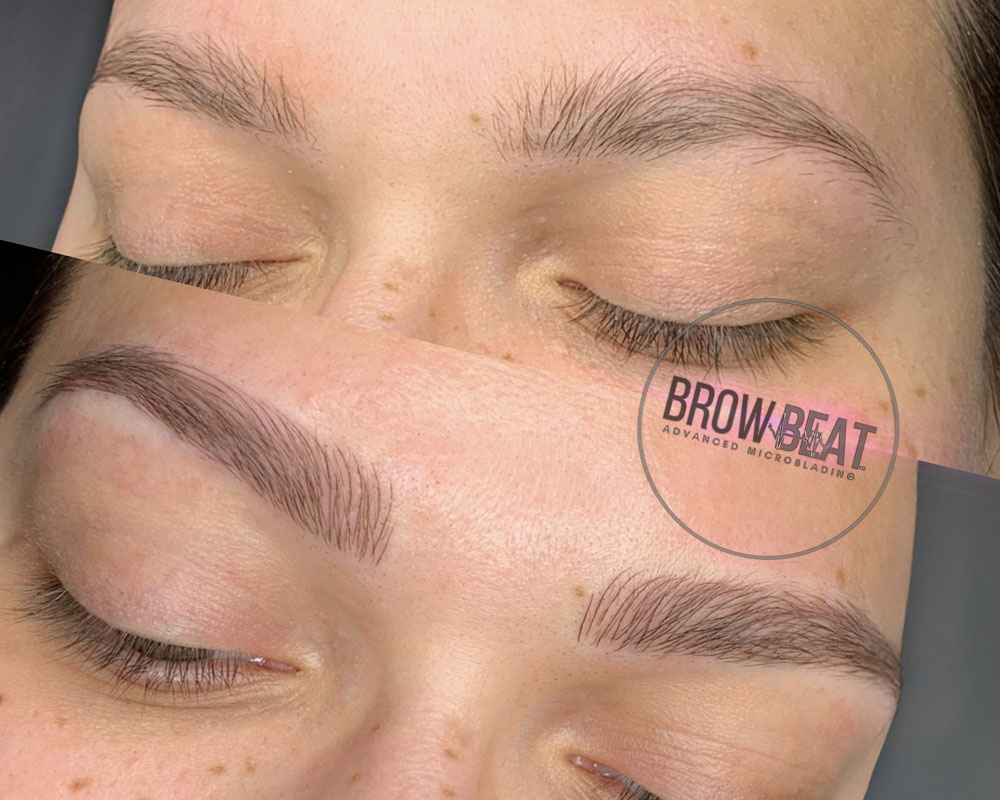
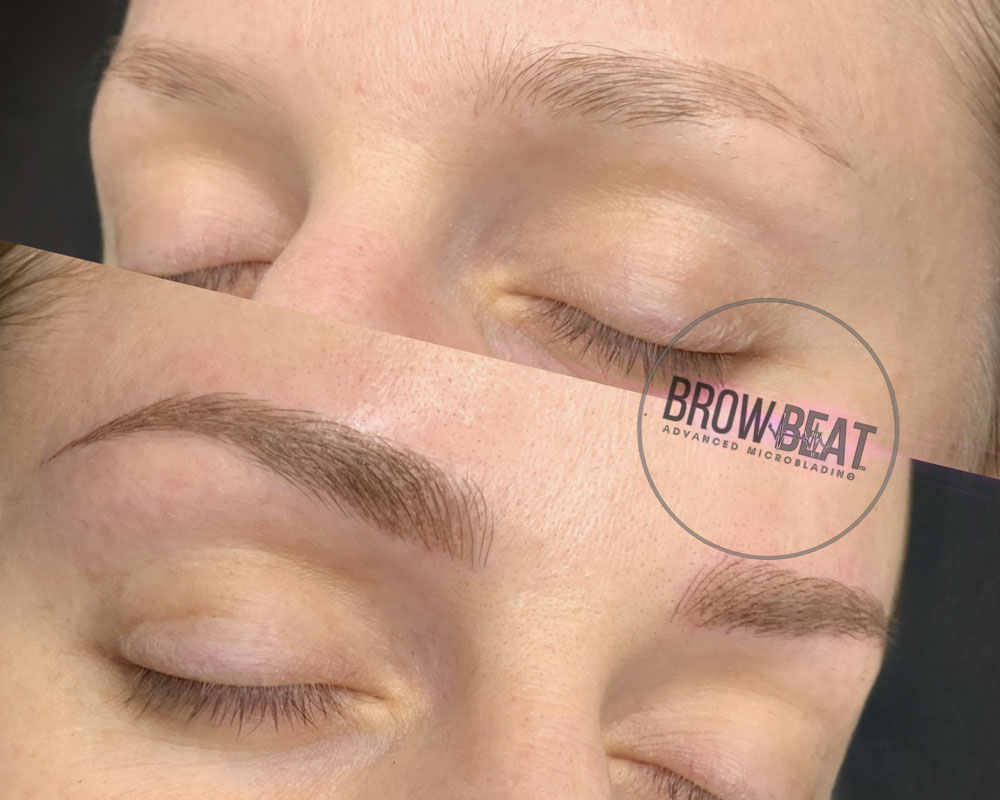
These before and after results reflect what happens when microblading follows a defined stroke system. Each section of the pattern — head, conversion, spine, upper, lower, and inner strokes — is placed intentionally. Balanced spacing and disciplined direction create symmetry that heals cleanly. This is the outcome of structured, repeatable microblading training built on clear frameworks.

prevents
Crowding
Spacing between strokes is intentional, negative space is preserved. More strokes do not equal better density. Structured training emphasizes restraint, allowing pigment to settle properly and preventing the brow from healing dense.
crisp
Lines
Clean strokes result from consistent blade angle and steady pressure. In this example, stroke edges remain defined because angle discipline was maintained throughout the pattern. Proper blade control prevents widened or blurred strokes and supports predictable healed clarity.
You Do Not Need to Arrive Already Knowing How to Microblade
Trying to teach yourself the entire technique before attending training defeats much of the purpose of beginner education.
Students come to class to learn. BrowBeat gives them structured processes for brow design, manual hair-stroke work and the treatment flow so they can develop an understanding of how the different parts of Microblading fit together.
A student who has already experimented with drawing brows or working with fine detail may recognize certain concepts more quickly, but previous familiarity is not the same thing as Microblading education.
What matters is being prepared to learn the process, practice it and accept that some parts will take longer to become comfortable than others.
Beginner-Friendly Does Not Mean Effortless
A beginner-friendly Microblading course should begin at a level a new student can understand. That does not mean removing the difficulty from the skill.
Microblading requires concentration and precision. Students need to think about the brow design while also developing a manual hair-stroke technique. Individual strokes need direction and placement, and they eventually need to work together within a larger pattern.
Beginners are also learning how the treatment process is organized and how the technical skill fits within professional permanent makeup work. It is a substantial amount of new information.
The purpose of structured training is to organize that information so the student can learn it progressively rather than being expected to understand everything simultaneously.
Is Microblading Hard to Learn?
Microblading can be challenging to learn because it combines visual judgment with fine manual control. The student needs to understand what the brow should look like and gradually become capable of creating the intended work with the hand.
Different students find different parts difficult. Someone with strong visual awareness may understand patterns quickly but need more time developing manual consistency. Another student may feel comfortable with the hand movement while finding brow design more demanding.
The useful question is therefore not whether Microblading is universally easy or hard. It is whether the student is willing to work through the parts that are unfamiliar rather than expecting immediate perfection.
What Do Beginners Find Challenging in Microblading Training?
One of the first challenges is learning to see the brow as a planned design rather than simply an area where strokes will be added. Mapping requires students to think about structure, proportions and the natural brow before technical execution begins.
Hair-stroke patterns introduce another type of thinking. Students need to recognize direction, spacing and flow so individual strokes work together rather than appearing as disconnected marks.
Then comes the physical challenge: getting the hand to reproduce what the student already understands visually. This is where repetition becomes important because knowing what should happen does not automatically create consistent manual control.
As training progresses, students begin connecting those individual skills. That integration can initially feel demanding because attention is being divided among several parts of the process. Familiarity gradually reduces that mental load.
Beginners Learn Microblading in Layers
BrowBeat does not expect a first-time student to manage every technical and visual demand in the first exercise. The learning process adds complexity progressively.
Students first develop understanding through structured instruction and paper exercises. Silicone then introduces more of the physical Microblading technique. The silicone brow headband later places the practice area in a more realistic facial position so students can apply what they have learned while thinking about positioning and treatment flow.
The purpose of this progression is not simply to move through different practice materials. It allows beginners to concentrate on fewer variables at a time and build on concepts they have already encountered.

Step-by-Step Systems Give Beginners Something to Rely On
Experienced artists develop judgment through repetition, but beginners do not yet have years of experience to draw from. A repeatable system gives them a starting point.
BrowBeat uses step-by-step processes for important parts of the training, including brow mapping and treatment workflow. Students learn what they are doing and why the steps are organized in that order rather than being asked to imitate an instructor’s finished work without understanding how it was constructed.
This structure becomes particularly useful when a beginner feels uncertain. Instead of relying entirely on intuition, the student can return to the process they were taught and work through it logically.
Do You Need to Be Naturally Artistic to Learn Microblading?
You do not need to arrive as a professional artist to begin Microblading training. Artistic awareness can certainly be useful, but Microblading also involves systems, observation, repetition and manual skills that can be developed.
Students learn how to look at brow structure and hair-stroke patterns rather than being expected to invent those concepts through natural talent alone. They also practice the physical technique instead of assuming good hand control is something a person either possesses or does not.
People will develop at different rates, and no responsible training course can guarantee that every student will reach exactly the same technical level. What beginner education can do is provide a structured foundation and opportunities to develop the relevant skills.
Do You Need to Know How to Draw Eyebrows?
Knowing how to draw brows can make some visual concepts feel familiar, but it is not the same thing as understanding Microblading brow design.
BrowBeat teaches a defined mapping system so students learn how the brow is planned through reference points and design relationships. The objective is not to depend on whether the student happens to be naturally good at freehand eyebrow drawing.
The manual hair-stroke technique is then learned separately within that planned framework. Drawing experience can be useful, but it does not replace either mapping education or Microblading-specific practice.
Hand-Eye Coordination Develops Through Practice
A beginner can see exactly where a stroke should go and still discover that the hand does something slightly different. That difference is part of learning a manual technique.
Practice helps the student connect visual intention with physical movement. As repetitions accumulate, the movement becomes more familiar and the student begins recognizing their own recurring habits.
Instructor feedback is particularly useful at this stage because beginners cannot always identify what their own hand or body is doing while concentrating on the result. A specific correction gives the student something concrete to change on the next attempt.
Your First Attempts Are Learning Attempts
Beginners sometimes judge their first exercises as though they were supposed to be portfolio work. That creates an unrealistic standard for the earliest stage of learning.
The first attempts are valuable because they reveal what the student does not yet control. A pattern may become crowded, a stroke direction may wander or the hand may feel awkward with an unfamiliar movement. Those results provide information about what needs more attention.
Improvement comes from using that information. The student receives feedback, makes an adjustment and tries again with a clearer objective.
The useful comparison is often not between the beginner’s work and an experienced artist’s portfolio. It is between the student’s current attempt and their own earlier work.

Beginners Should Develop Consistency Before Speed
Experienced Microblading artists can make the process look quick because they have repeated the movements and decisions many times. A beginner should not use that speed as the standard for early practice.
Working faster does not create better technique if the student loses control in the process. At the beginning, understanding the movement and producing increasingly consistent work are more important than completing the exercise quickly.
Efficiency develops as the process becomes familiar. The student spends less time wondering what comes next and becomes more comfortable with the physical movements. Speed can then emerge from experience rather than being forced before the foundation exists.
Instructor Feedback Helps Beginners Know What to Change
One of the hardest parts of learning independently is knowing why something does not look right. A beginner can recognize that the result is different from the intended example without knowing which part of the process caused the difference.
During BrowBeat’s in-person practical training, instructors observe students as they work and help identify areas that need adjustment. The student can then apply that correction while the exercise is still in progress rather than continuing to repeat the same problem.
Over time, students begin developing more ability to evaluate their own work. Instructor feedback helps establish that awareness while the technique is still new.
What Should You Know Before Microblading Training?
Expect to concentrate. Microblading involves detailed visual and manual work, and the early stages require active attention.
Expect to practice. Understanding a concept during instruction is only part of learning a physical technique.
Expect corrections. Feedback is not evidence that the student is failing; it is part of identifying what needs to change while there is still an instructor present to help.
Most importantly, expect the skill to continue developing after the classroom portion of the training. Completing education establishes a foundation. Continued practice builds greater familiarity and consistency on top of it.
How Should a Beginner Prepare for Microblading Training?
A beginner does not need to arrive having secretly mastered Microblading beforehand. It is more useful to arrive prepared to learn the system being taught.
Be ready to concentrate on unfamiliar information, ask questions when something does not make sense and repeat exercises when the first attempt is inconsistent. Be prepared to receive corrections without treating them as criticism of your potential.
It also helps to approach the course without expecting every part of the technique to develop at the same speed. One skill may feel comfortable quickly while another needs considerably more repetition.
That uneven development is part of learning rather than evidence that the entire technique is beyond the student.

What If You Have Never Worked in the Beauty Industry?
A previous career in beauty is not what teaches someone how to Microblade. Microblading is its own manual technique, with its own design process, hair-stroke patterns, practical skills and treatment workflow.
Someone entering training without a beauty background will encounter more unfamiliar terminology than a student who already works around cosmetic treatments, but that does not mean the technical skill is automatically beyond them. BrowBeat’s foundational education teaches the process rather than assuming students already understand permanent makeup.
What matters more at the beginning is the willingness to learn carefully, work through a structured process, practice the physical skill and accept feedback. Experience develops from there.
What If You Already Work in Beauty?
Students who already work in beauty can bring useful experience into Microblading training. They may already be comfortable communicating with clients, working carefully around the face or performing detailed hands-on services.
Those transferable skills can help, but Microblading still needs to be learned as a separate technique. Existing beauty experience does not automatically teach BrowBeat’s mapping system, manual hair-stroke patterns or Microblading treatment process.
The advantage of previous experience is familiarity with certain parts of professional work, not permission to skip the foundations of the new skill.
What Should a Beginner Learn First in Microblading?
A beginner needs to understand what they are trying to create before concentrating entirely on the manual tool.
Brow design provides the framework. Hair-stroke patterns introduce the visual logic of Microblading. Practical exercises then begin connecting that understanding with manual execution.
This order helps prevent the hand tool from becoming the student’s entire focus. Microblading is not simply the ability to create a small stroke. The stroke needs to belong inside an intentional brow design and work with the surrounding pattern.
Once those relationships begin making sense, practical repetition helps the student develop greater physical consistency.
How Long Does It Take to Learn Microblading?
There is an important difference between completing Microblading training and developing experience with Microblading.
A course can teach the foundations within a defined training period. Manual consistency, visual judgment and confidence continue developing afterward through practice and experience.
There is no responsible universal number of days or weeks after which every student suddenly becomes “good at Microblading.” Students begin from different starting points and develop different parts of the skill at different rates.
A more useful measure is whether the student’s work is becoming increasingly controlled and repeatable. When patterns become clearer, manual movements become more familiar and recurring mistakes begin disappearing, the student has evidence that the skill is developing.

When Does Microblading Start to Feel More Natural?
New skills require conscious thought because very little feels automatic. A beginner may initially have to think deliberately about each part of an exercise, which can make the process feel slow.
Repetition gradually changes that. Familiar decisions require less mental effort, movements become easier to recognize and the student has more previous experience to draw from when something does not look right.
That does not mean the artist stops thinking. It means fewer basic decisions feel completely unfamiliar.
Confidence develops in much the same way. It becomes more grounded as the student accumulates evidence that they understand the process and can reproduce increasingly consistent work.
What Happens After Beginner Microblading Training?
After training, students continue practicing the skills and processes introduced during class. Areas that remain inconsistent need additional attention, while stronger areas continue developing through repetition.
The practice materials and exercises used during training give students a structured place to continue rather than leaving them to invent an entirely new learning method once the classroom portion ends.
Students should not interpret the need for continued practice as evidence that training failed. A manual skill develops through education followed by repetition. The course establishes the foundation; continued work strengthens it.
What If You Feel Nervous About Learning Microblading?
Feeling uncertain before learning an unfamiliar hands-on skill is not unusual. The student does not yet know which parts will come naturally and which will require more attention.
The useful response is not to expect nervousness to disappear before beginning. It is to approach the training as a learning environment rather than a test of whether the student already possesses the skill.
Structured instruction gives beginners a process to follow, while practical exercises and instructor feedback give them opportunities to make adjustments as they learn. The student can concentrate on the next part of the process rather than trying to prove that they already understand the entire technique.
How Do You Know Whether Microblading Training Is Right for You?
Microblading can be a good skill to explore for someone who enjoys detailed work and is willing to develop precision through practice.
Patience matters because the technique is not learned through rushing. Attention to detail matters because small differences in placement and pattern affect the larger design. The ability to receive feedback matters because correction is part of developing a new technical skill.
It also helps to be realistic about continued development. Someone looking for a course that creates instant mastery without practice is likely to be disappointed by any genuine manual skill.
A student who is interested in the work, willing to learn systematically and prepared to continue practicing has a much more realistic understanding of what beginner Microblading education involves.

Beginner Microblading Training in Dallas, Texas
BrowBeat Certification provides in-person Microblading education in Dallas, Texas for students developing the foundations of the manual hair-stroke technique.
Beginners learn through structured instruction, step-by-step processes and progressive practical exercises rather than being expected to arrive with existing Microblading ability. Instructors observe practical work and help students understand what needs to change while they are developing the skill.
The training establishes the foundation. Students then continue strengthening their manual control, visual judgment and familiarity through practice after class.
Start as a Beginner and Build Through Practice
Beginning Microblading training does not require pretending that you already know the skill. The purpose of education is to give you a structure for learning it.
BrowBeat Certification teaches beginners through step-by-step processes, progressive practical exercises and instructor feedback. Students develop an understanding of brow design and hair-stroke patterns, begin building manual control and learn how the different parts of the Microblading process fit together.
The course establishes a foundation rather than promising instant mastery. What students do with that foundation afterward—continued practice, careful repetition and willingness to keep improving—is what allows a new skill to become increasingly familiar over time.
Frequently Asked Questions for Beginning Microblading Students
Can I learn Microblading with no experience?
Yes. BrowBeat’s foundational brow education does not require students to arrive already knowing how to Microblade. Students learn the technique through structured instruction and progressive practical work.
Can anyone learn Microblading?
Microblading involves learnable systems and manual skills, but people develop at different rates. Training cannot guarantee identical results for every student. Patience, attention, practice and willingness to respond to feedback all contribute to development.
Is Microblading hard for beginners?
Microblading can be challenging because beginners are developing visual judgment and manual control together. Structured training breaks the skill into more manageable stages so students do not have to master every variable simultaneously.
Do I need to be artistic to learn Microblading?
You do not need to arrive as a professional artist. Artistic awareness can be useful, but brow design, observation, hair-stroke patterns and manual control can also be taught and developed through practice.
Do I need beauty-industry experience?
Previous beauty experience can provide transferable skills, but it is not what teaches the Microblading technique. BrowBeat’s foundational education teaches students the specific brow-design and manual hair-stroke skills involved.
Do I need to know how to draw eyebrows?
No. BrowBeat teaches a structured mapping system rather than depending entirely on a student’s ability to freehand an eyebrow shape. Drawing experience can help with visual familiarity, but it does not replace Microblading education.
Is beginner Microblading training hands-on?
Yes. BrowBeat combines instruction with practical exercises so students can begin applying what they are learning and receive feedback while the skill is still unfamiliar.
What do beginners practice Microblading on?
BrowBeat’s practical progression moves from paper exercises to silicone practice and then to hands-on silicone brow-headband training.
Do Microblading students practice procedures on each other?
No. Students partner map each other as a brow-design exercise, but technical Microblading practice takes place through paper, silicone and silicone brow-headband training.
What if I make mistakes during Microblading training?
Practical exercises are part of learning precisely because beginners need opportunities to identify mistakes and make adjustments. Instructor feedback helps students understand what to change on the next attempt.