
Why Pressure Matters More Than Most Beginners Realize
Microblading is not just drawing lines in the skin. Every stroke is a tiny channel that holds pigment, and the depth of that channel determines everything that comes after. Too light, and the pigment will not hold; the strokes may disappear or fade prematurely. Too heavy, and the strokes can heal thicker, darker, or blurrier than intended. It does not matter whether the pigment you chose is blonde or brown — if it goes deep, it will heal darker. Skin depth changes color perception.

Microblading pressure is not luck — it is trained precision.
Straight Entry, Straight Exit — Why It Matters
A straight entry and exit keeps the stroke narrow, crisp, and unified. When the blade enters angled, pigment disperses outward, widening the line. When the exit is abrupt or uneven, the tail of the stroke may blur. Over time, these inconsistencies can add up, making the healed brow denser, darker, or heavier than the original pattern intended.
Artists often focus heavily on pattern design — where each stroke lands, how it leans, how it interlocks with others. But without an understanding of entry and exit control, even the most beautiful pattern can heal unpredictably. This is where consistency separates beginners from professionals. It is not the stroke sequence that builds mastery — it is how evenly those strokes are placed and pressure-managed.
The Deeper the Stroke, the Darker the Healed Result
Pigment behaves differently depending on where it sits in the skin. In shallow epidermis, the color may fade quickly, but it tends to heal truer to tone. In deeper dermal layers, where there is more vascular activity, pigment can appear darker as it settles. This is why even light blonde pigments can heal more brunette if they are implanted deeper than intended.

A darker result does not mean a mistake — but it does mean the artist needs to understand how pressure and depth, interact on different skin types. A medium pressure that works beautifully on one client may feel too light or too heavy on another. Experience teaches you how to read skin, evaluate resistance, and make adjustments that fit each unique face.
Assessing Skin Before You Begin
Not all skin behaves the same during microblading. High melanin skin typically has more structural integrity, while lower melanin skin can be softer, less resistant, and sometimes more sensitive to depth variation. Age plays a role. Hydration plays a role. Lifestyle, medications, and history of treatments all change the canvas.
Pressure control begins with assessment. Before the blade ever touches the skin, the artist should observe the surface visually, test elasticity with gentle stretch, and note density during pre-draw contact. These early impressions become your guide — they tell you whether to lighten your hand, slow your stroke, or maintain firmer structure for better retention.
Skin Suitability for Microblading — Visual Assessment Guide
- Low melanin skin — softer, more delicate, can benefit from controlled light pressure to avoid deep pigment saturation.
- Medium melanin skin — well-balanced resistance, excellent retention potential, responds well to consistent moderate pressure.
- High melanin skin — strong integrity and dense fiber structure, capable of retaining microblading strokes beautifully with stable, confident pressure.
- Mature skin — thinner, more fragile, requires gentle approach and slower stroke pace to avoid deep implantation.
- Very oily skin — may blur strokes faster, shading or combo techniques sometimes support better long-term clarity.
These points serve as an anchor rather than a rulebook. Skin is not binary — it exists on a spectrum, and every client brings a slightly different variation of that spectrum to your table. As an artist, your goal is not to memorize categories but to read what is in front of you. Over time, you learn to recognize whether a client’s brow area will respond well to microblading, whether combo techniques might provide better healed results, or whether a more powder-focused approach can deliver a longer-lasting, consistent outcome.
This is the reason BrowBeat Studio Dallas Microblading Certification and Training Academy prioritizes pressure exercises in our Microblading Certification course. When artists learn how to interpret skin visually and physically before they stroke, they build confidence not only in technique, but in decision-making. Technique is what you do with your hands — assessment is what tells you how.
Practice Is the Only Way to Learn Pressure
You cannot learn pressure intellectually. You must feel it. You must build familiarity with resistance, depth, and glide through repetition. This is why practice is everything — not once, not occasionally, but continuously. Pressure becomes your companion only when your hands have performed thousands of strokes. It settles in like handwriting — unique to you, controlled, and natural.
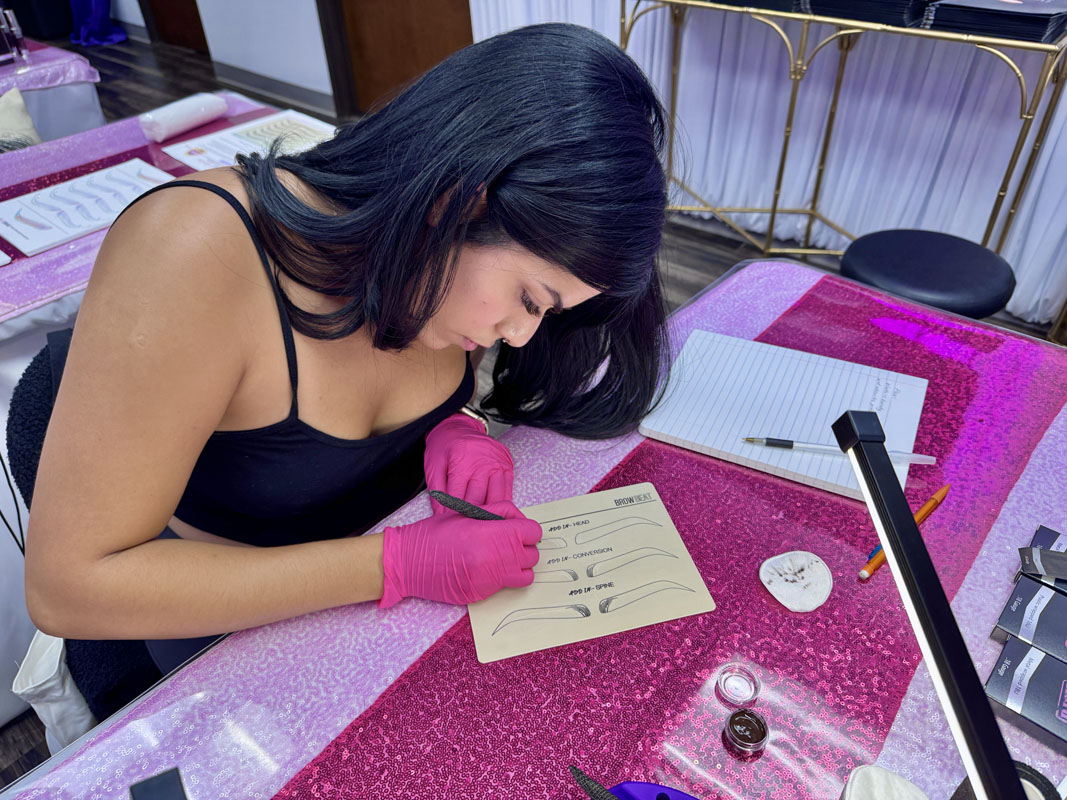
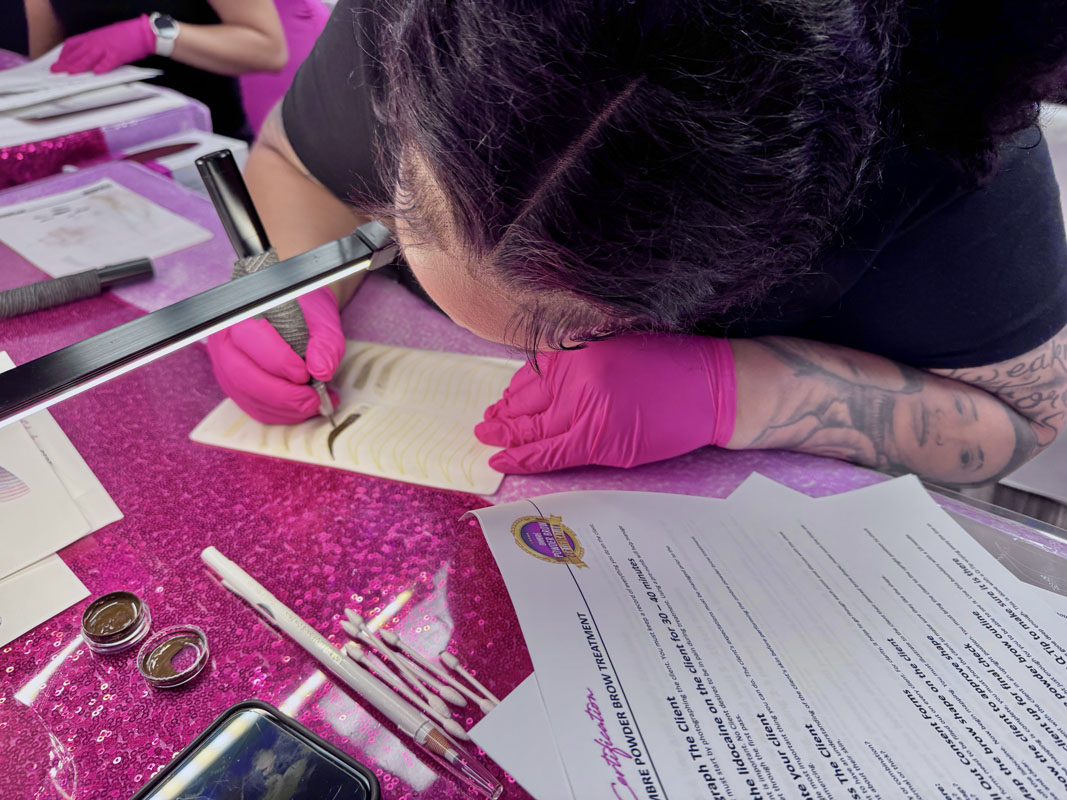
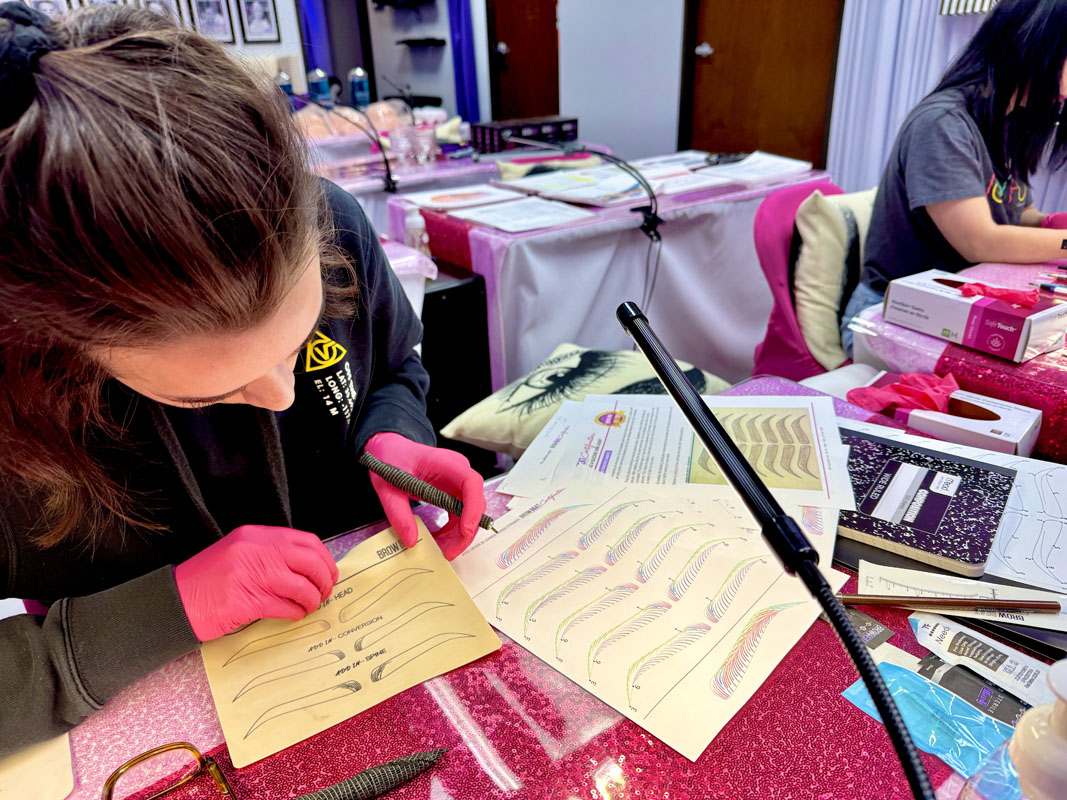
Practice exercises matter. Slow repetition matters. The ability to create consistent strokes at a measured pace matters. These sessions do not need to be glamorous or fast; they need to be deliberate. That is why training at BrowBeat Studio Dallas Microblading Certification and Training Academy includes simulation work, silicone skin repetition, and guided technique refinement. You develop control by feeling every millimeter of movement, not by rushing to fill a brow.

One of the best ways to measure progress is to look at your silicone strokes. Are they consistent in thickness? Do they darken or lighten randomly along the brow shapes? Are you entering with more force than you exit? Do the ends of your strokes still have definition? These questions help you build awareness long before you work on real skin.
How to Evaluate Your Practice Strokes
When you begin practicing, your goal is not beauty — your goal is consistency. Look at your silicone sheet and ask:
- Are all strokes the same width from beginning to end?
- Do any strokes appear darker due to deeper pressure?
- Are there strokes that widen toward the center or tail?
- Is pigment evenly distributed along the incision?
- Does the pattern maintain clean separation between strokes?
These small evaluations matter. They build your ability to recognize where pressure changes occur, even when you did not consciously feel them. Over time, these assessments tighten your control naturally. If every stroke looks the same, pressure is under control. If variation appears, the hand requires more sensitivity training.
This is why structured practice kits, tools, and silicone mediums play such a crucial role in training. The Microblading and Lip Blushing Kit gives you the materials to practice consistently, evaluate visually, and track improvement over time. Every sheet of silicone is a diary — a record of your pressure evolution.
How to Build True Pressure Control
Learning pressure is learning control. It requires more than talent — it requires patience. It takes time to understand how to glide the blade instead of pressing it. It takes intentional practice to learn how to maintain consistent depth along a curve. It takes awareness to feel the skin’s resistance and ease into it rather than force it.
You become good at pressure the same way you become good at drawing, painting, or playing an instrument. You repeat, and repeat, and repeat. You evaluate your results and make micro-adjustments. You slow down long enough to listen to your hands. You stop expecting mastery overnight. You become consistent first — beautiful comes second.
Managing expectations is a key part of artistic maturity. Pressure control cannot be rushed or skipped. It is built over months, sometimes years, of repetition and healed result observation. Every client teaches you something. Every heal teaches you something. Growth lives in the space between what you wanted to happen and what actually healed.
When Pressure Meets Real Skin
Practicing on silicone builds awareness, that is why hands-on training matters. Machine work provides vibration and diffusion cues, while manual blades provide direct tactile connection to the stroke.
When practicing in training environments like the Ombré Powder Brow Certification or Microblading Certification at BrowBeat Studio Dallas Microblading Certification and Training Academy, this contrast becomes clear. You learn that the blade does not need force — it needs guidance. Pressure becomes flow. The right pressure allows the blade to glide effortlessly along the skin surface, releasing pigment as it moves like a breath rather than a push.
The Relationship Between Confidence and Pressure
When artists are unsure, they grip harder, press deeper, and move faster. Confidence brings softness — confident artists glide. They trust their hand, trust their training, and trust the subtle feedback of the skin. Confidence leads to cleaner strokes, more consistent healing, less blurring, and happier clients.
Confidence comes from skill, and skill comes from time invested. There are no shortcuts. There are no magic rules. There is only practice, reflection, and growth.
So, What Is the Right Pressure for Microblading?
The right pressure is the one that creates even, consistent strokes from beginning to end. It is light enough to heal thin and natural, but deep enough to retain pigment through the full healing cycle. It is pressure that leaves the line looking the same width at the base, the midpoint, and the exit. It is pressure that respects skin type and responds to the individual, not the rulebook.
Over time, the right pressure becomes your personal signature. You stop thinking about depth consciously — your hands simply know. You stop needing to overcorrect — your skin assessments guide your choices. You stop rushing — you understand that mastery is long-term, not immediate.
To get there, artists need training, practice material, structured repetition, and healed result observation. This is why courses like the BrowBeat Studio Dallas Microblading Certification and the Ombré Powder Brow Certification exist. They give you the structure, feedback, and practice foundation that self-learning cannot replicate.
Pressure is not a mystery. It is a skill you build — slowly, intentionally, powerfully.