
Last Update: January 2026
Nursing school is not for the faint of heart. Years of coursework, clinical rotations, long nights studying, and emotional labor stack up fast. Then comes the surprise many nurses don’t expect — the student loan reality. You finally graduate, step into the workforce, and realize that while the work is meaningful, the financial pressure doesn’t magically disappear.
That moment sparks an important question: Is there a way to expand your skills, increase income potential, and still help people — without starting over from scratch?
For many healthcare professionals in Dallas and across Texas, microblading training has become a strategic career expansion option. Not because nursing isn’t valuable — but because modern professionals are building layered careers instead of relying on a single income stream.
This article explores why microblading education has become appealing to nurses, how the skills overlap surprisingly well, and what realistic training pathways look like when approaching semi-permanent makeup professionally.
The Reality of Nursing School Debt
Student loan balances for healthcare professionals can feel overwhelming. Between tuition, certification exams, continuing education requirements, and living expenses during training, many nurses graduate carrying significant financial obligations.
While nursing remains a respected profession, compensation varies widely depending on specialty, location, shift availability, and facility budgets. Many nurses quickly discover that overtime becomes the primary way to make financial progress — often leading to burnout.
That’s why more professionals are exploring supplemental career skills that provide scheduling control and income diversification without abandoning their primary profession.
Microblading education fits into this category as a specialized skill set that operates in a completely different service market while still using clinical precision, hygiene awareness, and interpersonal communication.
Why Nurses Transition Well Into Microblading Training
At first glance, healthcare and semi-permanent makeup may seem worlds apart. In reality, they share more overlap than many people realize.
Precision and Attention to Detail
Nurses develop exceptional attention to fine detail. Whether monitoring vitals, administering injections, or documenting care accurately, precision is part of daily routine. Microblading relies on the same level of controlled hand movement, careful spacing, and exact placement.
Understanding Skin Behavior
Clinical training introduces nurses to wound healing, inflammation response, tissue sensitivity, and aftercare compliance. These concepts directly support understanding how skin responds to pigment implantation and healing cycles.
Sterilization Awareness
Infection control protocols are second nature to healthcare workers. Maintaining sanitary workstations, following glove usage procedures, and understanding cross-contamination prevention transfers smoothly into professional microblading environments.
Client Communication Skills
Nurses already know how to explain procedures clearly, manage nervous clients, and build trust quickly — a crucial skill when performing aesthetic services that involve close face-to-face interaction.
What Microblading Training Actually Involves
Professional microblading education is not a weekend hobby course. Reputable training programs focus on building real technical skill through structured learning.
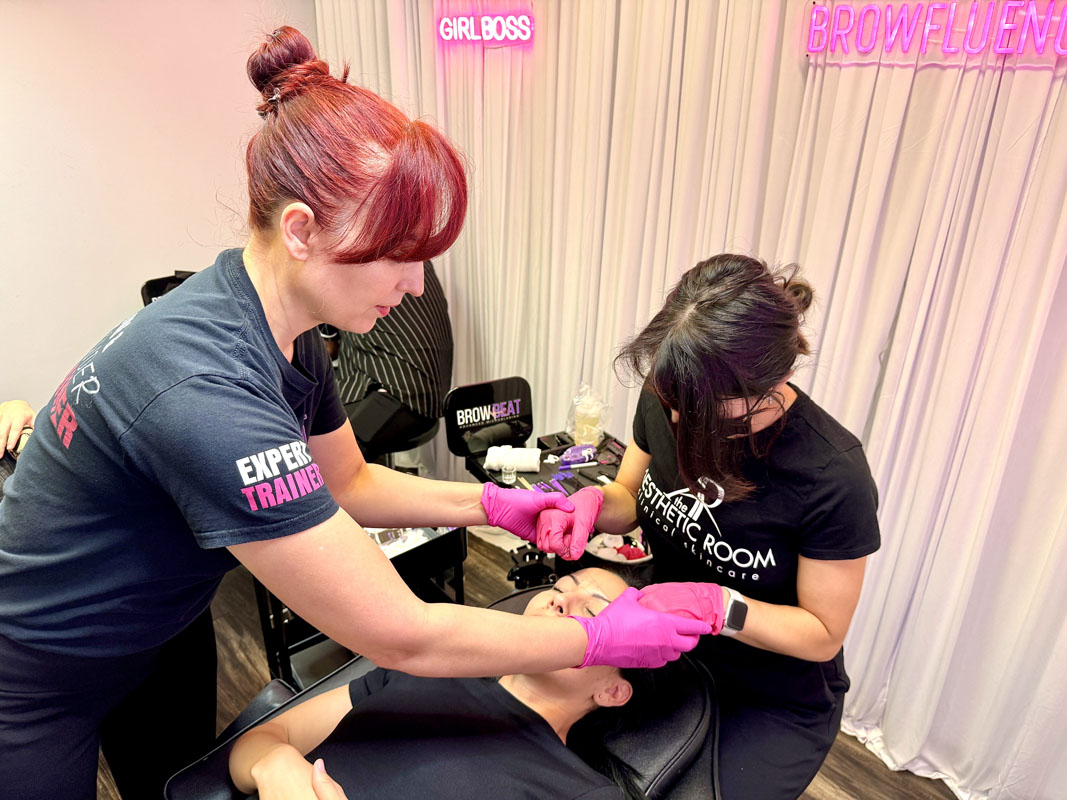
At programs such as microblading certification training in Dallas, students move through layered instruction covering:
- Brow mapping fundamentals
- Stroke pattern theory
- Pigment selection concepts
- Skin behavior analysis
- Equipment handling
- Safety protocols
- Aftercare education
Hands-on learning is reinforced using simulation exercises, allowing students to practice stroke techniques, mapping placement, and tool handling before working on real models later in professional development.
Time Commitment Compared to Nursing Programs
One of the main attractions for nurses exploring microblading education is the time efficiency.
Nursing programs require years of structured coursework. Microblading certification programs, while intensive, typically focus on condensed technical instruction combined with guided practice hours.
This allows professionals to expand skill sets without stepping away from existing careers entirely.
Many students attend training while maintaining current employment schedules and gradually build competency over time.
Career Flexibility Without Leaving Healthcare Entirely
Some nurses choose to integrate microblading as a complementary service path rather than a full career replacement.
Options may include:
- Offering aesthetic services on select days
- Reducing overtime dependency
- Transitioning into aesthetic medicine environments
- Building cosmetic specialization portfolios
This layered career strategy provides flexibility while maintaining professional identity.
Why Semi-Permanent Makeup Appeals to Healthcare Professionals
Microblading sits at the intersection of artistry and clinical procedure. It involves skin interaction, sterile technique, precision tools, and cosmetic design.
For nurses who enjoy hands-on procedures but want variety outside hospital environments, semi-permanent makeup offers a creative outlet while maintaining technical engagement.
Dallas as a Training Hub for Microblading Education
Dallas continues to grow as a major training hub for semi-permanent makeup education. With high client demand, strong beauty industry presence, and established training academies, students have access to advanced curriculum and equipment-supported courses.
Programs such as ombré powder brow certification and combination brow education further allow students to expand beyond microblading alone.
This multi-skill approach creates versatility across service offerings.

Building Long-Term Professional Stability
Career sustainability is about more than short-term earnings. It’s about building skill sets that adapt to market demand.
By learning multiple brow techniques — microblading, powder brows, and combination methods — professionals position themselves to serve a broader range of client preferences.
Many students also expand into business education programs such as beauty business operations training to better understand scheduling systems, compliance, and client workflow management.
Training Tools and Equipment Support
Quality programs provide starter kits that allow students to practice properly without sourcing equipment independently.
Training kits typically include:
- Professional machines
- Practice skins
- Measurement tools
- Pigments
- Mapping supplies
For example, training kit packages help streamline early learning stages by giving students consistent equipment standards.
Frequently Asked Questions
Do nurses need prior beauty experience?
No. Many successful microblading students come from healthcare backgrounds without prior beauty training. Structured education programs teach techniques step-by-step.
How long does it take to feel confident?
Skill development varies by student. Consistent simulation exercises and practice assignments gradually build technical confidence.
Can this be done alongside nursing shifts?
Many students attend training while maintaining employment schedules, gradually integrating new skills over time.
Is microblading physically demanding?
Compared to hospital floor work, microblading involves seated procedures and controlled hand movement, reducing physical strain.
Career Growth Without Burnout
Nurses often face emotional exhaustion due to long shifts and patient care demands. Introducing an alternate professional outlet allows many to regain control over schedules and creative expression.
Microblading allows professionals to engage in detail-focused work without the physical toll of extended hospital shifts.
Final Thoughts
Nursing education builds powerful foundational skills — discipline, responsibility, and technical precision. Microblading training allows those strengths to be redirected into an additional professional lane.
For nurses seeking diversified income pathways, flexible scheduling, and creative engagement, microblading education represents an opportunity to expand rather than replace their existing careers.
If you’re ready to explore professional training options, the next step is to schedule your appointment to learn more about available certification programs and enrollment schedules.
Visit BrowBeat Studio Dallas Microblading Certification and Training Academy to begin your next career chapter.