CHOOSING THE RIGHT PERMANENT MAKEUP COURSE TX
Choosing permanent makeup training can feel surprisingly complicated. Schools use different names for courses, similar techniques can be described in different ways, and almost every training provider naturally wants its education to sound comprehensive, professional and worth the investment.
The easiest way to make a better decision is to stop looking for the course with the most impressive description and start looking for the course that makes the most sense for the student.
The right permanent makeup course should match the skill someone wants to learn and the kind of education they need to develop that skill. The provider should be able to explain what is being taught, who the training is designed for, how students practice and what the course is intended to accomplish without making the student decode a page full of industry terminology.
That also means there is no single feature that automatically identifies the “best” PMU training. The longest course is not automatically the strongest. The biggest kit does not guarantee better teaching. Live-model work does not automatically prove that practical education is more effective. A formal-sounding word such as academy or institute does not tell a student how well the instructor teaches.
Good permanent makeup education should make sense before enrollment. Students should know what they are choosing and why it fits what they want to learn.
What Makes a Permanent Makeup Course the Right Fit?
The right permanent makeup training course begins with the student rather than the school.
A first-time student exploring permanent makeup education has different needs from an experienced PMU artist looking for advanced training. Someone who wants to learn manual brow strokes is looking for a different skill from someone interested in machine shading. A student interested in lips should not choose a brow course simply because both fall under the permanent makeup umbrella.
Before comparing providers, establish the objective. What does the student want to be able to do after learning and continued practice?
Once that question is clear, the course comparison becomes much more useful. Students can look at whether the technique matches their goal, whether the level is appropriate, whether the teaching format makes sense and whether the provider describes the education clearly.
A course can be excellent for one student and completely inappropriate for another. That does not make the course good or bad in isolation. It means suitability matters.

professional pmu
Training
Choosing the right permanent makeup course begins with curriculum structure. A professional PMU training program in Texas should clearly outline theory, mapping systems, pigment science, stroke development, and machine technique before live execution. When evaluating what to look for in PMU training, structured progression is essential. Instructor-led programs built on 10 years in the industry prioritize controlled skill development rather than trend-driven cosmetic tattoo shortcuts.
process before
Enrollment
Understanding the PMU training process helps future artists avoid incomplete education. When learning how to choose PMU training, review whether demonstration precedes execution and whether feedback is individualized. A serious permanent makeup course comparison includes workflow structure, sanitation protocols, and guided hands-on instructor feedback. Professional PMU training in Texas should teach not only application but pigment behavior, skin response, and long-term results.

technique
Control
A strong PMU school selection guide evaluates how technique is layered over foundational mapping systems. Choosing the right permanent makeup course means ensuring brow structure, facial symmetry, and pigment depth are taught before aesthetic design. Programs built on a decade of instructor experience emphasize repetition, correction awareness, and depth control. This structured approach differentiates comprehensive permanent makeup certification programs from accelerated cosmetic tattoo classes.
learning
Environment
Permanent makeup course comparison should include classroom organization and workflow structure. Professional PMU training environments in Texas prioritize procedural clarity. When evaluating the best PMU course for beginners, observe whether students are guided step-by-step rather than left to interpret techniques independently. Structured environments reflect serious instruction and long-term professional standards.


certification
Program
When choosing the right permanent makeup course, review the scope of certification. Many programs teach only microblading or only machine shading. A comprehensive permanent makeup certification program integrates microblading, ombré powder brows, and combo brow techniques within one structured curriculum. This 3-in-1 model provides broader competency and reduces skill gaps often seen in limited cosmetic tattoo training programs in Texas.
pmu
Education
Permanent makeup course comparison should include machine shading methodology. Ombré powder brow training requires depth control, pixel saturation awareness, and gradient technique development. When evaluating what to look for in PMU training, confirm that shading is taught as a foundational skill — not an afterthought. Structured PMU certification programs in Texas integrate shading alongside hairstroke training for complete artist development.


integrated in
Certification
Combo brows require blending microblading strokes with machine shading precision. Choosing the right permanent makeup course means verifying that hybrid integration is part of the certification structure. Programs that teach microblading and shading separately without integration limit skill flexibility. Comprehensive PMU training in Texas includes controlled layering systems that allow artists to adapt techniques to different skin types and client goals.
correction
Certification
Permanent makeup course comparison should also evaluate advanced education pathways. Professional PMU training programs may offer one-on-one tattoo correction certification for experienced working artists seeking deeper expertise. This advanced add-on focuses on pigment theory, color neutralization, and corrective shading strategies. While separate from foundational certification, advanced correction training reflects mature curriculum design built on long-term industry experience.


comparing pmu
Training
When choosing a permanent makeup course, don’t evaluate the classroom experience alone. Look at examples of the professional work associated with the training provider as well. Microblading before-and-after photos can help prospective students see the level of detail, brow design, and hair-stroke work represented by the school.
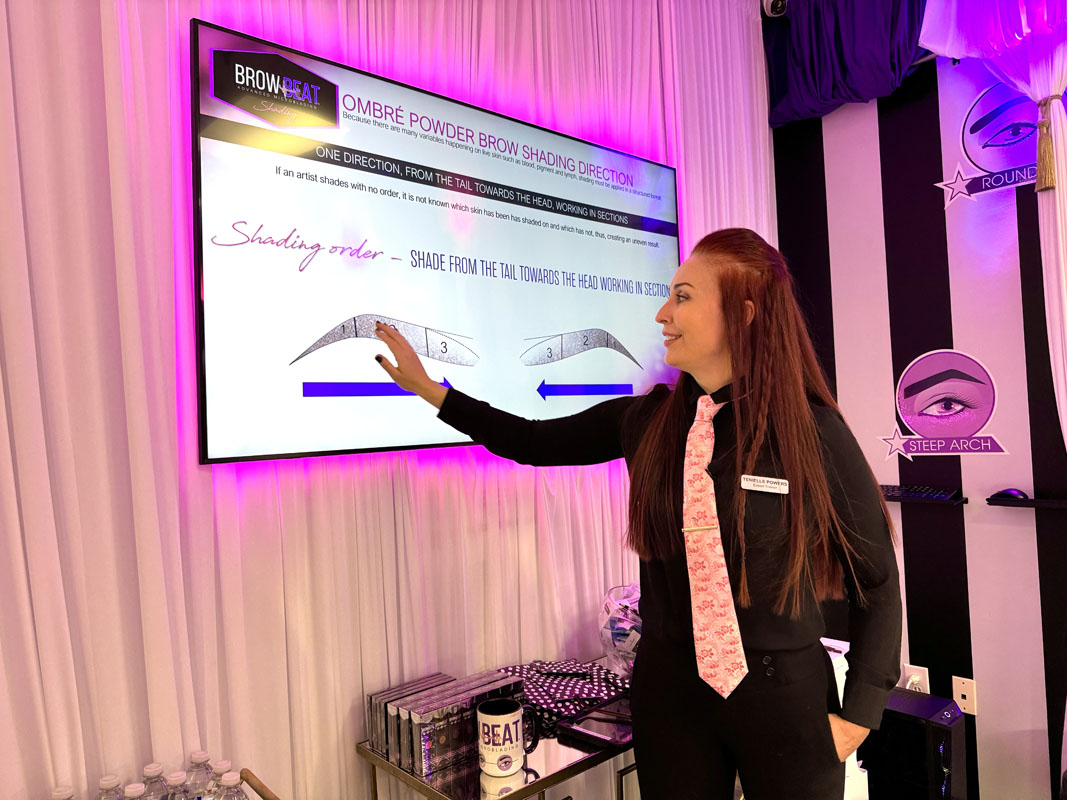
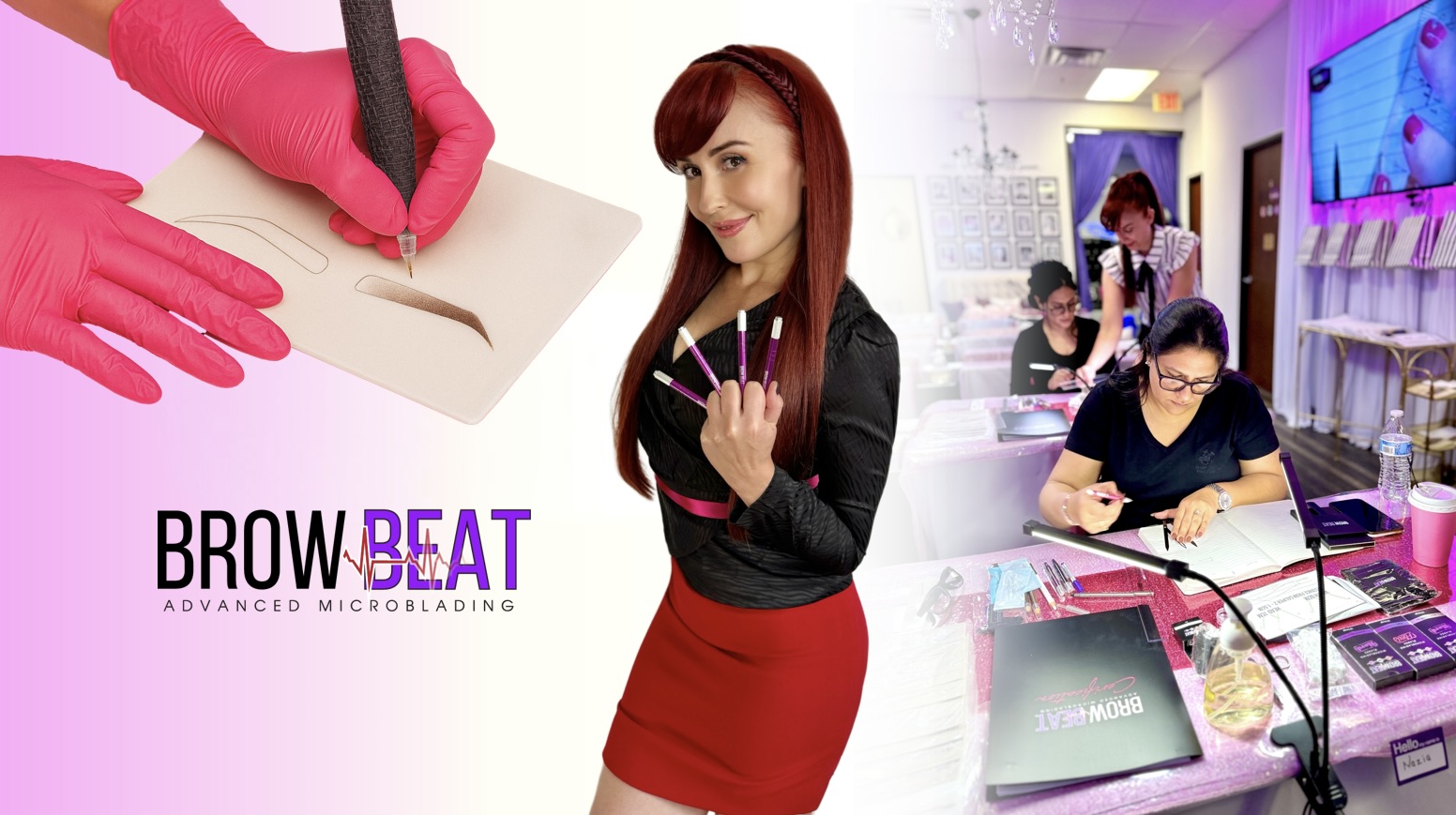
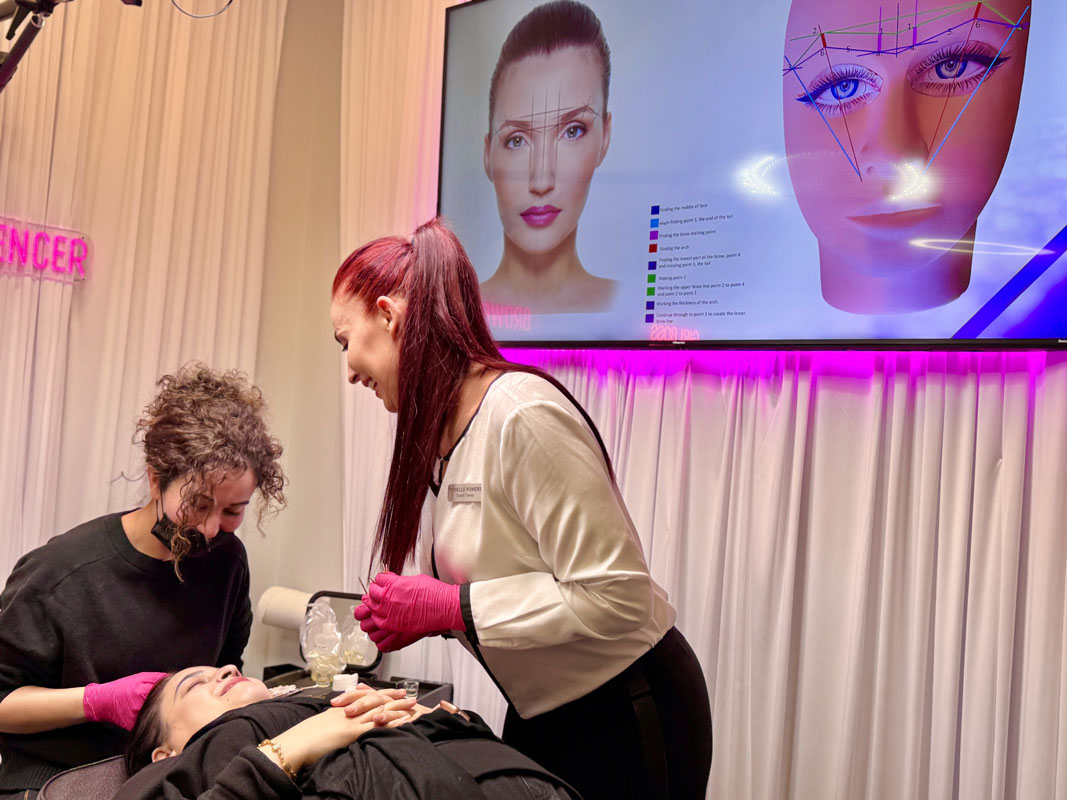
BrowBeat Certification in Dallas gives prospective PMU students access to both classroom imagery and examples of permanent makeup results. Together, these provide a more complete picture than a course description alone. If you’re comparing permanent makeup schools in Texas, look at the training environment, instructor involvement, student participation, and actual examples of work. A provider’s portfolio should be one part of a broader evaluation of the PMU education you’re considering.
pmu
Training
Before enrolling in permanent makeup training, take time to review examples across different PMU techniques. This Ombré Powder Brow before-and-after provides a visual example of machine-shaded brow work, allowing prospective students to see the type of professional artistry represented by the training provider.
BrowBeat Certification in Dallas combines professional work examples with photographs of actual students participating in PMU education. When comparing permanent makeup schools, consider both. The finished work gives you one perspective, while classroom images reveal more about how training is actually delivered. Students searching for professional PMU training in Texas can use this information alongside course details, instructor experience, and training format to make a more informed decision.


pmu
Schools
If a permanent makeup training provider discusses multiple techniques, prospective students should be able to see examples of that work. This Powder Brow before-and-after demonstrates a machine-shaded brow result and gives students something tangible to examine while researching PMU education.
When comparing permanent makeup courses in Dallas, look beyond generic claims such as “professional training” or “hands-on education.” Examine the provider’s classroom, students, instruction, and finished work. BrowBeat Certification gives prospective students a visual look at multiple parts of the training environment. Seeing actual Powder Brow results alongside students participating in class can help you develop a more complete understanding of the PMU program you’re considering.
comparing pmu
Courses
A permanent makeup provider’s portfolio shouldn’t necessarily stop at brows. Lip Blushing examples can help prospective students see the broader range of professional PMU work associated with a school or training provider.
This before-and-after provides a visual example of professional lip artistry. BrowBeat Certification in Dallas shows work from multiple permanent makeup specialties alongside photographs of students actively participating in training. For someone comparing PMU courses in Texas, this provides additional context when evaluating the provider. Look at the results, but also look at how students are taught, whether practical learning is visible, and how the instructor interacts with the class. Together, these factors can help you make a more informed training decision.


pmu
Classes
If you’re comparing permanent makeup training providers, take time to look at the full range of work they present. This Dark Lip Equalization before-and-after provides an example of specialized PMU artistry beyond standard brow and lip applications.
BrowBeat Certification in Dallas shows professional results alongside students participating in instructor-led, hands-on permanent makeup education. Together, these give prospective students a broader view of the training provider. When evaluating PMU schools, look at what is taught, how students learn, who provides the instruction, and examples of professional work. Using several factors together is a more reliable approach than choosing a course based on a single image or claim.
Start With the Skill You Actually Want to Learn
Permanent makeup is a field containing different techniques rather than one universal procedure. That is why choosing “PMU training” without identifying the skill can lead to confusion. Some students know immediately what interests them. Others begin with a general desire to enter permanent makeup and need to understand the options before choosing. Either way, read beyond the course title.
What will the student actually learn to do? Is the course teaching one technique or several? Is the work manual or machine based? Is it brow education, lip education or advanced work involving previous permanent makeup? The more specific the student’s goal becomes, the easier it is to eliminate training that does not match it.
This is also why a huge list of techniques should not automatically be considered an advantage. Learning several techniques can make sense when the course is deliberately structured to teach several techniques. It is less useful when unrelated subjects have simply been added to make the program look larger.
Make Sure the Technique Is Described Accurately
A useful test of any permanent makeup course is whether the provider can explain the technique clearly.
Within BrowBeat Certification’s training structure, Microblading means manual hair-stroke work. Ombré and Powder Brows use machine shading. Combo, Hybrid and 3D Brows combine hair strokes and shading in one finished brow technique. The 3-in-1 Brow Certification is different because it teaches Microblading, Ombré/Powder Brows and Combo/Hybrid Brows as three separate techniques.
Correction begins with previous aged permanent makeup and therefore requires a different type of assessment from creating new work. These distinctions are not merely website organization. They affect what the student is actually learning.
A training provider does not need to use exactly the same terminology as BrowBeat Certification, but the description should make the method understandable.
If a student cannot determine whether a brow course teaches manual strokes, machine shading, a combination of the two or several separate techniques, more clarification is needed before enrolling. Clear technique language is one sign that the provider understands the education well enough to explain it.
Look at How the Permanent Makeup Training Is Taught
Knowing what is taught is only half of the decision. Students should also consider how the semi-permanent training happens. Permanent makeup is a practical skill. Understanding an explanation and physically reproducing the skill are different stages of learning.
A student can watch an instructor perform a movement and understand exactly what they are seeing, then discover that their own hand does something very different when they attempt it.
That gap is normal. The training format should help the student work through it.
When comparing PMU schools, look for an educational process rather than simply a collection of demonstrations. Students should have opportunities to understand, attempt, receive feedback, adjust and repeat.
Hands-On Should Mean More Than Watching
The phrase “hands-on” appears frequently in training descriptions because students understandably want practical education. But the phrase itself does not explain how much meaningful practice occurs.
Watching an instructor at close range is useful, but watching is still observation. A student begins developing a physical skill when they have to attempt the movement themselves.
When comparing hands-on permanent makeup training, ask what the student actually does. How is practical learning introduced? Are students given time to repeat? Is there an opportunity for correction? Do exercises become more demanding as students develop? Those questions tell a student more than the label “hands-on.”
Progressive Practice Can Make Learning More Manageable
A new PMU student is trying to coordinate visual judgment, physical movement, sequence, positioning and technical understanding. Making every exercise complicated from the beginning can create unnecessary difficulty.
Progressive practice allows individual parts of the skill to develop before everything is combined.
At BrowBeat Certification, students can begin with exercises that emphasize understanding before moving into practical work and increasingly realistic treatment setups. The purpose is to add complexity for a reason rather than simply making the exercise look more advanced. Students comparing providers can ask whether the practical progression makes educational sense. What is each stage teaching? How does it prepare the student for what comes next?
When those questions have clear answers, the practice format has a purpose.

Instructor Feedback Changes the Value of Practice
Practice is important, but repetition alone is not enough. If a student repeatedly performs a movement incorrectly without realizing it, repetition can strengthen the wrong habit.
Instructor feedback helps interrupt that process.
A trainer may see something the student cannot yet identify: a movement that needs adjustment, an awkward working position, a misunderstanding of the sequence or a detail the student is overlooking. The student can then repeat the exercise with new information.
This is why instructor access matters when comparing beginner PMU education. The value is not simply having an expert physically present. The value comes from observation, explanation and correction that helps the student improve.
Ask Whether the Practice Format Has a Clear Purpose
Practice materials can look impressive in photographs, but students should ask why each one is being used. Different formats can solve different learning problems.
Paper can allow a student to concentrate on structure and placement without simultaneously managing a tool on a realistic surface. Silicone can add physical execution and hand-eye coordination. Mannequin and silicone headband practice can introduce a curved treatment area and more realistic positioning. Partner mapping, where appropriate, can add real facial assessment and communication without turning the exercise into a live PMU procedure.
The important point when choosing training is not that every course must contain exactly the same exercises. It is that the exercises should have a reason. A student should be able to see how practical work supports the skill being developed rather than assuming that more practice surfaces automatically mean better training.
Read the Course Description for Clarity, Not Hype
Permanent makeup education is exciting, and course marketing will naturally reflect that. There is nothing wrong with a provider being enthusiastic about its training. The problem begins when enthusiasm replaces information. A useful course description should answer basic questions without forcing the student to guess.
What is being taught? Who is it for? What level of experience is expected? How does the training happen? What does the provider actually mean by the claims being made? Words such as master, elite, professional, intensive, complete and advanced can sound impressive, but they need context.
“Advanced” should tell the student something about the level of the education. “Complete” should not be used to imply that one course somehow teaches everything an artist could ever need to know. “Professional” should not be treated as a substitute for explaining the training itself. Good course descriptions reduce uncertainty.
Watch for Promises That Skip the Learning Curve
One of the most useful things a student can bring to PMU training is realistic expectations. Permanent makeup is a hands-on precision skill. Education can provide a strong foundation, but no responsible course can manufacture years of experience during a short period of formal instruction.
Be cautious with language that suggests a student will leave instantly performing with the confidence, speed or judgment of an established artist. Students can learn a great deal during training. They can understand processes, develop practical control and leave with a much clearer idea of how to continue improving.
That is different from promising immediate mastery.
A provider willing to acknowledge the learning curve is not underselling its training. It is giving the student a more realistic picture of how practical skills develop.
Evaluate the Teaching Approach, Not Just the Feature List
Course comparison pages naturally encourage students to compare features.
One course has this. Another has that. One includes more materials. Another lists more modules. Those details can matter, but the feature list does not explain whether the student will understand the education.
Ask whether the teaching approach appears structured. Does the provider explain why steps matter? Are complicated processes broken into manageable pieces? Is there a repeatable system the student can use while experience is developing? Is feedback part of the practical learning process?
A course containing fewer clearly connected elements can be more useful than a course containing a huge amount of disconnected information.
The goal is not to collect the most topics. It is to learn the skill.

Be Careful With Live-Model Claims
Live-model training can sound like one of the strongest features a PMU course could offer. It deserves more thought than that.
The important question is not simply whether a live model is present. The question is whether the student has developed enough understanding, coordination and control for live-skin work to be an appropriate part of that training experience.
A student who is still learning how the tool behaves, how to position themselves and how to reproduce a movement consistently is still working through fundamentals.
Putting live skin underneath that learning curve does not automatically improve the education.
BrowBeat Certification does not use student live-model procedures during its in-person training. Students instead develop through progressive practical formats that allow early mistakes to be examined, corrected and repeated without another person’s skin becoming the practice surface.
That is BrowBeat Certification’s educational approach. It does not require claiming that every provider using live models is automatically providing poor education.
Students should evaluate the reasoning behind the format and decide whether the progression makes sense.
Do Not Confuse a Large Training Kit With a Complete Education
Training kits are tangible, which makes them easy to compare. A student can see the equipment, count the supplies and attach an immediate value to what is included. Education is harder to photograph.
A kit can contain useful tools, but it cannot explain why a technique works. It cannot watch a student practice. It cannot identify a mistake. It cannot explain why one decision makes more sense than another.
When comparing PMU training cost and PMU school pricing, treat materials and equipment as one part of the overall training rather than allowing the kit to become the deciding factor.
Questions about exactly what PMU training contains belong in the detailed curriculum guide. During course selection, the important point is simpler: supplies support education; they do not replace it.
Understand What “Certification” Means Before Enrolling
Certification language deserves careful attention because students can easily assume more than a provider actually means. Before choosing a course, ask what the student receives after completing the training and what that document represents.
A course completion certificate, professional certification, credential, state license and legal authorization to perform a procedure are not interchangeable.
A provider should describe its own training outcome accurately.
Students do not need to become experts in licensing law simply to compare courses, but they should be cautious if educational marketing appears to blur a training certificate with government authorization. The dedicated permanent makeup certification guide explains those distinctions more fully.
Does the Course Match Your Current Experience?
A course can be well taught and still be the wrong level for the student. Some permanent makeup education is designed to establish foundational skills. Other courses assume that those skills already exist.
Students should look for clear prerequisite and suitability information rather than assuming that every PMU course begins at the same starting point. Advanced does not mean better. It means the course expects the student to arrive with knowledge or experience that allows the education to move into more complex questions.
PMU Correction is a good example. Correction begins with previous permanent makeup and requires assessment and case-selection decisions. It is advanced education and should not be treated as someone’s first introduction to PMU.
A beginner benefits from education designed for the stage they are actually in. A more experienced artist benefits from training that does not spend unnecessary time pretending they are still at the beginning.
Students unsure about first-time PMU education can explore the dedicated beginner training guide for a deeper discussion of readiness and no-experience questions.
Compare What Is Included Without Turning It Into a Checklist Contest
Students should absolutely understand what they are enrolling in. But course comparison becomes less useful when it turns into a contest over which provider can list the most modules, tools, supplies or topics. More is not automatically more relevant.
The curriculum should support the technique. A Microblading course should devote its attention to the knowledge and practice required for manual hair-stroke work. Machine-shading education belongs where machine shading is actually being taught. Lip education should be designed around lips. Advanced Correction should reflect the fact that the artist is dealing with previous healed PMU.
A course that tries to sound comprehensive by mentioning everything may actually make it harder for the student to understand what the training is supposed to accomplish.
For students whose primary question is what PMU training includes, the curriculum guide is the appropriate place to explore modules, tools, machines, needles, pigments, mapping, practice and materials in greater depth.
Course, Class, Program, School or Academy: Does the Label Matter?
Students may search for a permanent makeup course, PMU class, training program, school, academy or institute and assume each label represents a different level of education. That is not a reliable way to judge quality.
A school is not automatically more thorough than an academy. An academy is not automatically more professional than a course. A program is not automatically more comprehensive than a class. Providers choose different language to describe their education. Look beyond the label.
What is actually taught? Who teaches it? How does the student practice? Is the level appropriate? Are the claims clear? Does the course description help the student understand what they are choosing? The substance matters more than the title attached to it.

What About Private or One-on-One PMU Training?
Students may also encounter private or one-on-one permanent makeup training while comparing providers. Individual instruction can sound automatically superior because the student imagines receiving all of the instructor’s attention. Whether that format is the right choice still depends on how the education is taught.
A one-on-one label does not guarantee a strong curriculum, meaningful practical progression or clear instruction any more than a group format automatically means a student receives less useful education. If private training is important to the student, ask what the format actually changes. How is instruction delivered? How does practice work? What type of instructor feedback is provided?
How to Compare PMU Training Near You
For in-person education, location is a legitimate part of the decision.
Travel affects convenience, scheduling and whether the student can realistically attend the training they are considering. But “near me” should narrow the search, not make the final decision.
A nearby course may be convenient but still teach the wrong technique, operate at the wrong experience level or use a training approach that does not make sense for the student’s goals.
Students comparing in-person PMU training should first identify realistic local options and then evaluate those options using the same standards they would use anywhere else: technique clarity, appropriate course level, practical structure, instructor feedback and realistic claims.
BrowBeat Certification provides in-person permanent makeup training in Dallas, Texas. For students considering training in the Dallas area, location can therefore be one factor in the decision without becoming the only reason to choose a course.
How to Compare Two Permanent Makeup Courses Side by Side
When two courses initially look similar, comparing them by category can make the differences easier to see. Start with the technique. Are both courses actually teaching the same skill, or do similar names hide different methods? Then look at the intended student. Is one designed for beginners while the other assumes previous PMU experience?
Next, compare how practical learning happens. Does the course explain how students move from instruction into practice? Is instructor feedback part of the process? Are students given opportunities to repeat and improve?
Look at the language around outcomes as well. Does the provider describe what students can reasonably expect to learn, or does the marketing jump from taking a course to sounding like an experienced professional?
Finally, consider whether the course information leaves important questions unanswered. A student should not have to make major assumptions about what they are enrolling in. This type of comparison is more useful than simply placing two feature lists beside each other and counting which one is longer.
Common Mistakes Students Make When Choosing PMU Training
Many poor course decisions begin with perfectly understandable assumptions.
A student sees a large kit and assumes the course must provide more value. They see live models and assume the training must be more advanced. They see the word “master” and assume the course must go deeper. They find a school five minutes away and assume convenience makes it the obvious choice.
Any one of those features may be useful. None of them answers the entire question.
Choosing by Course Name Alone
Course names are marketing tools as well as descriptions.
Do not assume that “master,” “complete,” “professional” or “advanced” has a standardized meaning across the industry. Read what the course actually teaches and who it is intended for.
Choosing the Course With the Most Techniques
More techniques can be valuable when the course is intentionally designed as multi-technique education. But the number of techniques should not replace depth or clarity. Students need enough education to understand what they are learning rather than simply being introduced to a long list of services.
Choosing Based Only on Convenience
Nearby training can make attendance easier, but convenience cannot compensate for a poor match. The better question is whether the course is both realistically accessible and appropriate for the student’s goals.
Assuming a Certificate Answers Every Professional Question
Certification matters, but students should understand what the training provider means by it. A course certificate does not automatically answer separate questions about legal requirements, licensing or professional readiness.
Expecting Training to Eliminate the Need for Practice
A good course should improve the quality and direction of a student’s practice. It cannot replace practice entirely. Students choosing PMU education should look for a strong foundation rather than a promise that the learning curve disappears at graduation.
What Should a Student Know Before Enrolling?
By the time a student enrolls, several basic questions should already have clear answers. The student should know which technique or group of techniques the course teaches. They should understand whether the education is appropriate for their current experience. They should have a reasonable picture of how the training is delivered and how practical learning happens.
They should also understand what claims the provider is making about certification and what questions belong outside the course itself, such as current legal requirements.
Not every detail of the future learning experience needs to be known in advance. Part of taking a course is discovering and developing new skills. But enrollment should not feel like buying a mystery box.
Clear information before training allows the student to arrive concentrating on learning rather than discovering that the course is different from what they thought they purchased.

Questions to Ask Before Choosing a PMU Course
Students do not need to interrogate a training provider with dozens of questions. A focused conversation can usually reveal whether the course information is clear and whether the education matches the student’s goals.
- What exact technique or techniques are taught?
- Who is the course designed for?
- Is previous PMU experience required?
- Is the training in person?
- How is practical learning structured?
- What types of practice are used?
- How does instructor feedback fit into the training?
- What should the student expect to be practicing during class?
- What does the course certificate or certification represent?
- Where can the student find detailed information about the specific technique or curriculum?
The purpose of these questions is not to find a provider that gives the most impressive answer to every item. It is to make sure the student understands what they are choosing.
Why BrowBeat Certification Emphasizes Clear Technique Boundaries
Students make better training decisions when different skills are described honestly. Microblading is manual hair-stroke work. Ombré/Powder Brows involve machine shading. Combo/Hybrid Brows integrate hair strokes and shading as one finished technique.
The 3-in-1 Brow Certification teaches three separate brow techniques. Lip Blushing is its own PMU discipline, while Correction begins with previous healed work and requires an existing PMU foundation. Those distinctions help students understand what they are choosing before they begin. Clear education should start with clear language.
Choose Training That Makes Sense for What You Want to Learn
Choosing permanent makeup training is easier when the student stops looking for one feature that proves a course is the “best” and starts evaluating the education as a whole.
The technique should match the goal. The level should match the student. Practical exercises should have a reason. The teaching approach should make complicated skills easier to understand. Course claims should be realistic, and important terms should be explained clearly. Most importantly, the student should understand what they are choosing before training begins.
BrowBeat Certification provides in-person PMU education in Dallas, Texas across brow, lip, multi-technique and advanced subjects. Students can explore the available training and choose the course that matches the skill they want to develop and the stage they are currently in.
Frequently Asked Questions About Choosing Permanent Makeup Training
How do I choose the right permanent makeup course?
Choosing the right permanent makeup course starts with knowing what you need from it. Look for a curriculum that matches your goals, clear information about what’s included, and a teaching style that fits how you learn. Ask how practice is structured, how feedback is given, and what support exists during the learning process. So the right course should feel clear, structured, and aligned with your learning needs.
What should I look for in a permanent makeup school?
Look for clear technique descriptions, realistic course claims, purposeful hands-on education, appropriate training levels and information that helps students understand what they are choosing. A provider should make the education easier to understand.
How do I know if PMU training is good quality?
Look beyond the marketing language and examine the teaching approach. Good practical education should help students understand why they are doing something, give them opportunities to practice and provide useful feedback that helps them improve.
Is the most expensive PMU course automatically the best?
No. Price does not prove teaching quality or suitability. Cost is a separate consideration, while choosing a course should focus on whether the education matches the student’s goals, experience and learning needs.
Is a longer permanent makeup course automatically better?
No. Course duration should be appropriate for the subject and training structure. More hours do not automatically mean clearer instruction or more effective practice, just as a shorter course should not automatically be assumed to be better or worse.
Should I choose a PMU course because it offers live models?
Live-model access should not automatically be treated as proof of stronger education. Students should consider whether they have developed enough control before live-skin work is introduced. BrowBeat Certification uses progressive practice rather than student live-model procedures during its in-person training.
How important is hands-on practice when choosing PMU training?
It is important because permanent makeup is a practical skill. The more useful question is how the hands-on education works. Practice should have a clear purpose, become appropriately challenging and give students opportunities to apply feedback.
How important is instructor feedback?
Instructor feedback helps students recognize details they may not yet see themselves. It can turn repetitive practice into deliberate practice by giving the student something specific to adjust on the next attempt.
Should I choose a permanent makeup course because it has a large kit?
A training kit can be useful, but it should not be the main measure of educational quality. Supplies support training; they do not replace clear instruction, purposeful practice or instructor feedback.
How can I tell whether a PMU course is appropriate for beginners?
The provider should clearly explain who the course is designed for and whether previous experience is required. If beginner suitability is unclear, ask before enrolling rather than assuming that every permanent makeup course starts from the beginning.
How do I know whether a course teaches the PMU technique I want?
Read beyond the course name and identify the actual method. Determine whether the training teaches manual hair strokes, machine shading, a combined brow technique, several separate techniques, lip work or another specific PMU skill.
What questions should I ask before enrolling?
Ask what is taught, who the course is for, whether previous experience is required, how practical learning works, what practice formats are used and what the training certificate represents. The goal is clarity before enrollment.
Does “academy” mean better PMU training than “school” or “course”?
No. Academy, school, institute, program, class and course are labels rather than quality standards. Evaluate the education itself instead of assuming that a more formal-sounding name guarantees stronger training.
Is private or one-on-one PMU training always better?
No. Individual instruction can be useful, but the format alone does not determine quality. Students should still evaluate the curriculum, teaching approach, practical structure and feedback rather than assuming one-on-one automatically means better education.
How should I compare two PMU courses that look similar?
Compare the actual technique, intended experience level, practical training structure, instructor feedback and clarity of the course claims. This usually reveals more meaningful differences than simply comparing the number of features listed on each website.
How do I compare permanent makeup training near me?
Use location to identify realistic in-person options, then compare those options on educational fit. A nearby course still needs to teach the right skill, match the student’s experience and provide a practical training approach that makes sense.
How do I compare in-person PMU courses?
Look at what students actually do during training. Consider how practical work progresses, whether feedback is available, how the provider describes the technique and whether the training level matches the student’s current experience.
How do I know if an advanced PMU course is right for me?
Look at the prerequisites and the type of problems the course expects students to solve. Advanced training should build on an existing foundation rather than simply use the word “advanced” as marketing language.
Where can I find in-person permanent makeup training in Dallas?
BrowBeat Certification provides in-person permanent makeup training in Dallas, Texas. Students can begin by identifying the skill they want to develop and then explore the training designed around that subject.