PERMANENT MAKEUP TRAINING & PMU COURSES DALLAS TX
Permanent makeup is a skill that is built. No student is expected to instinctively know what to do the moment a tool is placed in their hand. At BrowBeat Certification, permanent makeup training is taught through a progression that helps students understand the work before expecting the hands to perform it. Students learn what they are trying to create, why each step matters and how the pieces of a procedure fit together. Practical exercises then help develop the hand-eye coordination, control and judgment needed to turn that knowledge into a usable skill.
Learning permanent makeup involves much more than memorizing a sequence of steps. A developing PMU artist is learning how to look at a face, assess what is in front of them, understand placement, work with tools, follow a process, evaluate results and recognize when something needs to be adjusted. Those abilities take education, repetition and constructive feedback.
BrowBeat Certification provides permanent makeup training in the Dallas, Texas area for students interested in professional PMU education across brow and lip techniques, along with advanced education for experienced artists ready to develop more specialized skills. Training options include Microblading, Ombré/Powder Brows, Combo/Hybrid Brows, the 3-in-1 Brow Certification, Lip Blushing and advanced PMU Correction.
Each has a different purpose. Microblading focuses on manual hair strokes. Ombré and Powder Brows use machine shading. Combo/Hybrid Brows integrate hair strokes and shading into one finished brow. The 3-in-1 Brow Certification teaches Microblading, Ombré/Powder Brows and Combo/Hybrid Brows as three separate techniques within one broader course.
Lip Blushing moves beyond brows into permanent lip color. PMU Correction addresses the very different challenge of assessing and working with previous aged permanent makeup.
The right place to begin depends on what a student wants to learn and, for advanced education, the experience they already have. Students do not need to learn everything at once. They need a strong foundation, a process they understand and enough deliberate practice to continue developing after the classroom portion of training ends.
What Is Permanent Makeup Training?
Permanent makeup training teaches the knowledge and practical skills used in cosmetic tattoo procedures. The field is described using several related terms, including permanent makeup, PMU, semi-permanent makeup, permanent cosmetics, cosmetic tattooing and micropigmentation. Although the terminology varies, these searches often lead students toward the same broad field of professional cosmetic tattoo education.
What matters more than the label is what is actually being taught. Permanent makeup is not one procedure. A student interested in brows may learn manual hair strokes, machine shading or a technique that combines the two. Another student may want to learn Lip Blushing. An experienced PMU artist may later pursue advanced education for previous aged permanent makeup. Each requires its own knowledge and practical skills.
That is why permanent makeup training is better understood as an umbrella for several related disciplines rather than one universal course.
Permanent Makeup, PMU and Cosmetic Tattoo Training
PMU is a common abbreviation for permanent makeup. Permanent cosmetics and cosmetic tattooing are also used to describe work in which pigment is implanted for cosmetic purposes. The term cosmetic tattoo helps distinguish permanent makeup from conventional cosmetics applied to the surface of the skin, while also separating this area of education from conventional decorative body tattooing.
That distinction is particularly important when someone is searching for tattoo training classes or tattoo courses. A course described broadly as tattoo training does not necessarily teach permanent makeup. BrowBeat Certification is focused on PMU and cosmetic tattoo education rather than general body tattoo training.
For students comparing permanent makeup schools, PMU academies, courses or training programs, the name attached to the education tells only part of the story. The actual technique, curriculum and training approach matter far more.
Learning a Technique Is More Than Learning a Movement
Watching an experienced PMU artist can make a technique look deceptively simple. The visible part may be a hand holding a tool, a machine moving across an area, a hair stroke being placed or shading gradually being built. What is less visible is the thinking underneath the movement.
The artist is making decisions: Where should the work begin? Where should it stop? What belongs in a particular area? What should be avoided? What is the artist looking for before moving to the next step? How does the artist know when an adjustment is needed What changes when the person in front of the artist is different from the example practiced during training?
Those decisions are part of the skill. Good PMU education therefore needs to teach more than imitation. Students need a permanent makeup educational process they can understand and repeat. In the beginning, structure gives the student somewhere to go next instead of leaving them to guess. As experience grows, many of those decisions become more familiar, but that familiarity is built from understanding and repetition.
Why Structured PMU Education Matters
A new student is learning several things at once. There is a visual component involving shape, placement, balance and the intended finished result. There is a technical component involving tools and the way physical movements affect the work. There is a practical component involving hand-eye coordination, positioning and learning how to work around a treatment area. There is also a decision-making component. Students need to observe what is happening, understand what they are seeing and know why the next step makes sense.
Trying to master all of those elements simultaneously can make a new skill feel much harder than it needs to be. A structured progression allows students to concentrate on one layer before adding another.
This is one reason BrowBeat Certification emphasizes progressive practice rather than expecting students to move immediately from explanation to performing a complete procedure. The fundamentals come first. Practical control is added. The working environment becomes increasingly realistic. Students have opportunities to repeat, receive feedback and make adjustments while they are still learning.
The deeper guide to how semi-permanent makeup training works explains the training experience, class structure and practical learning process in greater detail.
Permanent Makeup Courses at BrowBeat Certification
Students searching for permanent makeup training often arrive with very different goals. Some already know they want to learn brows but are unsure which brow technique interests them most. Some are specifically drawn to manual hair strokes. Others want machine shading or a broader education that covers several brow methods.
Some students want to add Lip Blushing. Experienced PMU artists may be looking for advanced microblading and tattoo correction certification that helps them assess previous aged work and make better corrective decisions. Understanding what each technique actually does makes choosing training much easier.
Microblading Training
Microblading is a manual hair-stroke brow technique. Rather than creating machine shading, the artist creates individual strokes designed to contribute to the appearance of brow hair within a planned design. The defining skill is manual stroke work.
That means Microblading training needs to develop more than the ability to make a small mark. Students need to understand how strokes are placed, how they relate to one another and how individual strokes contribute to the finished brow. The technique has its own learning demands, including brow design, stroke placement, pattern, spacing and manual tool control.
For students specifically interested in learning manual hair strokes, Microblading provides a clear area of study. Machine shading does not become Microblading simply because both techniques can be used to create eyebrows. Keeping that boundary clear helps students understand what they are actually learning.
When hair strokes and shading are intentionally integrated into one finished brow, the technique moves into Combo/Hybrid territory.
Ombré and Powder Brow Training
Ombré and Powder Brows use machine shading. Instead of building the brow primarily from individual manual strokes, the artist uses a PMU machine to develop a shaded result through controlled pigment application. That creates a different physical skill set from Microblading.
Machine work requires the artist to understand how movement, control and application affect the developing result. Students need to become comfortable working with the machine while also understanding the visual effect they are trying to create.
The goal is not simply to fill in an eyebrow. Powder and Ombré work should be intentional. The artist is building a designed result through shading, and that requires both technical control and visual judgment.
Students specifically interested in machine-shaded brows can explore Ombré/Powder Brow training in greater depth without confusing it with manual Microblading education.
CLASS
Environment
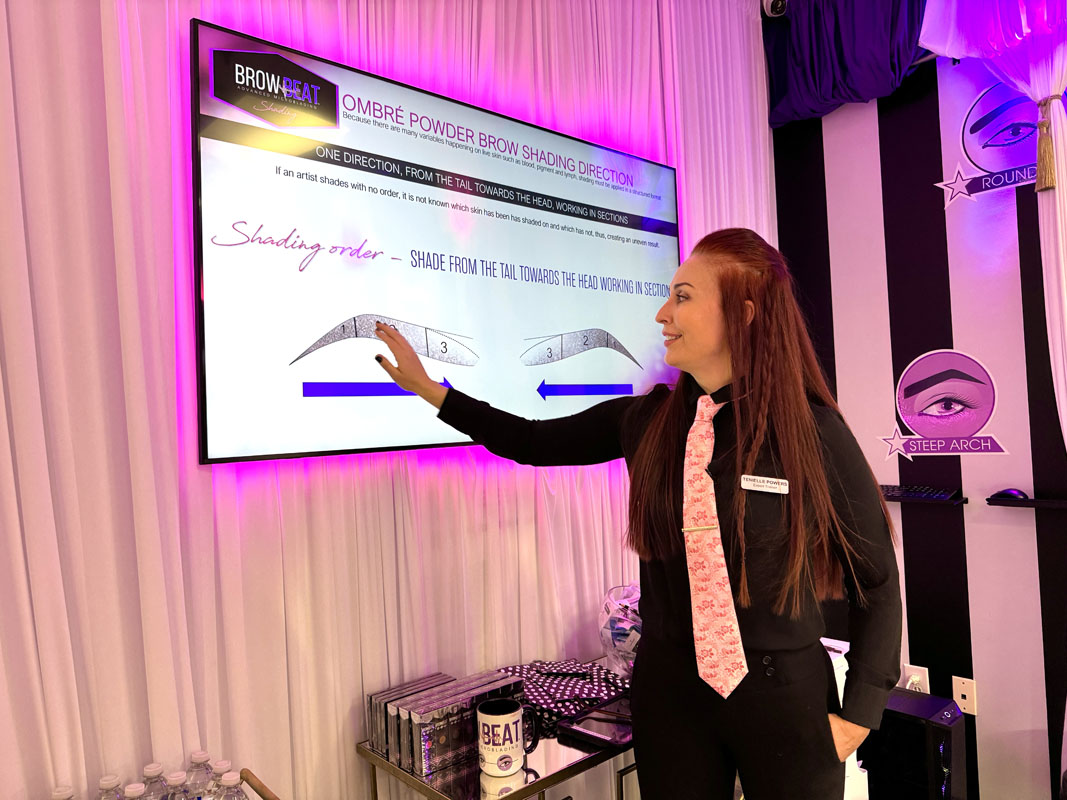
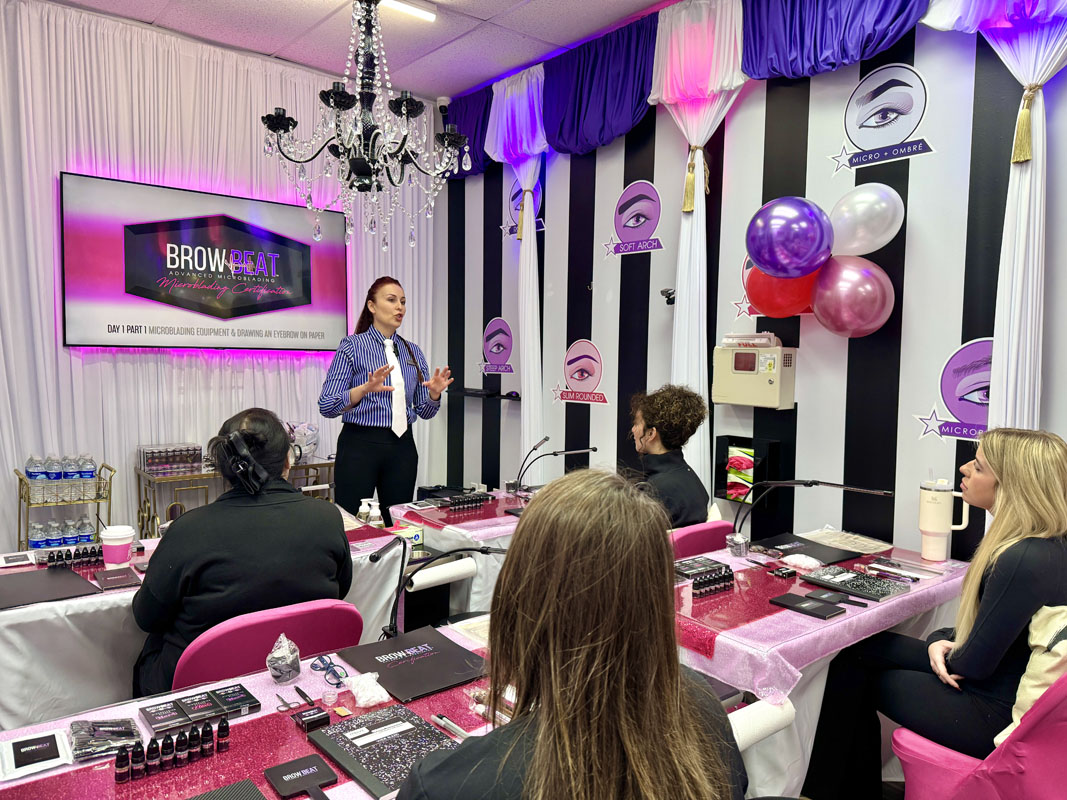
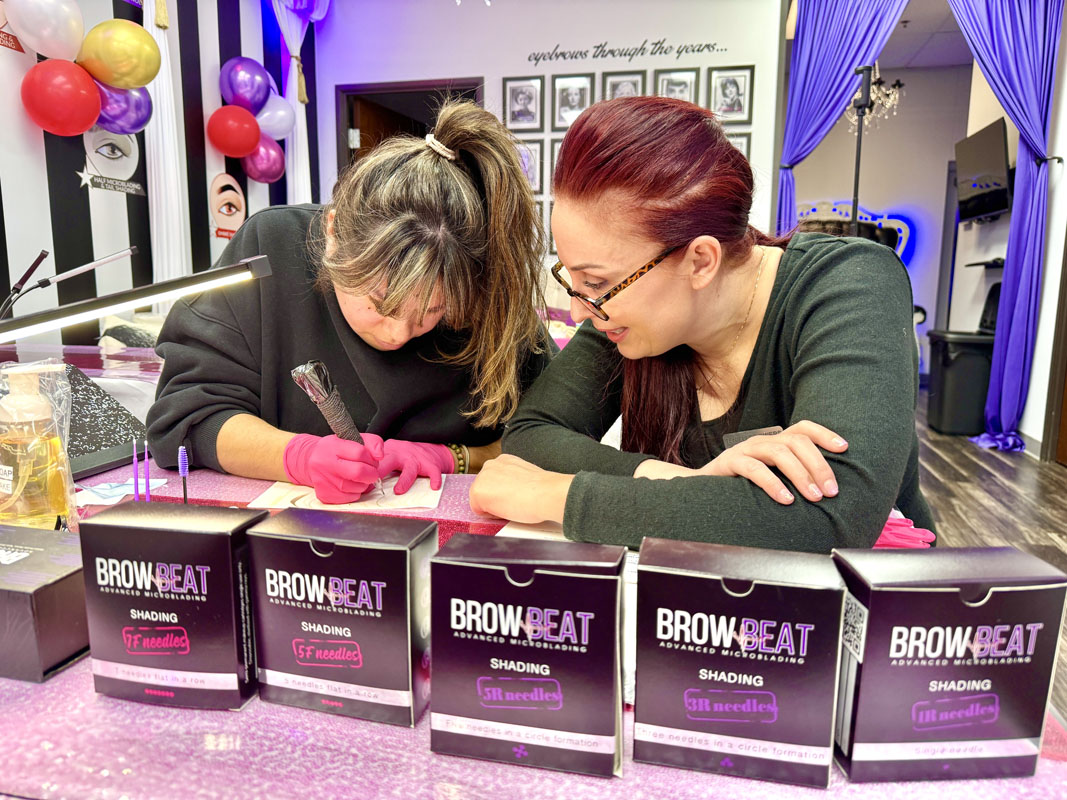
Certification courses are taught in a professional classroom environment designed to support focused learning, discussion, and instructor-led guidance. This setting allows students to engage with course material in a structured, in-person format while learning alongside others pursuing permanent makeup certification.
STRUCTURED
Training Steps
Training follows a clear, progressive structure so students understand how concepts build throughout certification coursework. Lessons are organized to introduce foundational topics first, followed by more advanced applications as students move through the program.

In-person
Guidance
Individual guidance is incorporated throughout training, giving students opportunities to ask questions, receive clarification, and refine their understanding during the learning process. This approach supports confidence and comprehension within cosmetic tattoo education.
practical
Lessons
Courses balance theoretical instruction with practical learning, helping students understand not only how techniques are performed, but why they are applied. This balance supports informed decision-making and a deeper understanding of permanent makeup principles.


Step-by-step
Systems
Certification programs include structured support documents and step-by-step systems that guide students through workflows used during training. These materials help reinforce consistency and organization throughout the learning process.
treatment room
Simulations
Simulation exercises introduce students to treatment room workflows used in professional PMU environments. These structured exercises help students understand process flow, setup, and procedural consistency within a controlled learning setting.

microblading,
Certification
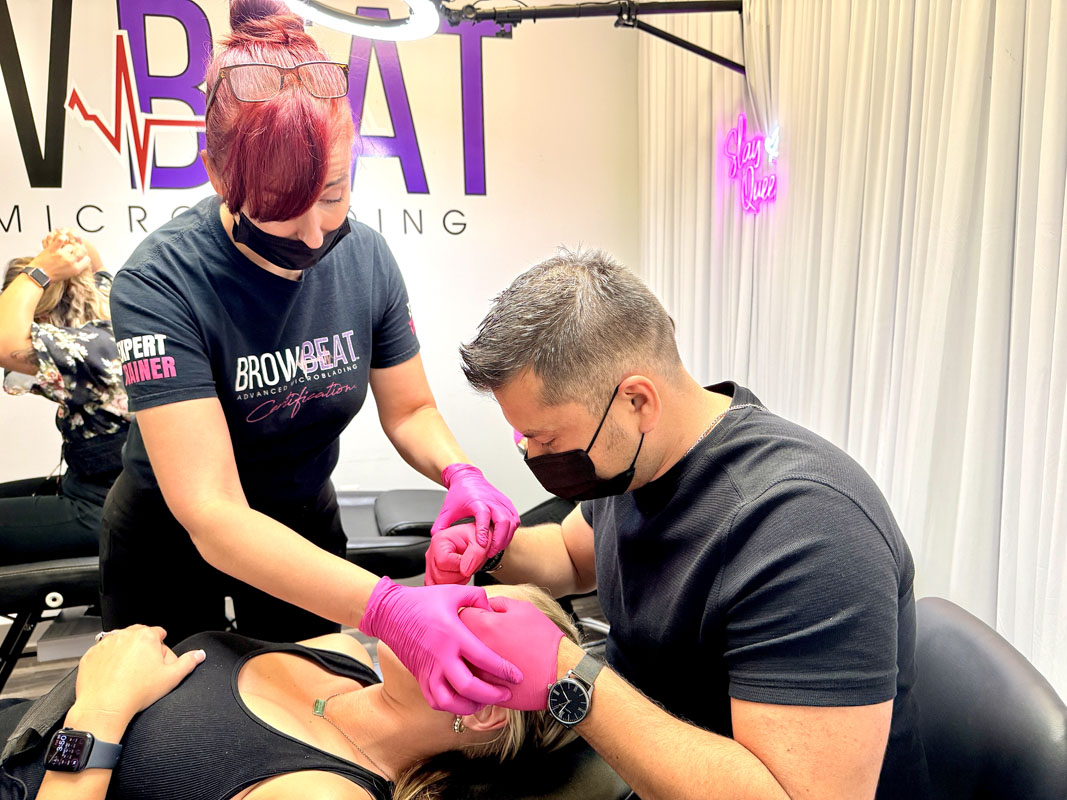
Brow certification programs may include multiple skill areas taught within a unified training framework. This approach supports well-rounded semi-permanent makeup education while maintaining structured instruction across brow techniques.
lip blushing
Certification
Lip training includes both lip blushing and dark lip equalization, teaching controlled color application and corrective color balancing as part of a comprehensive permanent makeup certification program.

correction
Certification
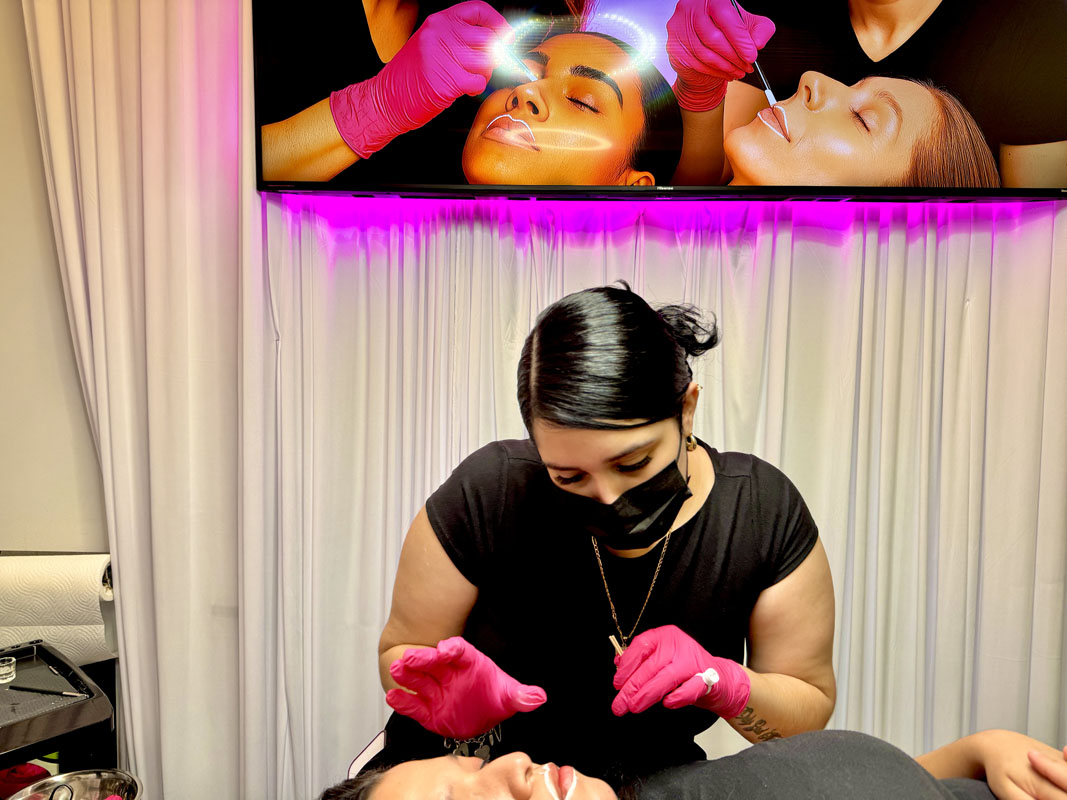
Correction training introduces foundational approaches to working with existing pigment, helping students understand microblading and tattoo correction concepts within certification education.
microblading
Before & After
Microblading before-and-after photos give prospective permanent makeup students a clear look at the precision involved in creating individual brow strokes. The finished work shows how carefully placed strokes add definition, structure, and the appearance of brow hair while maintaining an overall balanced shape.
At BrowBeat Certification in Dallas, Microblading is part of the broader world of professional PMU education students are introduced to as they explore permanent makeup training. Seeing actual examples of completed work helps connect classroom learning with the level of detail professional artists work toward. It also gives students a visual reference for understanding why control, placement, symmetry, and technique matter when developing permanent makeup skills.


combo brow
Results
Combo Brows bring two visual elements together in one finished technique: hair-stroke detail and machine shading. This before-and-after gives students a clear example of how those elements can work together to create both definition and dimension within the brow.
For students exploring professional permanent makeup training at BrowBeat Certification, seeing Combo Brow work helps clarify the difference between learning several separate brow techniques and combining strokes and shading within one finished brow.
Our Dallas PMU education gives students exposure to the broader permanent makeup field while specialty training goes deeper into individual techniques. Real before-and-after work provides useful visual context for understanding how professional brow artistry can vary.
powder brows
Before & After
Ombré Powder Brows demonstrate how machine shading can be used to build a defined brow without relying on individual Microblading strokes. In this before-and-after, the finished brows provide a visual example of the soft-to-defined appearance associated with professional Powder Brow work.
Students exploring PMU training in Texas benefit from seeing the differences between permanent makeup techniques in actual work. At BrowBeat Certification, professional examples complement classroom and hands-on education by helping students recognize the visual characteristics associated with different PMU specialties. The goal isn’t simply to know the names of the techniques, but to begin understanding how professional execution produces distinctly different results.


pmu machine
Work
Lip Blushing expands permanent makeup education beyond the brows. This before-and-after gives students a visual example of professional lip work and how permanent makeup can enhance the appearance of lip color and definition.
At BrowBeat Certification in Dallas, students exploring professional PMU training can see examples from multiple specialties rather than viewing permanent makeup as a single technique. Lip Blushing involves its own specialized education and application skills, but seeing professional work helps establish the broader scope of the industry. It also allows prospective students to visualize the different directions permanent makeup education can take as they develop their skills and professional interests.
dark lip
Neutralization
Dark Lip Equalization is a specialized area of permanent makeup that addresses uneven or darker natural lip pigmentation. This before-and-after gives students a visual example of the type of lip pigmentation concerns a PMU artist may encounter.
At BrowBeat Certification, exposure to specialized professional work helps students understand that permanent makeup education extends beyond standard brow and lip applications. Dark Lip Equalization requires its own assessment and technical knowledge, so it should be understood as a distinct specialty rather than simply another Lip Blushing result. Students researching professional PMU training in Dallas can use examples like this to appreciate the breadth of advanced permanent makeup artistry.


training
In Texas
Correction work introduces students to an entirely different challenge within professional PMU: the client may already have previous permanent makeup present. This before-and-after gives students a visual example of work involving an existing PMU result rather than a completely new application.
At BrowBeat Certification in Dallas, students can see examples from across the permanent makeup field as they develop their professional understanding. Correction is a specialized area with its own assessment and technical considerations, but seeing real examples helps students understand why previous work changes the situation an artist is approaching. It also reinforces the importance of developing strong foundational PMU knowledge before moving into more complex specialty work.
correction
Certification
This before-and-after demonstrates why PMU correction deserves to be recognized as a specialized area of permanent makeup. Existing work changes what an artist must assess and consider before determining an appropriate approach.
BrowBeat Certification provides professional permanent makeup training in Texas that gives students exposure to the breadth of PMU artistry. Correction examples allow students to see that permanent makeup professionals may encounter clients with previous work as well as clients receiving new procedures. That visual context helps aspiring artists appreciate the importance of professional education, careful assessment, and continued skill development throughout a PMU career.

Combo and Hybrid Brow Training
Combo Brows, also called Hybrid Brows and sometimes described as 3D Brows, combine hair strokes and shading in one finished brow technique. The important word is combine.
The artist is not simply placing one technique beside another. Hair strokes contribute one visual element and shading contributes another. The skill lies in making those components work together so the finished brow looks intentional. This is why Combo brow education deserves its own training focus.
A student may know how to create strokes and understand machine shading independently, but integrating the two creates another set of design and execution decisions. Students searching for Microblading with shading, hair strokes with shading, Hybrid Brow training or 3D Brow education are therefore looking for Combo technique.
3-in-1 Brow Certification
The 3-in-1 Brow Certification teaches three separate brow techniques: Microblading + Ombré/Powder Brows + Combo/Hybrid Brows.
This distinction prevents one of the easiest points of confusion in brow education. 3D Brows refer to Combo/Hybrid Brows. The 3-in-1 Brow Certification teaches three brow techniques.
Students in the 3-in-1 course develop an understanding of manual hair-stroke work through Microblading, machine shading through Ombré/Powder Brows and the integration of strokes and shading through Combo/Hybrid Brows. The benefit is broader brow education rather than simply learning several names for similar work.
Students can begin understanding why different techniques exist, what each is designed to accomplish and how the technical demands change from one method to another.
Shared brow pigment and color education also fits naturally within this broader course. Students need to understand how pigment selection relates to the work they are creating, how skin characteristics influence color decisions and how color choices support different brow techniques.
This is not presented as a separate pigment certification. Pigment and color education supports the brow techniques being learned. The dedicated 3-in-1 Brow Certification information explores Microblading, Powder/Ombré, Combo/Hybrid and the shared brow curriculum in much greater depth.
Lip Blushing Training
Lip Blushing Certification moves permanent makeup education beyond eyebrows and into a different treatment area. The artist is now working with the lips, where design, mapping, border and Cupid’s bow planning, color selection and machine application require lip-specific knowledge.
Students should not assume that learning a brow technique automatically prepares them to perform Lip Blushing. The treatment area is different. The design decisions are different. The mapping is different. The technical application has its own considerations.
Lip Blushing therefore deserves to be learned as its own PMU discipline. Color education also needs to remain specific to the work being performed.
Choosing a desired color for ordinary Lip Blush work is different from developing a corrective color strategy for dark or melanin-rich lips. Dark Lip Neutralization has its own reasoning and should not be treated as simply another name for standard Lip Blush color selection.
The dedicated Lip Blushing training information separates those subjects so students can understand the differences clearly.
PMU Correction Training
PMU Correction begins from a completely different starting point: previous permanent makeup is already present.
The artist is no longer approaching new work without existing pigment influencing the decision. Aged PMU may have an unwanted color, inconsistent coverage, dark previous work, saturation or other characteristics that need to be evaluated before anything new is added. That makes Correction an advanced subject.
BrowBeat Certification’s PMU Correction education is not positioned as foundational training for someone who has never learned permanent makeup. An experienced artist needs to assess the existing work before deciding whether direct correction is appropriate.
When corrective color work is suitable, the reasoning begins with what is actually visible: assess the color that is present, identify what color is missing and determine the corrective color or approach that makes sense for the case. Not every previous result should automatically be worked over. That judgment is part of advanced PMU education.
Correction is also not removal. Correcting existing pigment does not mean removing or lightening it. Some previous work may not be suitable for direct correction, particularly when the existing pigment creates limitations that cannot responsibly be solved by simply adding more.
The dedicated PMU Correction training information explores case assessment, corrective color reasoning and execution in greater depth while keeping the boundary between correction and removal clear.
Which Permanent Makeup Course Fits What You Want to Learn?
Choosing the right permanent makeup training course becomes easier when the decision starts with the skill rather than the course name. The useful question is simple: What do you actually want to learn to do?
A student interested in manual hair strokes has a different goal from someone interested in machine shading. Someone wanting a broader brow education has a different objective from an experienced artist learning to work with previous aged PMU. Starting with the skill helps narrow the choices.
If You Want to Create Manual Hair Strokes
Microblading is the clearest match. The defining skill is manually creating and placing hair strokes within a brow design. Students drawn specifically to detailed stroke work can focus on Microblading without treating every brow course as though it teaches the same thing.
If You Want to Learn Machine Shading
Ombré/Powder Brow education focuses on machine-created shading. This is a different technical discipline from manual Microblading and requires students to develop a working relationship with the PMU machine. For someone whose primary interest is a shaded brow result, this is the more relevant subject to explore.
If You Want Hair Strokes and Shading in One Finished Brow
That is Combo/Hybrid Brow training. Combo specifically teaches the integration of hair strokes and shading as one finished technique. It is not shorthand for learning several different brow techniques.
If You Want to Learn All Three Core Brow Techniques
The 3-in-1 Brow Certification is designed for broader brow education. Students study Microblading, Ombré/Powder Brows and Combo/Hybrid Brows as three distinct techniques within the same course.
For someone who is unsure which brow technique they ultimately want to emphasize, understanding all three can also provide a much clearer picture of how the techniques differ.

If You Want to Expand Into Lip Services
Lip Blushing is the relevant area of PMU education. Students interested in lips need training built specifically around lip procedures rather than trying to transfer brow processes onto a different treatment area.
If You Already Have PMU Experience and Want to Work With Previous Healed Work
PMU Correction is the advanced subject. Previous work changes the question. Instead of asking only how to create a new technique, the artist must first determine what already exists, whether it is appropriate for direct correction and what should happen next.
That assessment requires an existing PMU foundation. Choosing a course can involve other considerations as well, including training format, teaching approach, practical exercises and the student’s current experience. Those broader comparison questions belong in the dedicated guide to choosing the right permanent makeup course.
How Permanent Makeup Skills Are Built
Permanent makeup can look deceptively simple when an experienced artist performs it. The movements appear controlled. The artist knows where to sit, where to place the hands, what to look for and what to do next. Decisions that once required concentration may happen quickly after years of repetition.
A beginner does not have that familiarity yet, and they should not expect to. Learning PMU means asking the brain, eyes and hands to coordinate in new ways while the student is also absorbing terminology, design principles, technical processes and visual information. That can feel uncomfortable at first, but the discomfort is not necessarily a sign that someone lacks ability. Very often, it is simply the point where learning has moved beyond understanding something intellectually and into actually developing the skill.
Drive Matters More Than Getting Everything Right Immediately
Natural artistic ability can be helpful in permanent makeup. Some students arrive with strong hand-eye coordination. Some recognize shape and balance quickly. Others have previous experience in beauty or another field that makes certain parts of the learning process feel familiar.
Those advantages can help, but they do not guarantee long-term progress. The students who continue developing are often the ones willing to work through the details when something does not come easily. They can look at an imperfect attempt without deciding the entire exercise was a failure. They are willing to ask what went wrong, listen to an explanation, make an adjustment and try again.
That attitude matters because adversity does not disappear after training. There will eventually be procedures that require more thought than expected, clients who communicate differently, results that teach the artist something and situations where an established process requires careful assessment rather than automatic execution. Students who learn how to respond constructively to difficulty are developing something valuable alongside the technical skill itself.
Learning Starts Before the Tool Does
There is a reason to separate understanding from execution. If a student is trying to learn placement, sequence, tool control, body positioning and the finished design all at the same time, there are too many new variables competing for attention.
Paper exercises allow students to concentrate first on the concept. What belongs here? What belongs there? How does one element relate to the next? What is the intended structure? What should the student be looking for?
Once the student understands the idea, another layer can be added. Silicone practice introduces physical execution. Now hand-eye coordination matters. The student has to control the appropriate tool, repeat the movement and begin connecting what the brain understands with what the hand can actually produce.
That progression makes the learning process more manageable. Instead of asking a beginner to perform an entire treatment immediately, individual skills can be developed and then brought together.
Practice Becomes More Realistic as Skills Develop
A flat practice surface is useful, but it cannot reproduce every practical consideration involved in working around a person. Mannequin-head practice and eyebrow- or lip-shaped silicone headbands make the setup more realistic.
The treatment area is now on a curved surface, and that changes things. Students have to think about where the chair would be, where the client’s face would be, how their own body is positioned and whether they need to move around the treatment area rather than twisting their hand or body into an awkward position.
Ergonomics become part of the exercise. The student begins learning that PMU technique is not performed by a hand floating independently in space. The artist’s chair, posture, position, viewing angle and ability to move around the client all affect how comfortably and consistently the work can be performed.
Partner mapping adds another practical layer. Students can look at a real face, assess features, work through placement and design, and experience the communication involved in mapping another person. The partner is breathing, talking and moving. Facial features are individual rather than printed or molded into a standardized practice surface.
That gives students valuable experience with assessment and design without turning the exercise into a live permanent makeup procedure.

Why BrowBeat Certification Does Not Rush Students Onto Live Skin
Live-model work can sound impressive when it appears in a course description. That does not automatically make it the strongest way to teach a beginner.
BrowBeat Certification does not use live-model procedures simply to make training appear more advanced or more hands-on. A beginning student is still developing hand-eye coordination. They are learning how the tool behaves, how to position themselves, what the movement should feel like and how the individual steps fit together.
There is a significant difference between understanding a demonstration and having enough physical control to reproduce it consistently. Practice surfaces give students room to discover that difference safely. A movement can be repeated, a mistake can be examined, the instructor can identify what needs to change, and the student can adjust and try again.
Those repetitions have educational value precisely because the student is still learning. BrowBeat Certification places greater value on building the student’s foundation before independent work on live skin than on being able to say a beginner performed a live procedure during class.
The goal is not to touch live skin as quickly as possible. The goal is to develop enough understanding, coordination and control that future work has a stronger foundation underneath it.
Step-by-Step Formulas Give Beginners Something to Rely On
Experienced artists can make complicated procedures look intuitive. They have seen similar situations before, recognize patterns quickly and know which details deserve attention. A beginner does not yet have that library of experience.
A clear formula helps fill the gap. Instead of asking the student to rely on instinct they have not had time to develop, the process can be broken into steps. What comes first? What needs to be assessed before moving forward? What information affects the next decision? What should the student check? When should an adjustment be made?
A repeatable process reduces guesswork. As students practice, the formula becomes more familiar. Eventually, they no longer have to consciously retrieve every individual step because the pieces begin connecting. That is how a process that initially feels complicated starts becoming manageable.
The Learning Curve in Permanent Makeup Is Real
Permanent makeup education can teach the foundation of a professional skill in a much shorter period than many traditional educational routes. That does not mean expertise appears as soon as the course ends.
A student can understand a technique and still need substantial practice before performing it with the ease of an experienced artist. Training teaches the foundation, practice develops control, and experience adds judgment. The learning curve is the space between first understanding a skill and becoming consistently comfortable using it.
Students are better served when that learning curve is acknowledged rather than hidden behind promises of instant confidence.
Natural Talent Helps, but Persistence Changes What Happens Next
Some students pick up a new movement quickly. Others need to repeat it many times. The student who learns fastest on the first day is not automatically the person who will develop furthest.
Progress depends on what happens after the first attempt. A student who is willing to notice small differences, accept correction and repeat an exercise has a mechanism for improvement. A student who expects immediate perfection may find the same learning process much more frustrating.
PMU requires attention to detail. The ability to stay engaged with those details is often more useful than expecting everything to feel natural from the beginning.
Constructive Feedback Is Part of Learning
Feedback can be uncomfortable because it draws attention to the gap between what someone intended to create and what actually happened. That gap is also where useful information lives.
An instructor may notice a technical habit the student cannot yet see. A practice partner may reveal that an explanation was unclear. Later, models and clients can provide information about communication, comfort, expectations and the overall experience of working with the artist.
A developing professional does not have to treat every opinion as automatically correct, but being willing to listen and ask whether there is something useful in the feedback creates opportunities to improve. Students who can receive constructive criticism without treating it as a personal attack often have more information available to them, and that can shorten the distance between repeating a mistake and understanding how to change it.
Confidence Comes From Repetition
Confidence in permanent makeup is sometimes discussed as though it can be handed to a student along with a certificate. It cannot. Useful confidence is built from familiarity.
The student has performed the movement before. They have followed the process before. They recognize what should happen next and can identify when something does not look right. They have evidence that an unfamiliar skill is becoming more manageable.
Repetition creates that evidence. This is why feeling nervous after completing training does not automatically mean the training failed or the student is incapable. The student has moved from a supported educational environment into the stage where continued practice turns new knowledge into experience.
Practice Before Pressure
After training, developing artists still need opportunities to use what they have learned. Appropriate practice remains important, and when an artist is legally permitted, properly prepared and ready to begin working on people, volunteer models can provide valuable early experience.
A volunteer model may understand that the artist is still developing speed and confidence. That can create a lower-pressure environment than immediately expecting every procedure to carry the expectations associated with an established paying clientele.
The purpose is not to undervalue the work. The purpose is to gain experience. Early procedures teach things that are difficult to learn from theory alone. The artist begins noticing how smoothly the setup went, whether the consultation was clear, whether the working position was comfortable, where hesitation appeared and what should be changed next time.
Over time, setup becomes more familiar. Communication becomes clearer. Movements become more controlled. The artist begins seeing patterns that were invisible during the first few experiences. Confidence grows because experience is accumulating underneath it.
Training and Experience Are Not the Same Thing
A course can provide instruction, structure, demonstrations, exercises, terminology, technical principles and correction from an instructor. Experience develops when the artist continues applying that education.
Both matter. Without a strong educational foundation, a beginner can spend a great deal of time practicing something incorrectly. Without continued practice, even excellent instruction can remain knowledge the student understands but cannot yet execute consistently.
Training gives the student a starting structure. Experience gradually teaches the artist how that structure behaves outside the classroom.
Permanent Makeup Is Also a Relationship Business
Technical ability matters enormously in PMU, but so does the experience surrounding the procedure. Clients are trusting an artist with a cosmetic change that matters to them, and they pay attention to more than the finished technical work.
They notice whether the artist listens, whether expectations are explained clearly, whether questions are welcomed or dismissed, and whether the artist communicates professionally. They notice whether they feel as though their concerns have actually been heard.
Those relationships are built over time. A new artist should not expect to finish training and immediately possess the client base, reputation, speed or confidence of someone who has been working for years.
A PMU business develops through accumulated experiences. Each client teaches the artist something. Each procedure adds practical knowledge. Each thoughtful piece of feedback provides another opportunity to refine the process, and each positive relationship can contribute to the artist’s reputation.
Students Do Not Need to Pretend They Are Experts
There can be pressure in beauty industries to appear completely established immediately after training. A new artist earns a certificate, creates professional social media pages and suddenly feels as though they should sound and perform like someone with years of experience.
That pressure can work against development. Remaining teachable is more useful.
A developing artist should be able to recognize the current level of skill without being embarrassed by the fact that there is more to learn. The useful question is not how to make it look as though everything is already mastered. It is what can be improved next.
That question remains valuable throughout a career. The details simply become more sophisticated as experience grows.
What Does Permanent Makeup Training Include?
Permanent makeup training courses can include very different material depending on the technique and the purpose of the training. A broad PMU curriculum may involve theory, design principles, mapping, tools, pigments, color education, practical exercises, machine education where applicable, treatment setup and technical execution.
That should not be treated as a universal checklist. Course content needs to match the technique.
A Microblading student needs education relevant to manual hair-stroke work. An Ombré/Powder Brow student needs machine-shading education. A Combo student needs to understand the integration of strokes and shading. A Lip Blush student needs lip-specific design, color and machine education. An experienced artist studying PMU Correction needs education built around previous aged work, assessment, corrective decision-making and appropriate machine execution.
The important question is not how many topics can be squeezed into a course description. It is whether the curriculum supports the skill the student came to learn.
Tools, Machines and Practice Materials
Professional tools matter, but equipment alone does not create technique. Owning a PMU machine does not mean someone knows how to control it. Having pigments does not mean someone understands color selection. Having mapping supplies does not mean someone understands design. Practice materials are only useful when the student knows what the exercise is intended to develop.
Education connects the equipment to the skill. For machine-based PMU, students need an understanding of the physical mechanics that influence application. Manual techniques such as Microblading require a different relationship with the tool because the artist is creating strokes manually rather than producing machine shading.

Pigment and Color Education
Color is part of permanent makeup, but the relevant education changes according to the work being performed.
For new brow work, students need to understand pigment characteristics, color selection, skin characteristics and the relationship between the selected pigment and the appearance of the skin. Shared brow pigment and color education belongs within BrowBeat Certification’s 3-in-1 Brow Certification curriculum because those principles support Microblading, Ombré/Powder Brows and Combo/Hybrid Brows.
Lip Blushing has its own color considerations. PMU Correction presents a different problem again because previous pigment is already healed in the skin. The artist is no longer simply selecting a color for new brow work. The existing healed color has to be assessed first.
Corrective reasoning begins with what is present, what color is missing and what corrective color or approach is appropriate. Keeping these areas distinct gives students a clearer understanding of why color decisions change from one PMU situation to another.
For students who want to examine curriculum, tools, machines, needles, pigments, mapping and practical exercises in greater detail, the guide to what’s included in PMU training programs owns that deeper discussion.
Permanent Makeup Training for Beginners
Starting permanent makeup can be exciting because students are learning a skill with a visible result. It can also be humbling. A demonstration may make perfect sense while the student’s first attempt looks very different from what they expected. The brain understands the instruction, but the hand has not yet had enough repetition to reproduce it consistently.
That gap is normal in practical education. Beginners are not expected to arrive already performing like experienced PMU artists. They do, however, need realistic expectations about what learning a precision skill involves.
Can Someone Learn Permanent Makeup With No Experience?
That depends on the particular course. Some permanent makeup education is designed for students who are building foundational skills. Other courses are advanced and require previous PMU experience.
Correction is a clear example. PMU Correction asks an artist to evaluate previous work, make case-selection decisions and solve more complicated problems. It requires an existing permanent makeup foundation and should not be presented as though it were an introductory course for someone who has never worked in PMU.
Students should therefore look at the requirements of the specific training they are considering rather than assuming every permanent makeup class begins at the same level. For education that is appropriate for beginners, previous experience is only one part of the picture. Patience, attention to detail, willingness to practice and the ability to receive instruction all influence how a student approaches the learning process.
The dedicated beginner guide to permanent makeup training explores readiness, first-time training and what students can realistically expect when they are completely new to PMU.
Is Permanent Makeup Hard to Learn?
Permanent makeup is a precision skill, so some parts can feel difficult at first. That should not be confused with being impossible to learn. Much of the initial difficulty comes from coordinating several unfamiliar responsibilities at the same time.
A student may be assessing shape, remembering a sequence, controlling a tool, watching placement, adjusting body position and thinking about the next step all within the same exercise. With practice, individual tasks begin to require less conscious effort.
The student no longer has to think quite as hard about something that once consumed all of their attention. That creates more mental space for the next layer of the skill. Progressive training supports that development by giving students time to become familiar with individual components before expecting everything to happen together.
Do You Need to Be Naturally Artistic?
An artistic eye can certainly be useful in permanent makeup. Shape, proportion, placement and visual balance are part of the work. But natural artistic ability is not a substitute for technical education, and the absence of an art background does not automatically mean someone cannot develop PMU skills.
Some of the qualities that support learning are much less dramatic. A student needs to observe carefully, notice small differences, have enough patience to repeat an exercise and be willing to correct something rather than pretending the mistake is not there. They also need to remain engaged when progress feels slower than they hoped.
A naturally talented student can stop progressing if they resist feedback. A determined student who listens, practices and adjusts can continue improving. That is why drive matters so much in a hands-on industry.
How to Evaluate Permanent Makeup Training
Students often begin by searching for the “best” permanent makeup training or the “best” PMU school. There is no useful answer to that question without context. Best for whom?
A beginner choosing a first course has different needs from an experienced artist seeking advanced Correction education. Someone who wants only Lip Blushing is looking for something different from a student who wants to learn three brow techniques.
The quality of a course should be considered alongside the student’s goals, current experience, the technique being taught and the way the education is delivered. The most expensive course is not automatically the best. The least expensive is not automatically the best value. The longest course is not automatically the most thorough, and a course with the longest list of features is not necessarily the one that provides the clearest education.
A student should be able to understand what is being taught, why the practical exercises support that skill and what the course is actually designed to accomplish.
Look Beyond the Course Name
Permanent makeup education uses many labels: school, academy, course, class, program, institute and training. Those words can describe how a provider presents its education, but they do not tell a student whether the training itself is appropriate.
Look at the substance. What technique is actually being taught? Is the course intended for beginners or experienced artists? Does the description clearly distinguish manual and machine techniques? Does the practical training format make sense? Are course claims specific and realistic? Does the provider accurately distinguish a training certificate from legal licensing? Does the curriculum relate to the skill named in the course?
These questions tell a student much more than whether the provider calls itself a school or an academy. The dedicated guide to choosing the right permanent makeup course takes the comparison process further for students evaluating PMU schools, academies, instructors and training programs.
Understanding Permanent Makeup Certification
Certification is one of the most important words in PMU education to define carefully. Students may encounter terms such as certification, certificate, credential, qualification and license while researching training. Those words should not automatically be treated as interchangeable.
A course can provide education and a certificate associated with completion of that training without that document becoming a government license or universal legal authorization to perform permanent makeup. Understanding the difference helps students evaluate what a training provider is actually promising.
What Does a Permanent Makeup Training Certificate Mean?
A course completion certificate documents completion of the requirements established for that particular training program. Its meaning is connected to the course and the organization issuing it.
Students should understand what they need to complete, what document they receive and what that document represents. They should not assume that a course certificate automatically satisfies every legal or regulatory requirement that may apply where they intend to work. That is a separate question.
Certification and Legal Authorization Are Different Questions
Training answers an educational question: What has the student learned?
Legal and regulatory requirements answer another: What does the person or establishment need in order to perform the work legally in a particular location?
Those questions can interact, but they are not the same. This distinction is particularly important when someone searches for permanent makeup certification in Texas and assumes the word “certification” alone answers the legal question.
The dedicated permanent makeup license and requirements guide explains the Texas licensing and legal requirements.

Permanent Makeup License and Requirements in Texas
Students planning to work professionally in Texas need to think beyond the course itself. Learning how to perform permanent makeup and understanding the legal framework surrounding professional work are both important, but they are different responsibilities.
Texas requirements can involve rules that belong outside the control of a training provider. That is why BrowBeat Certification does not use course marketing language to casually turn a training certificate into a promise of legal authorization.
Students need accurate information. Questions about licensing, establishment requirements, eligibility, health and safety obligations and other legal requirements should be answered using current authoritative Texas sources because regulations can change.
How Much Does Permanent Makeup Training Cost?
Cost is an important part of choosing education, but “PMU training” can describe very different courses. A single-technique class is not necessarily comparable to a broader program teaching multiple techniques. Beginner and advanced education may require different types of instruction. Materials and equipment may differ. The training format may differ. Instructor access and practical exercises may differ.
Those differences affect what a student is actually comparing. A useful question is therefore not simply, “Which course has the lowest price?” It is, “What education does this price represent?”
A lower price is not automatically better value if the course does not address the student’s goal. A higher price is not proof of better education either. Price needs context.
Students researching permanent makeup training cost, PMU course prices, school pricing or certification cost can use the dedicated Permanent Makeup Training Cost & School Pricing guide for the deeper discussion. That keeps price intent in the place where it belongs without allowing every course page to become another pricing page.
Can Permanent Makeup Become a Career?
For some students, permanent makeup training is about adding a skill to work they already do. For others, it represents the beginning of an entirely new professional direction. Both are legitimate reasons to learn.
What matters is keeping expectations realistic. Completing training does not instantly create a full client calendar, years of technical experience or an established reputation. Training provides education. What an artist builds from that education develops over time.
Skill Comes Before Speed
Experienced PMU artists can make procedures look effortless. Their movements may be efficient, their setup is familiar and they recognize common situations quickly. A beginner sees the finished version of a skill that may have taken years to refine.
Comparing a new artist’s first months with someone else’s tenth year is not particularly useful. Speed is not the first objective. Control, understanding and consistency matter more.
As the process becomes familiar, efficiency can improve naturally. Trying to become fast before becoming controlled simply introduces another source of pressure into a skill that is still developing.
Professional Relationships Take Time
A PMU business is built person by person. Clients remember the technical result, but they also remember the experience. Was the consultation clear? Did the artist listen? Were expectations explained honestly? Did the client feel comfortable asking questions? Did the artist communicate professionally?
Trust develops through these interactions. Over time, positive experiences can contribute to referrals, reviews, repeat relationships where appropriate and a stronger professional reputation.
That growth cannot be manufactured by receiving a certificate. It comes from doing the work well and treating people well, repeatedly.
Early Experience Has Value
After appropriate training, and once an artist is properly prepared and legally able to perform the procedure, early model or volunteer work can provide valuable experience. The expectations of a volunteer model may be different from those of an established paying client, which can give a developing artist room to concentrate on the process while still building real-world experience.
The value is not simply completing another procedure. The value comes from noticing what happened. Was the setup efficient? Was the consultation easy to explain? Did the artist feel comfortable with positioning? Which part of the process caused hesitation? What feedback did the model provide? What should be improved before the next appointment?
This is how experience becomes useful. The artist is not merely accumulating procedures; they are learning from them.
A Career Is Built Through Continued Improvement
Artists who remain observant keep finding opportunities to improve. They notice patterns, recognize weak areas, ask better questions, become more efficient and communicate more clearly. Their judgment becomes more developed.
The questions also change as experience grows. A beginner may ask how to perform a movement. An experienced artist may ask why a particular situation behaved differently from what they expected. That evolution is part of professional development.
Students considering PMU primarily as a career can explore the dedicated Permanent Makeup Career Guide for a deeper discussion of professional development, opportunities, earnings questions and building experience.
Why Learning More Than One Brow Technique Can Matter
No single brow technique is the answer to every artistic goal. Microblading, Powder/Ombré Brows and Combo/Hybrid Brows all create permanent makeup brows, but they do so differently.
Learning more than one method can therefore give an artist more than a longer list of services. It can create a broader understanding of brow work.
Manual and Machine Skills Develop Different Abilities
Microblading develops manual hair-stroke skills. Powder/Ombré Brows develop machine-shading skills. These are different physical disciplines.
An artist who studies both begins to understand how the methods differ in execution as well as appearance. Combo Brows introduce another challenge: integrating strokes and shading into one finished design.
That is why the 3-in-1 Brow Certification and Combo training must remain distinct. Combo teaches one combined technique. The 3-in-1 course teaches three techniques.
Learning Three Brow Techniques Creates More Range
A student studying Microblading, Powder/Ombré Brows and Combo/Hybrid Brows gains exposure to three different approaches to brow work. One is built around manual hair strokes, one is built around machine shading, and one intentionally combines strokes and shading.
Understanding all three can help students see why technique selection matters rather than assuming every desired brow should be approached in exactly the same way.
The 3-in-1 Brow Certification goes deeper into how the techniques are taught together and how shared brow pigment and color education supports that broader training.

Why Advanced PMU Education Matters
Initial training gives an artist a foundation. Experience creates new questions. Early questions are often about execution: How do I make this movement? Where should this go? What happens next?
Later questions become more complex. Why did this heal differently? Is this case appropriate for the technique? What is creating the problem I can see? Should I proceed? What needs to change? What should be left alone?
Advanced education exists because professional development does not end when a foundational course is completed.
Previous PMU Changes the Starting Point
New work and corrective work do not begin with the same question. With new work, the artist is making design and technique decisions for what they intend to create. With previous healed PMU, the artist first needs to assess what is already present.
Existing color matters. Coverage matters. Saturation matters. Placement matters. The overall suitability of the case matters.
Some previous work may be appropriate for direct correction. Some may not. Being able to recognize the difference is part of advanced judgment.
Correction Is Not Removal
This boundary needs to remain clear. Corrective pigment does not erase existing pigment.
If previous work is too dark, heavily saturated or otherwise unsuitable for direct correction, simply placing additional pigment over it may not solve the problem. Removal or lightening is a separate subject.
PMU Correction education should therefore develop assessment and judgment alongside corrective execution. Sometimes the most professional decision is recognizing that direct correction is not the appropriate next step.
Permanent Makeup Training in Dallas, Texas
For students searching for permanent makeup training in Dallas, location is naturally part of the decision. Being able to attend training in the Dallas area can make education more accessible, but proximity alone does not tell a student whether a course is right for them. The training still needs to match the skill they want to learn.
BrowBeat Certification provides permanent makeup education in the Dallas, Texas area across brow, lip, multi-technique and advanced PMU subjects. Someone searching for permanent makeup classes, PMU courses, a permanent makeup school, PMU training near them, cosmetic tattoo education or professional permanent makeup training may use different language while looking for essentially the same thing: serious education that teaches the skill they want to develop.
That is why the course itself should remain the focus. Students interested in manual brow strokes can explore Microblading. Students interested in machine shading can explore Ombré/Powder Brows. Those wanting to integrate hair strokes and shading can explore Combo/Hybrid Brows. Students who want to learn Microblading, Powder/Ombré and Combo/Hybrid as three techniques can explore the 3-in-1 Brow Certification. Students interested in permanent lip color can explore Lip Blushing, while experienced artists interested in previous aged PMU can explore advanced Correction education.
Clear distinctions make it easier to choose training for the right reason.
Explore Your Permanent Makeup Training Options
Students do not need to answer every question about the PMU industry before deciding what to investigate next. Start with the question that matters now.
If the question is how PMU education is structured and what the training experience is like, the guide to how semi-permanent makeup training works takes that subject further.
If the question is how to compare permanent makeup schools, courses, academies or training providers, the guide to choosing the right permanent makeup course explains what to consider.
If the question is whether permanent makeup can be learned without previous experience, the beginner guide focuses on readiness, first-time training and the learning curve.
If the question is what permanent makeup certification means, the certification guide explains the process and distinguishes course completion, certificates and other credential terminology.
If the question is what students actually learn, the PMU curriculum guide explores course content, tools, machines, needles, pigments, mapping and practical exercises.
If the question involves Texas licensing, legal requirements or eligibility, the Texas permanent makeup requirements guide is the appropriate place for current regulatory information.
If the question is how much PMU education costs, the permanent makeup training cost and school pricing guide addresses that subject directly.
If the question is whether permanent makeup can become a career, the career guide explores professional development, earnings questions, opportunities and the realities of building experience.
If the goal is learning Microblading, Powder/Ombré Brows and Combo/Hybrid Brows together, the 3-in-1 Brow Certification explains the complete multi-technique brow course.
Permanent Makeup Education Should Give Students Something to Build On
A good permanent makeup course should accomplish more than creating an exciting classroom experience. Students need something they can continue using after class.
During training, an instructor is present. Exercises have been selected. The learning environment has been prepared, and questions can be answered as they arise. Independent work is different. The instructor is no longer standing beside the treatment chair.
That is when a student needs more than a memory of what the demonstration looked like. They need a process they understand, a way to recognize when something is not going according to plan and enough understanding to stop, assess and make a reasoned decision instead of simply continuing because the next step was written on a worksheet.
That is why progressive exercises, formulas and repeated fundamentals have value beyond the classroom. They give students something to return to.
Understanding Why Makes a Process Easier to Use
Memorizing a sequence can help a beginner get started. Understanding the reasoning behind the sequence makes that knowledge more useful.
If a student remembers only that one step follows another, the process can become fragile when a situation changes. When the student understands why a step exists, there is more information available for making a decision.
Why is this placed here? What is this step intended to accomplish? Why does the artist need to change position? Why is one technique appropriate in this situation and another one different? Why is a particular color being considered? Why might an experienced artist decide not to proceed?
These are the questions that begin turning information into judgment.

Good Training Cannot Remove Every Future Challenge
No permanent makeup course can show a student every client, every facial structure, every healed result, every personality, every business situation or every technical problem they may encounter. A course that promises to eliminate every future difficulty would be setting an unrealistic expectation.
A stronger goal is to give students a foundation that helps them approach unfamiliar situations thoughtfully. They learn when a familiar process applies, begin recognizing when something falls outside that process and learn when more information is needed.
As they become more experienced, students also learn that deciding not to proceed can sometimes be as professional as knowing how to perform the procedure.
PMU Training Is an Investment in a Skill, Not Only a Certificate
Receiving a certificate can be an important milestone. The lasting value of education, however, is the skill the student carries away.
Can the student understand the process? Can they reproduce the fundamentals? Can they recognize errors? Can they continue practicing productively? Can they communicate professionally? Can they make increasingly informed decisions as experience develops?
Those abilities matter after the course itself is over. This is why students comparing permanent makeup classes should look beyond a long list of features or an impressive course name. The useful question is what those features are teaching the student to do.
A kit can contain tools, but a curriculum gives those tools context. An instructor can demonstrate a technique, while practice helps the student begin developing it. A certificate can document completion, but experience determines what the artist continues building afterward.
A Permanent Makeup School Should Make Complicated Things Understandable
PMU contains plenty of technical language. Machines, needles, pigments, mapping, color, depth, pressure, movement, patterns, saturation, healing, design and correction can make the industry sound intimidating to someone encountering the terminology for the first time.
Good instruction should make those subjects clearer as the student learns more. Technical accuracy does not require confusing teaching. An instructor who understands a complicated subject should be able to break it into manageable pieces, explain why the pieces matter and show the student how they connect.
Students should leave education with greater clarity than they had when they arrived. That is the difference between simply receiving information and beginning to understand a professional skill.
From the First Exercise to Professional Development
An early paper exercise can seem very far removed from eventually performing professional PMU. That is intentional. Foundational exercises isolate details so the student can concentrate on them.
The purpose of an early exercise is not always to create an impressive finished result. Sometimes the purpose is simply to develop control.
As training progresses, individual pieces begin connecting. Placement supports design. Design connects with mapping. Tool control supports execution. Execution becomes more consistent through repetition. Color education informs pigment decisions. Technical decisions influence the finished work. Communication affects the client’s experience, and experience gradually brings those pieces together.
That is how an exercise becomes part of a larger skill. The first attempt does not need to look like the hundredth. It needs to teach the student something useful enough to make the next attempt better.
Choose the Permanent Makeup Training That Fits Your Goals
Permanent makeup is broad enough that students do not need to choose training blindly. Someone interested in manual hair strokes has a clear place to begin with Microblading. Someone interested in machine shading can explore Ombré/Powder Brows. Students who want hair strokes and shading together can study Combo/Hybrid Brows, while those wanting a broader brow education can learn Microblading, Powder/Ombré and Combo/Hybrid through the 3-in-1 Brow Certification.
Students interested in permanent lip color can explore Lip Blushing. Experienced PMU artists interested in previous aged work can explore advanced Correction education. Students who are still deciding can use BrowBeat Certification’s broader guides to understand beginner training, course selection, certification, curriculum, Texas requirements, PMU training costs and career questions before choosing what to learn.
There is no advantage in pretending every student begins in the same place or needs the same course. The useful question is much simpler: What skill makes sense to learn next?
BrowBeat Certification provides permanent makeup training in Dallas, Texas with education built around clearly defined techniques, progressive skill development, practical learning and processes students can continue using after training ends.
Finishing a class is an important milestone. Building a skill is what gives the education lasting value.
Frequently Asked Questions About Permanent Makeup Training
What is permanent makeup training?
Permanent makeup training teaches the knowledge and practical skills associated with cosmetic tattoo procedures. The exact education depends on the course and technique being studied. Training may involve design principles, technical execution, tools, machine education where applicable, pigment and color concepts, mapping, practical exercises, treatment setup and professional processes.
What does PMU stand for?
PMU stands for permanent makeup. The abbreviation is commonly used when discussing permanent makeup artists, training, equipment, courses and procedures. Permanent cosmetics, cosmetic tattooing, micropigmentation and semi-permanent makeup are other terms students may encounter while researching the field.
Is permanent makeup the same as cosmetic tattooing?
Permanent makeup falls within cosmetic tattooing because pigment is implanted for a cosmetic purpose. The terminology helps distinguish PMU procedures from conventional body tattooing and from traditional cosmetics applied to the surface of the skin.
What permanent makeup techniques can students learn at BrowBeat Certification?
BrowBeat Certification offers training across Microblading, Ombré/Powder Brows, Combo/Hybrid Brows, the 3-in-1 Brow Certification, Lip Blushing and advanced PMU Correction education.
The techniques have different purposes. Microblading uses manual hair strokes. Powder/Ombré Brows use machine shading. Combo/Hybrid Brows integrate strokes and shading into one finished technique. The 3-in-1 Brow Certification teaches those three brow methods within one broader course. Lip Blushing introduces permanent lip color, while PMU Correction is advanced education involving previous aged permanent makeup.
How do I know which PMU course is right for me?
Begin with the skill you want to learn and your current level of experience. Students interested in manual hair strokes can explore Microblading. Those interested in machine shading can explore Powder/Ombré Brows. Students who want to combine strokes and shading can look at Combo/Hybrid Brows, while those wanting broader brow education can explore the 3-in-1 Brow Certification.
Lip Blushing is for students interested in permanent lip work. PMU Correction is an advanced subject for artists with an existing PMU foundation.
Is permanent makeup difficult to learn?
Permanent makeup requires precision, coordination, observation and practice, so beginners should expect parts of the learning process to feel challenging. A structured progression can make that learning curve more manageable.
Students can first understand concepts, then practice movements and gradually bring individual skills together in more realistic working situations. Something feeling difficult on the first attempt does not automatically mean the student lacks ability. It often means the skill is genuinely new.
Do you need artistic talent to become good at permanent makeup?
Artistic ability can be helpful, particularly when working with shape, placement and visual balance, but it is not the only quality involved in developing PMU skills. Technical control, patience, observation, consistency, practice and willingness to receive constructive feedback all matter.
What should students expect from hands-on PMU training?
Hands-on permanent makeup education should allow students to apply what they are learning rather than relying only on theory.
At BrowBeat Certification, practical learning can include paper exercises, silicone practice, hands-on exercises, mannequin-head practice, eyebrow- or lip-shaped silicone headbands where appropriate and partner mapping where it applies to the course.
The specific exercises depend on the technique being taught. The purpose is to build understanding and practical control progressively rather than expecting a beginner to perform every part of a procedure immediately.
Does BrowBeat Certification use live models during training?
No. BrowBeat Certification does not build classroom training around students performing PMU procedures on live models.
Instead, training uses a progression designed to develop understanding, hand-eye coordination, practical control and realistic treatment positioning before students independently work on live skin. Depending on the course, practice can include paper, silicone, mannequin heads, eyebrow- or lip-shaped silicone headbands, hands-on exercises and partner mapping.
Why doesn't BrowBeat Certification put students directly onto live skin?
A beginner needs time to develop physical control as well as intellectual understanding. Practice materials allow students to repeat movements, identify errors, receive feedback and make adjustments while they are still developing hand-eye coordination.
Mannequin and silicone headband practice can also introduce realistic positioning and curved working surfaces without using another person’s skin as the student’s first opportunity to work through those fundamentals.
BrowBeat Certification’s priority is building a stronger foundation before independent live-skin work rather than using a live-model procedure simply as a course feature.
What is the difference between Microblading and Powder Brows?
Microblading is a manual hair-stroke technique. Powder/Ombré Brows use a PMU machine to create shading.
Because the methods are different, students develop different physical skills when learning them. Someone specifically deciding between Microblading and Powder/Ombré training can explore the dedicated technique information for a deeper comparison.
What is the difference between Combo Brows and 3-in-1 Brow Certification?
Combo/Hybrid Brows combine hair strokes and shading into one finished brow technique. The 3-in-1 Brow Certification teaches three separate brow techniques: Microblading, Ombré/Powder Brows and Combo/Hybrid Brows.
They are not interchangeable terms. Within BrowBeat Certification’s training structure, 3D Brow terminology belongs with Combo/Hybrid Brows rather than the 3-in-1 course.
Can students learn Microblading, Powder Brows and Combo Brows together?
Yes. BrowBeat Certification’s 3-in-1 Brow Certification is designed around learning Microblading, Ombré/Powder Brows and Combo/Hybrid Brows as three techniques within one broader brow course.
Students interested specifically in learning all three can explore the 3-in-1 course rather than assuming a Combo Brow course teaches three separate techniques.
Does permanent makeup training include pigment and color education?
Color education can be an important part of permanent makeup training, but the relevant concepts depend on the procedure.
Shared brow pigment and color education is part of BrowBeat Certification’s 3-in-1 Brow Certification curriculum and supports learning across Microblading, Powder/Ombré and Combo/Hybrid Brows. Lip Blushing has lip-specific color education.
Correction requires different reasoning because previous pigment is already healed in the skin. The artist assesses the existing color, identifies what color is missing and determines an appropriate corrective color or approach.
What is the difference between PMU certification and a state license?
They are not the same thing. A training certificate or certification relates to education and the completion requirements established by a training program.
Licenses, registrations, permits and other legal requirements come from the laws and regulations governing professional work in a particular location. Students should understand what their training provides and separately verify the current legal requirements that apply where they intend to perform permanent makeup.
How much does permanent makeup training cost?
Permanent makeup training prices vary according to the course and what the education includes. Factors can include the technique or number of techniques being taught, training format, materials or equipment, instructor access, practical exercises and curriculum depth.
Students primarily researching price can use the dedicated PMU training cost and school pricing guide for a more detailed discussion.
How long does it take to become confident performing PMU?
There is no responsible universal number of procedures after which every artist becomes confident. Confidence develops through meaningful repetition and experience.
Students who continue practicing, review their work, accept useful feedback and deliberately improve weaker areas give themselves more opportunities to become comfortable with the process. A certificate can mark the completion of training. Practical confidence develops through using what was learned.
Where can I take permanent makeup training in Dallas, Texas?
BrowBeat Certification provides permanent makeup education in the Dallas, Texas area, with training options across brow techniques, Lip Blushing, multi-technique brow education and advanced PMU Correction.
Students can begin by identifying the skill they want to learn and then exploring the course designed around that subject.