ADVANCED POWDER BROW SHADING SKILLS TEXAS
Advanced Powder Brow shading is not about collecting more techniques or using more complicated equipment. At BrowBeat Certification, advanced understanding means knowing why the technique works and how the different parts of machine shading connect.
Students learn the relationship between powder brow techniques and machine setup, body position, movement, machine angle, pixel creation, passes, saturation and the finished result the client actually wants. These principles are built into BrowBeat’s three-day brow certification.
BrowBeat’s philosophy is simple: understanding is doing. A student should not only know what movement to perform. They should begin understanding why they are performing it, what that movement is intended to create and what to evaluate when the result looks different from what they expected.
That deeper understanding gives students a foundation they can continue developing as their machine control and experience grow.
Advanced Powder Brow Shading Begins With Understanding Why
A student can copy an instructor’s hand movement without understanding what makes the movement effective. That may help them reproduce an exercise, but it gives them much less information when something changes.
BrowBeat teaches the reasoning behind the technique. Students learn why machine setup matters, why the direction of movement matters, why the machine is held at a specific angle and why changing the movement changes the shading being produced.
This creates a foundation for problem solving. Instead of responding to every unexpected result by randomly changing something, students can begin considering which part of the technique may have produced the difference. Advanced development begins with that ability to connect cause and effect.
Machine Setup Affects Everything That Comes After It
The physical shading technique cannot be separated completely from the machine that is creating it. The machine, cartridge and needle setting establish the working tool before the artist begins concentrating on Powder Brow shading. If the equipment is not prepared as intended, a student can mistakenly start changing their physical technique to compensate for a setup issue.
BrowBeat Powder Brow Certification therefore teaches students to understand their equipment before expecting them to troubleshoot the finished shading.
The detailed setup, cartridge and machine-control education belongs to the foundational machine lesson. At the advanced level, students begin understanding how that foundation influences everything that follow.

powder
Brows
Explaining the difference between microblading and ombré powder brows allows students to understand how advanced powder brow shading skills differ from stroke-based techniques. This comparison highlights advanced ombre brow techniques while reinforcing professional powder brow shading as a layered visual approach supported by professional shading control methods.
Shading
Is dots
This teaching moment illustrates how advanced brow shading techniques rely on dot-based pigment placement rather than linear strokes. Demonstrating this concept supports advanced powder brow shading skills development while helping students understand how to improve powder brow shading through layering saturation, rather than stroke direction.


uses
Discussion
Discussing advanced machine uses introduces learners to equipment and increases the literacy of how to use them. This curriculum moment highlights how professional powder brow shading depends on machine configuration awareness, reinforcing advanced brow shading techniques that adapt to cartridge type, speed variation, and shading motion.
control
Methods
Demonstrating the combination of wrist action and hand action reveals the biomechanics behind professional shading control methods. Students observe how advanced powder brow shading skills develop through coordinated movement.


90
Degrees
Showing pigment implementation at 90 degrees illustrates advanced ombre brow techniques focused on saturation consistency and gradient formation. This teaching moment reinforces professional powder brow shading principles while helping students understand how to improve powder brow shading through angle awareness and pigment layering.
paper
Exercises
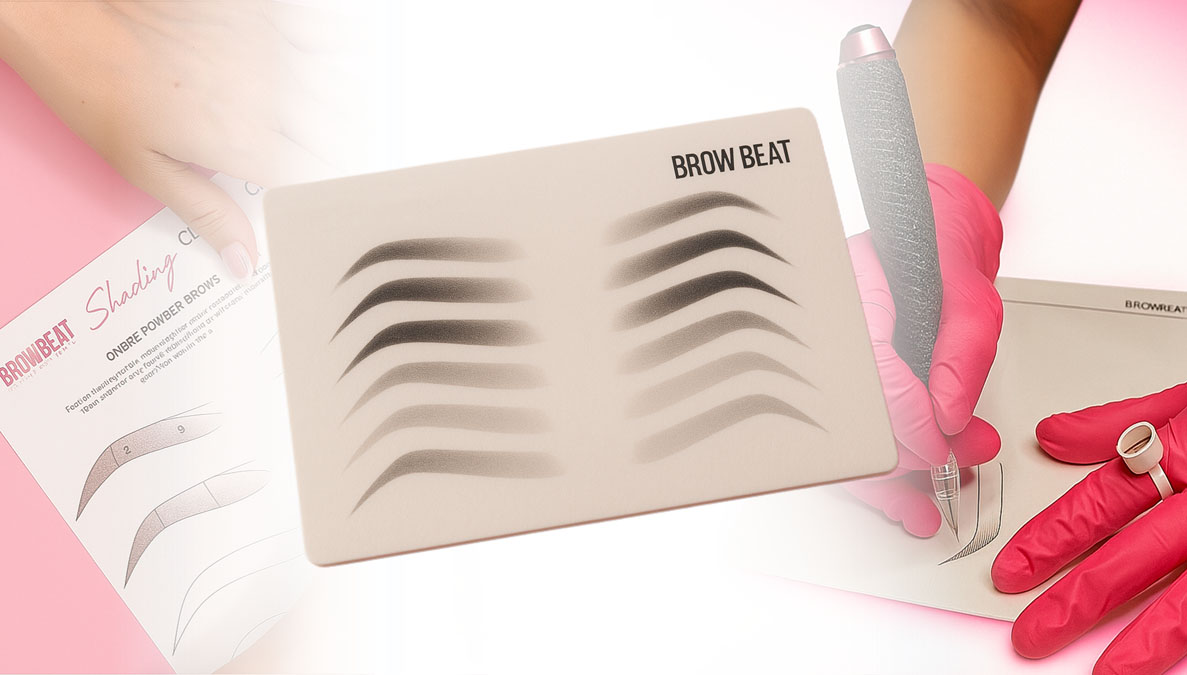
Shading paper exercises represent conceptual rehearsal for advanced brow shading techniques. This classroom activity shows how advanced powder brow shading skills begin with an understanding of layering and direction, supporting how to improve powder brow shading through structured planning before machine work.


skin
Exercises
Simulation exercises capture advanced powder brow shading skills transitioning from theory to application. Working within simulated environments allows students to explore advanced ombre brow techniques while reinforcing professional shading control methods through repeated practice and guided observation.
machine
Included
Introducing the shading machine as part of training highlights the equipment-driven aspect of advanced powder brow shading skills. This moment demonstrates how professional powder brow shading education integrates machine familiarity with advanced shading techniques to support confident gradient creation.

blonde
Example
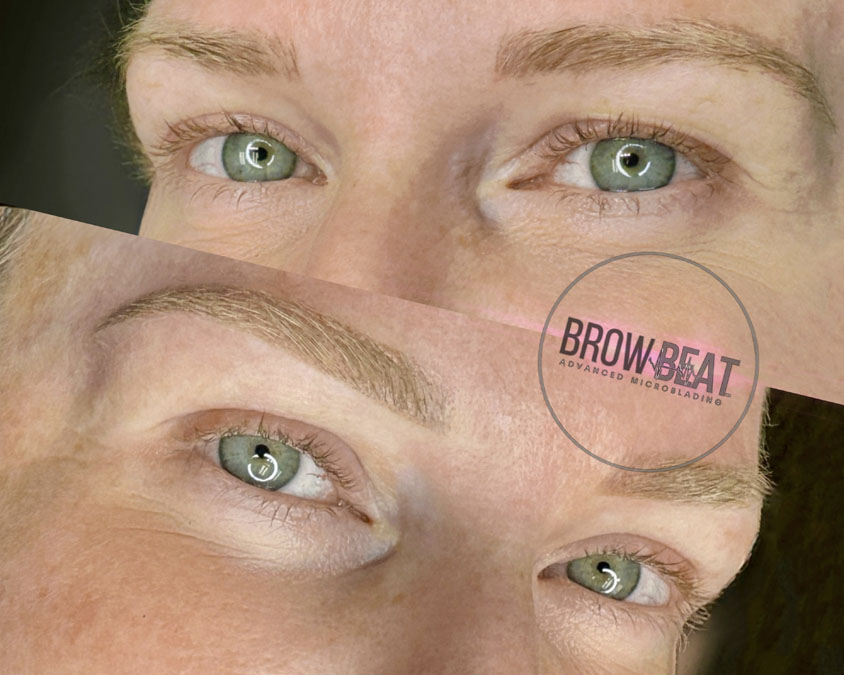
This result shows a soft powder brow application designed for a blonde client example. Light layering creates gentle fullness while keeping the brow head airy and natural. The shape is present but not overpowering, allowing blonde brow tones to remain believable while still improving density, structure, and overall brow visibility across the entire design.
blonde
Example
This example demonstrates a stronger powder brow application with increased saturation and clear structure. The shading builds noticeable density through the body and tail while maintaining a smooth front transition. This style reflects how powder brows can create a confident, defined look that enhances shape, strengthens presence, and delivers a polished finished brow.


darker
Hair
This brunette example illustrates a medium layered powder brow application balancing softness and density. Multiple controlled layers create fullness without appearing heavy, while the shape remains clean and symmetrical. The shading depth complements brunette hair tones, producing brows that feel structured, complete, and naturally integrated with the client.
melanin
Skin
This high melanin example highlights a dramatic powder brow application with strong visibility and structured depth. Saturation is built intentionally to ensure the shape reads clearly while maintaining smooth transitions through the brow head. The result shows how powder brows can create impactful definition, enhanced framing, and confident brow presence on medium to high melanin skin.

Body Mechanics Affect Machine Control
A PMU machine is controlled by a person, which means the artist’s body position influences the stability of the movement.
BrowBeat teaches beginning students to work with their body rather than unnecessarily fighting against it. As the working arm and elbow move farther away from the body, a beginner may find it more difficult to maintain the same level of control.
This is why body mechanics are part of the technique. The hand, wrist, elbow and body are not separate from the machine movement. They help create it.
Why BrowBeat Teaches Movement Toward the Body
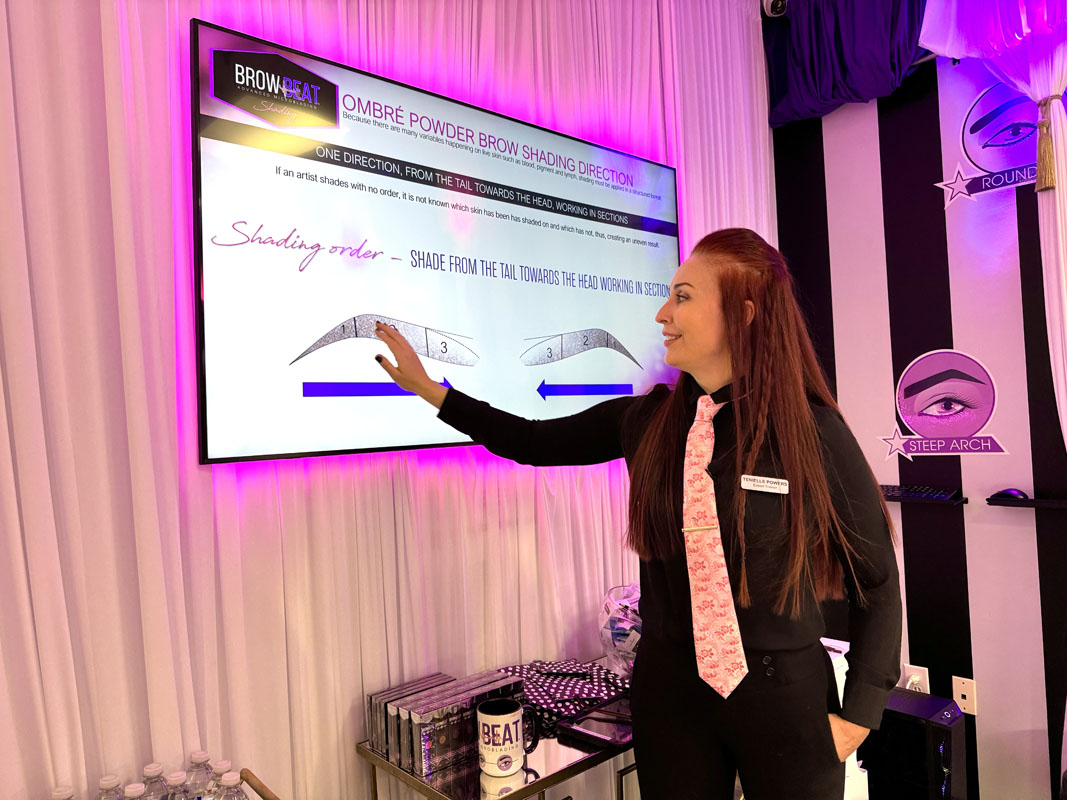
BrowBeat teaches students a one-way shading movement that travels toward the artist’s body. This gives beginners a repeatable movement that works toward the body’s center and provides a stable starting point while machine control is developing.
The student is not repeatedly changing direction or moving the machine back and forth without a defined approach. They learn one controlled movement, repeat it and begin recognizing what that movement produces. That consistency makes the technique easier to evaluate and easier to develop through practice.
One-Way Movement Gives Students a Repeatable Technique
When the fundamental movement remains consistent, students have a clearer baseline for understanding their results. If a student changes the speed, wrist action or machine position and the resulting shading changes, they can begin connecting the difference in execution with the difference they see. This is more useful than constantly changing direction and then trying to determine which of several movements created the result.
BrowBeat’s one-way approach gives beginning students a controlled foundation from which greater machine awareness can develop.
Understanding BrowBeat’s Whip-Shading Motion
BrowBeat teaches a quick, wrist-driven whip-shading movement to create the separated pixel effect used in its Powder Brow technique training. The student is not slowly drawing through the brow. The wrist creates a controlled whip movement that allows the machine to produce the individual visual deposits used to build the shading.
Within BrowBeat’s technique, the speed and character of that movement matter because changing the movement changes the outcome.
Quick Whip Movement Creates the Pixel Effect
Within BrowBeat’s whip-shading technique, a quick, controlled wrist movement creates the separated pixel effect students are trying to produce. If that same movement becomes too slow and continuous, the shading begins moving toward a line rather than the intended pixelation.
This gives students a clear cause-and-effect relationship to understand. They can look at the outcome being produced and ask whether their physical movement matches the result they are trying to create. The objective is not speed for the sake of working quickly. The speed belongs to the specific movement being used to create the intended pixel effect.

Pixelation Comes From Technique, Not Just the Cartridge
A PMU cartridge does not automatically create controlled Powder Brow pixels. The cartridge is one part of the working system. The artist still controls the machine position, wrist movement and the speed and direction of the whip. This is why two artists can use the same cartridge and produce different-looking shading. The equipment matters, but the artist’s execution determines how that equipment is being used.
Understanding this prevents students from searching for one cartridge that will somehow create the technique for them.
BrowBeat Teaches a 90-Degree Machine Angle
BrowBeat teaches students to hold the PMU machine at a 90-degree angle for its Powder Brow whip-shading technique.
The 90-degree position gives students a clear and repeatable relationship between the cartridge and the working surface. Rather than allowing the machine angle to change unpredictably as the hand moves, students learn to maintain the position while performing the shading motion.
Machine angle is therefore part of the technique itself. It works together with the wrist-driven whip and the artist’s control to produce the intended shading effect.
Why the 90-Degree Position Matters
The angle of the machine changes how the needle approaches and travels through the working surface.
BrowBeat teaches the 90-degree position because it supports the direct needle relationship used within its whip-shading method. Students learn to recognize and maintain that position rather than allowing the machine to become increasingly shallow during the movement.
An unnecessarily shallow machine position changes the way the needle travels and can increase the risk of catching or creating unnecessary tissue trauma.
For BrowBeat students, the rule is intentionally clear: the Powder Brow whip-shading technique is taught at 90 degrees.
Advanced Pixel Control Means Creating the Mark Intentionally
A useful pixel is not simply a small mark that happened to appear. The artist should begin understanding what physical movement created it. BrowBeat connects the 90-degree machine position, quick wrist-driven whip and controlled movement with the resulting pixel effect.
As students practice, they begin developing greater ability to repeat those physical relationships rather than hoping the next movement produces the same result. That repeatability is an important part of powder brow machine shading technical development.
Consistency Comes From Understanding Cause and Effect
If a student does not understand why one attempt worked, repeating it can become difficult.
BrowBeat encourages students to pay attention to what they did when the machine produced the intended result. Was the machine maintained at 90 degrees? Was the wrist creating the intended whip? Was the movement quick and controlled?
The same reasoning applies when the result is different from what they expected. Instead of making unrelated adjustments, the student has specific parts of the technique to evaluate. This is how understanding begins turning into consistency.

Saturation Is Relative to the Artist’s Execution
Powder Brow saturation is not created by pass count alone. Each pass is affected by the way the artist performs the technique, which means two artists can complete the same number of passes and produce different levels of saturation.
BrowBeat teaches students to count their work because counting creates structure. At the same time, students learn that the number cannot tell them everything about the developing brow. The artist needs to know how much work has been performed and then look at what that work actually produced.
Count the Work, Then Look at the Work
BrowBeat’s shading workflow gives students a system for counting their passes rather than working without knowing how much shading has already been performed. The next step is evaluation.
If two students have each completed the same number of passes, their brows do not automatically have the same saturation. Their individual execution affects what each pass contributes.
The count gives the artist information. The developing brow gives the artist information. Both are used to decide what happens next.
More Passes Are Not Automatically Better
A larger number of passes does not automatically mean a more complete or more advanced Powder Brow. As an artist develops greater control, the amount of work produced during each pass can change. An artist may eventually reach an intended result with fewer passes than they needed earlier in their development.
That does not make a particular pass count a measure of skill. The goal is not to finish in the fewest possible passes. The goal is to create the intended result with controlled technique.
Advanced Saturation Control Begins With Knowing the Goal
Before deciding whether a brow needs more saturation, the artist needs to understand what the client wants the finished brow to look like.
A client asking for a very soft, natural-looking result is describing a different goal from a client who normally wears stronger brow makeup and wants permanent makeup that reflects that preference. Neither result is automatically better.
The artist needs enough technical control to build the level of density that supports the intended result rather than automatically creating the same intensity on every client.
Soft and Natural Is Different From Defined and Makeup-Like
Powder Brows can be created with different levels of visual definition. Some clients want a softer effect that supports the natural brow without looking strongly made up. Others prefer a more defined result because that better reflects how they normally wear their brows.
BrowBeat teaches students that the underlying shading process can remain structured while the intended endpoint changes.
The artist still works systematically, counts, layers and evaluates. The client’s desired result helps determine how far the saturation should be developed.

Listening to the Client Is Part of Technical Decision-Making
Machine skill needs to serve the person receiving the treatment. As part of the appointment, the artist needs to understand how the client normally likes their brows to look and whether they are asking for a softer or more defined finished result.
That information gives the artist context for technical decisions. Without it, an artist can unintentionally create their own preferred brow style on every client. Understanding what the client wants is therefore connected to knowing how much of the technique to apply.
The Technique Should Respond to the Intended Result
A structured Powder Brow workflow does not mean every finished brow should look identical.
BrowBeat gives students consistency in how they approach the work. They understand the machine, use the 90-degree position, perform the BrowBeat whip-shading movement, count their passes, build progressively and evaluate the developing result.
The client’s desired result helps determine the endpoint. This allows the artist to use a repeatable technique without turning it into a one-result formula.
Advanced Control Includes Knowing When to Stop
Adding another layer is an action. Deciding that the brow already has enough saturation requires judgment.
BrowBeat teaches students to evaluate what is actually present rather than continuing simply because another pass can be performed. Once the intended level of softness or definition has been achieved, additional shading is not automatically an improvement.
Knowing when to stop is part of controlled Powder Brow technique.
Preventing Unnecessary Oversaturation
Oversaturation prevention begins with progressive work and continued evaluation. The artist knows how many passes have been performed, looks at what those passes have produced and compares the developing brow with the intended result.
This is one reason BrowBeat teaches layering rather than trying to create maximum saturation immediately. The artist has repeated opportunities to evaluate the work before deciding whether more is needed. More shading should have a reason.
Avoiding Patchiness During New Powder Brow Work
Patchiness during the creation of a new Powder Brow can indicate that the developing shading is not being distributed consistently. The artist can evaluate the movement, pixel distribution, relative density and transitions rather than simply adding more shading everywhere.
BrowBeat’s structured workflow helps students know where they have worked and how the different areas of the brow are developing. This gives them a more organized way to recognize inconsistencies while the work is being created.
This discussion applies to preventing inconsistent coverage in new Powder Brow work.
Refined Gradients Depend on Controlled Density
An Ombré gradient is more than a light head and a dark tail. The density between those areas needs to progress smoothly so the brow reads as one complete design. As an artist develops greater control, they can pay closer attention to how those changes in density relate to one another.
The three areas used in BrowBeat’s foundational shading workflow remain connected. Greater refinement means controlling those transitions without allowing the divisions used for learning to become visible in the finished work.
Soft-Front Refinement Requires Restraint
The head remains the lightest area of the Ombré Powder Brow but lighter does not mean disconnected or unfinished. The artist needs to maintain enough relationship between the head and the rest of the brow for the design to remain cohesive while resisting the urge to keep adding saturation simply because the front appears softer.
As confidence develops, restraint becomes increasingly important. Being capable of adding more pigment does not mean more pigment is always needed.

Advanced Powder Brow Technique Is Not About Making Brows Darker
Greater technical ability should give an artist greater control over the result, not automatically create heavier brows. An artist with developing skill should become increasingly capable of creating the intended level of density whether the client wants a soft Powder Brow or a more defined makeup-style result.
The measure of control is not how dark the artist can make the brow. It is whether the artist can understand the intended result and use the technique deliberately to create it.
When Powder Brow Shading Looks Different Than Expected
An unexpected result gives the artist information. If the intended pixels are beginning to look more like lines, the student can evaluate whether the whip movement has become too slow. If the shading itself changes, the artist can consider whether the 90-degree machine position, wrist movement or other elements of execution have changed.
If one area appears denser than another, the student can evaluate the progression and transitions. The objective is to identify cause and effect rather than respond to every difference with the same correction.
Advanced Troubleshooting Starts With What Changed
When something looks different from the intended result, BrowBeat teaches students to think through the system. Was the machine set appropriately? Was the machine maintained at 90 degrees? Was the wrist-driven whip quick and controlled? Did the movement change? How much work has already been performed? What level of saturation is actually present?
Those questions give the artist a logical place to begin. Understanding the technique creates a troubleshooting framework because the artist knows which parts of the process can influence the result.
Technique Develops as the Artist Develops
An artist’s relationship with machine shading changes through experience.
Movements that initially require intense concentration become more familiar. The artist becomes better at recognizing what the machine is producing and can make decisions earlier in the process.
Pass counts may change. Equipment preferences may change. The artist may discover that something they found difficult earlier becomes useful once their physical control develops. The foundational reasoning remains valuable because it gives those later changes context.
Why BrowBeat Teaches Technical Depth From the Beginning
BrowBeat does not reserve the reasoning behind Powder Brow technique for some undefined later stage of an artist’s education.
Students are introduced to the why while they are learning the how. They learn why the machine setup matters, why body position affects control, why BrowBeat teaches a one-way movement toward the body, why the machine remains at 90 degrees and why the quick wrist-driven whip creates the pixel effect used in the technique.
They also learn why passes are counted, why saturation is evaluated and why the client’s desired result determines how far the technique should be taken.
This does not mean a first-time student immediately has the experience of an artist who has performed Powder Brows for years. Experience still develops through continued work. It means the student begins with a deeper framework for understanding what they are practicing.
Advanced Powder Brow Education Is Built Into BrowBeat Certification
BrowBeat does not sell a separate advanced Powder Brow course. The deeper technical principles described here are built into the three-day brow certification. Students move from understanding the machine to understanding the shading workflow and then to understanding why the physical technique produces the result it does.
Machine setup, body mechanics, one-way movement, the 90-degree machine position, wrist-driven whip shading, pixel creation, counted passes, saturation and client goals become parts of one connected system.
The purpose is to help students understand the complete path from equipment to movement to application to finished result.
Understand the Why Behind Powder Brow Shading
Powder Brow technique becomes more useful when the artist understands the relationship between the different parts of the process.
Machine setup affects execution. Body mechanics affect control. BrowBeat’s 90-degree machine position establishes the working relationship with the surface. The quick, wrist-driven whip creates the separated pixel effect. Counted passes provide structure, while visual evaluation tells the artist what those passes actually produced.
Then the client gives the work its intended destination. A soft brow and a more defined makeup-style brow may require different endpoints, even though the artist is using the same underlying technical system.
BrowBeat Certification teaches students to connect those decisions rather than memorize them as isolated rules. The goal is not simply to know what movement to perform. It is to understand what the movement is doing and why.
Frequently Asked Questions About Advanced Powder Brow Shading Skills
What makes Powder Brow shading advanced?
At BrowBeat, advanced shading means understanding why the technique produces a particular result. Students begin connecting machine setup, body mechanics, movement, the 90-degree machine position, whip shading, pixel creation, saturation and visual evaluation rather than learning those concepts as unrelated instructions.
Does BrowBeat offer a separate advanced Powder Brow course?
No. BrowBeat builds this deeper technical understanding into its three-day brow certification rather than selling a separate advanced Powder Brow course.
What does “understanding is doing” mean in Powder Brow training?
It means students learn why a movement is performed and what it is intended to create. Understanding the relationship between the machine, movement and result gives students a framework for evaluating their own work as their experience develops.
Why do body mechanics matter in Powder Brow shading?
The artist’s body position influences control of the PMU machine. BrowBeat teaches beginning students to work with a stable body relationship rather than unnecessarily making the arm and hand work farther from the body’s center.
Why does BrowBeat teach one-way machine shading?
A one-way movement gives students a consistent physical approach they can repeat and evaluate. BrowBeat teaches that movement toward the artist’s body as part of its foundational Powder Brow shading method.
What is whip shading in BrowBeat’s Powder Brow technique?
BrowBeat’s whip shading is a quick, controlled wrist-driven movement used to create the separated pixel effect that builds Powder Brow shading.
Why does the whip-shading movement need to be quick?
Within BrowBeat’s technique, the quick wrist-driven movement creates the separated pixel effect. If that same movement becomes too slow and continuous, the shading outcome begins moving toward a line rather than the intended pixelation.
Can moving too slowly create a line instead of Powder Brow pixels?
Within BrowBeat’s whip-shading method, yes. Movement speed affects the shading outcome, which is why students learn to connect the physical movement with what the machine produces.
Why does BrowBeat teach a 90-degree machine angle?
The 90-degree position creates a clear, repeatable relationship between the cartridge and the working surface within BrowBeat’s technique. Students learn to maintain that position while performing the wrist-driven whip movement.
What is advanced pixel control?
Advanced pixel control means increasingly understanding and reproducing the physical technique that creates the intended pixel effect rather than relying on the cartridge alone.
How do artists make Powder Brow shading more consistent?
Consistency develops by connecting cause and effect. The artist learns what machine position and movement produced the intended result and uses repetition to make those physical relationships increasingly familiar.
How does client preference affect Powder Brow shading?
The client’s desired result gives the artist an endpoint. A soft, natural-looking Powder Brow and a more defined makeup-style brow require different levels of saturation even though the underlying technique remains structured.
Does advanced Powder Brow shading mean darker brows?
No. Advanced control means being increasingly capable of creating the intended result, whether that result is soft or more defined.
Can beginners learn these advanced Powder Brow principles?
Yes. BrowBeat introduces the reasoning behind the technique during its three-day certification. Students still need continued practice and experience, but they can begin understanding why the technique works while they are learning how to perform it.
Are advanced Powder Brow principles part of BrowBeat certification?
Yes. BrowBeat incorporates this deeper technical understanding into the three-day brow certification.