OMBRE POWDER BROW TECHNIQUES TRAINING
Creating an Ombré Powder Brow is not a matter of turning on a PMU machine and shading until the brow looks dark enough. BrowBeat Certification teaches students a structured shading workflow so they understand where to begin, how to progress through the brow and how to build saturation deliberately rather than working without a plan.
The technique is taught as a process. Students learn the direction of the workflow, what constitutes a pass, how shading is layered, why the number of passes can vary and how different areas of the brow transition into one another. They also learn to count their work so they know what they have actually done.
Before students add the complexity of operating the PMU machine, BrowBeat introduces the shading process on paper. Once the formula makes sense, students move to silicone and begin connecting that understanding with the physical machine control they have learned.
The principle is simple: understand the process first. Then execute it with control.
Powder Brow Technique Is a Process, Not Random Shading
A student needs more than the instruction to “shade the brow.” They need to understand what happens first, what happens next and what they should be evaluating as the work develops.
BrowBeat Ombré Powder Brow Certification teaches a repeatable workflow that gives students a structure to follow. Instead of moving randomly around the brow or repeatedly returning to areas without knowing how much work has already been performed, students learn to progress through the design systematically.
This matters particularly for beginners because they do not yet have years of experience to rely on. Machine shading training they learn in class gives students a formula and something concrete to return to while their visual judgment and physical machine skills are still developing.
Start With the Intended Brow Result
Before deciding how much saturation a brow needs, the artist needs to understand the intended result. Not every client wants the same amount of definition. The objective is not to make every Powder Brow reach one predetermined level of darkness simply because that is what the technique can produce.
The artist considers the result the client wants and uses that goal to guide how the shading develops. The technique provides the process; the intended result helps determine how far that process needs to go.
This is one reason BrowBeat does not teach a universal pass count. The number is not the goal. The finished brow is.
Ombré Powder Brow Shading Works From the Tail Toward the Head
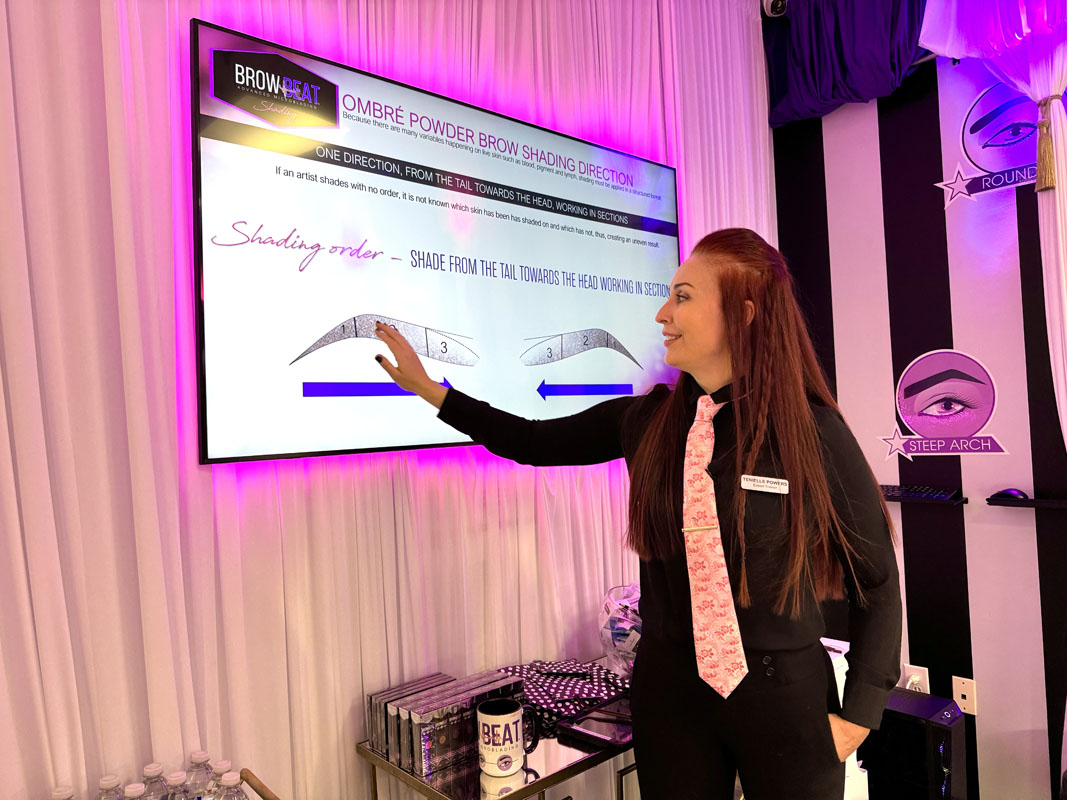
BrowBeat teaches students to construct an Ombré Powder Brow by progressing from the tail toward the head. This direction supports the density relationship within the technique. The tail carries greater definition, while the head of the brow remains the lightest area.
Students continue traveling forward through the brow rather than repeatedly doubling back through areas they have already completed. This creates an organized workflow and helps the student keep track of how the shading has been built.
The direction is also different from BrowBeat’s manual Microblading workflow, which progresses from the head toward the tail. The distinction reinforces that Microblading and Ombré Powder Brows are separate techniques with different execution systems.

foundation
Building
Inside the microblading and ombré powder brow certification in Dallas, students are introduced to powder brow techniques training as a natural extension of brow design education. Many arrive curious about shading, and quickly discover how soft pixel placement creates structure without strokes. This moment marks the start of understanding how ombre powder brow techniques transform brow artistry.
brow
Techniques
Students first explore powder brow technique basics before touching machines. Trainers explain density, layering, and gradient theory so shading feels intentional. This foundation prepares students for real practice while reinforcing how powder brow shading techniques support long-term brow balance.


step
By step
Observation plays a major role as students watch demonstrations showing how powder brows are done step by step from lining to pixel layering, the workflow is explained. This visual exposure helps students connect theory to execution and reduces uncertainty before hands-on work begins.
creates
Clarity
During shading education, trainers model ombré powder brow techniques slowly so students can observe the ombré powder brow workflow. These guided moments are often where understanding deepens, allowing students to translate observation into their own developing technique.


machine
Included
Students learn that cartridge selection influences pixel size, density, and shading softness. Understanding this relationship strengthens powder brow techniques and helps students see how small choices shape final results.
gentle
Lining
Soft lining introduces structure before shading begins. Trainers explain controlled placement so students experience how ombré powder brow techniques can create definition without harsh borders, supporting natural brow transitions.


ombré
Workflow
As shading exercises progress, students begin practicing gradients. This stage highlights how ombré brow shading methods build depth gradually, reinforcing patience and layering awareness during powder brow technique application.
certification
Journey
By the end of shading exercises, students understand that powder brow techniques training is one component of the broader microblading and ombré powder brow certification in Dallas. The experience reinforces how microblading, shading, and hybrid methods work together — creating confident artists equipped with multiple brow design skills.


be
Dark
Powder brow technique is not defined by intensity but by distribution. This result illustrates how soft colors can enhance blonde brows while preserving brightness and natural dimension. This trainer work demonstrates delicate pixel saturation and controlled fade at the brow head.
brow
Balance
Strategic shading placement can visually support brow symmetry and proportion without relying on strong outlines. This transformation demonstrates how powder brow technique enhances fullness through controlled density placement and structural shading. Trainer work reflects advanced shaping through shading strategy.


dramatic
Ombré
Ombré powder brows rely on progressive layering to create visual movement from head to tail. This transformation showcases gradient continuity, tail emphasis, and seamless color progression achieved through controlled pixel distribution.
melanin
Skin
This transformation demonstrates controlled pigment layering across high-melanin skin, where saturation and balance are essential. The ombré powder brow technique allows gradual density build while maintaining dimensional softness. Trainer work highlights even shading distribution and depth across the brow body.

Why the Head of an Ombré Brow Stays Lightest
The softer head is an important part of the Ombré Powder Brow effect. If the entire brow carries identical density from beginning to end, the result loses the gradual change that gives the technique its Ombré character. BrowBeat therefore teaches students to think about relative density rather than treating every area of the brow exactly the same.
The head remains lighter while the brow develops greater definition through the rest of the design. The transition needs to feel intentional rather than looking like separate blocks of shading.
What Is a Pass in Powder Brow Shading?
Within BrowBeat’s shading workflow, a pass is one complete progression through the brow from the tail toward the head. Thinking in passes gives students a way to measure the work they have performed. Instead of shading for an undefined amount of time, they can keep track of how many times they have progressed through the design and evaluate how the saturation is developing.
A pass does not mean the brow should reach full saturation immediately. Powder Brow shading is built progressively, with each stage contributing to the developing result.
Powder Brows Are Built Through Layers
BrowBeat teaches students to layer machine shading rather than trying to force the finished saturation into the brow in one stage. Each pass contributes another layer of work. The artist evaluates what has developed and determines whether additional shading is needed to move closer to the intended result.
This progressive approach gives the student more control over the outcome. The brow is built intentionally rather than becoming heavily saturated before the artist has had an opportunity to evaluate what is happening.
There Is No Universal Number of Powder Brow Passes
Students frequently want a number: How many passes does a Powder Brow need?
BrowBeat does not teach one universal answer because artists do not all produce the same amount of saturation with one pass. An artist’s hand movement and pressure influence what each pass produces. A student who moves differently from another student may need a different number of passes to reach a comparable visual result.
During training, students may find that the complete process requires somewhere within a broader range such as approximately eight to fifteen passes. That range is not a target or a rule. One artist may reach the intended saturation with fewer passes while another needs more.
The important skill is learning to evaluate the developing brow rather than chasing a predetermined number.
Why Two Artists Can Need Different Numbers of Passes
A pass is only useful as a measurement when the student understands that not every pass produces an identical amount of saturation. Hand speed and pressure affect what happens as the artist travels through the brow. Because those physical variables differ from one artist to another, two people can follow the same overall workflow and still require different numbers of passes.
This is why pass count should not be separated from machine control. The technique gives the student a structure for building the brow, while their physical execution determines what each layer contributes.
The detailed mechanics of hand speed, machine speed, pressure and depth belong to machine-control training. Within the Powder Brow technique, students learn how the result of that control is evaluated.

BrowBeat Teaches Students to Count Their Work
Counting prevents the shading process from becoming random. If an artist repeatedly moves between brows and sections without tracking what has been completed, it becomes harder to understand why one area or one brow is developing differently from another.
BrowBeat gives students a structured counting system so they know how much work has been performed and can compare the progression more deliberately. The count does not decide when the brow is finished. It gives the artist information while they work toward the intended result.
Working in Twos or Threes
BrowBeat teaches a system described as working in twos or threes. Students build the shading in small, counted sets rather than performing an undefined number of passes before evaluating the work.
The artist can complete a controlled set, move through the workflow and continue building each brow systematically. This makes it easier to keep track of the progression and reduces the temptation to repeatedly work an area simply because the student has lost count.
Working in twos or threes is not a rule that every finished brow needs the same total number of passes. It is an organizational method for building the technique deliberately.
Building Both Brows Systematically
Permanent makeup artists are creating a pair of brows, so the workflow needs to account for how both sides are developing. BrowBeat’s counted approach gives students a way to progress through the work without completing one side through an arbitrary amount of shading and then attempting to remember what was done when they move to the other.
The student can build, evaluate and continue in measured stages. That structure supports consistency while still allowing the artist to respond to what each brow actually needs.
BrowBeat Breaks the Brow Into Three Connected Areas
Students are shown a diagram that divides the brow into three areas for understanding the shading workflow. The purpose is not to create three separate blocks. The diagram gives beginners a way to understand where they are within the brow and how the shading should progress as one area moves into the next.
This makes a complex visual technique easier to organize. Instead of trying to understand the entire brow as one undefined space, students can think about the progression through connected areas while still maintaining one continuous finished design.
Transitions Matter Between Shading Areas
Dividing the brow conceptually does not mean the finished brow should reveal those divisions. Each area needs to transition into the next. The student learns to recognize where one working area meets another and how to avoid creating a visible band or obvious overlap at that point.
A smooth Powder Brow should read as one continuous shading progression rather than three separately completed sections placed next to one another.
A Gradient Should Not Look Like Separate Blocks
The three-part diagram is a learning tool, not a blueprint for three visible sections in the finished brow. If one area is shaded independently and then the next area is heavily worked over the edge of it, the overlap can become visually obvious. BrowBeat teaches students to think about transitions while progressing through the workflow so one area flows into the next.
The objective is a gradual relationship between density levels rather than a coloring-book effect where the viewer can identify exactly where one section ended and another began.
What Pixelation Means Within Powder Brow Technique
Pixelation describes the visual deposits that build machine-shaded brow coverage.
Students are not trying to create one solid, uninterrupted block of pigment. Controlled machine work creates the individual deposits that collectively produce the shaded appearance.
Within the BrowBeat workflow, those pixels are part of a larger system. Their placement and density contribute to how the brow builds through each pass and how softer and more defined areas relate to one another.
Pixel Density and Shading Density Are Connected
The amount and concentration of visible pixelation contribute to the perceived density of the shading. A softer area needs a different visual density from an area intended to carry greater definition. Students therefore learn to evaluate more than whether pigment is present. They consider how much visual density has developed and how that density relates to the surrounding brow.
Precision pixel refinement becomes increasingly important as an artist advances, but the foundational technique begins with understanding that density needs to be controlled.

Building Saturation Gradually
Saturation is developed through the layering process. Rather than trying to create the final level immediately, students build the brow in stages and evaluate the result between those stages. Additional passes contribute additional work until the intended level has been achieved.
This gives saturation a structure. It becomes something the artist builds and assesses rather than something that simply happens because the machine has been moving over the brow for a certain amount of time.
Saturation Is the Result of More Than Pass Count
Counting passes helps organize the workflow, but the number alone does not tell the artist how saturated the brow has become. Two artists can each complete the same number of passes and produce different levels of saturation because their physical machine control is different.
The artist therefore needs both pieces of information: how much work has been performed and what that work has actually produced. BrowBeat gives students a process to follow while still requiring them to observe and evaluate the brow.
Creating a Soft Powder Brow Front
The brow head is intentionally kept lighter within the Ombré Powder Brow technique. Because BrowBeat’s workflow progresses from the more defined tail toward the head, students are continually moving toward the area that ultimately requires the greatest softness.
The student learns to think about the head in relationship to the rest of the brow. It should belong to the same design while carrying less visual density.
That relationship creates softness without making the head look disconnected or unfinished.
Building Definition Through the Body, Arch and Tail
The body, arch and tail contribute greater definition to the Powder Brow design than the soft head.
BrowBeat teaches students to think about how density progresses through these areas rather than applying identical shading everywhere. The tail provides a clear starting point for the workflow, and the artist then travels forward through the brow while managing the transitions in density that create the intended Ombré effect.
Creating the Ombré Gradient
The gradient is the visual relationship between the softer and more defined areas of the brow. It is created through controlled differences in density and the transitions connecting those differences. The artist is not simply making one end light and the other dark. The areas between them need to progress naturally.
BrowBeat’s structured workflow gives students a way to build that progression.
The Client’s Desired Result Determines the Goal
A technique formula should create consistency in the artist’s process without forcing every client into the same finished brow. The client may want a softer result or greater definition. That intended outcome helps the artist evaluate how much saturation is appropriate and when additional layering is or is not needed. The process remains structured while the endpoint can respond to the intended result.
This is why BrowBeat teaches both a formula and visual evaluation. A formula without judgment becomes rigid; judgment without a process can become random.
Why BrowBeat Starts the Shading Workflow on Paper
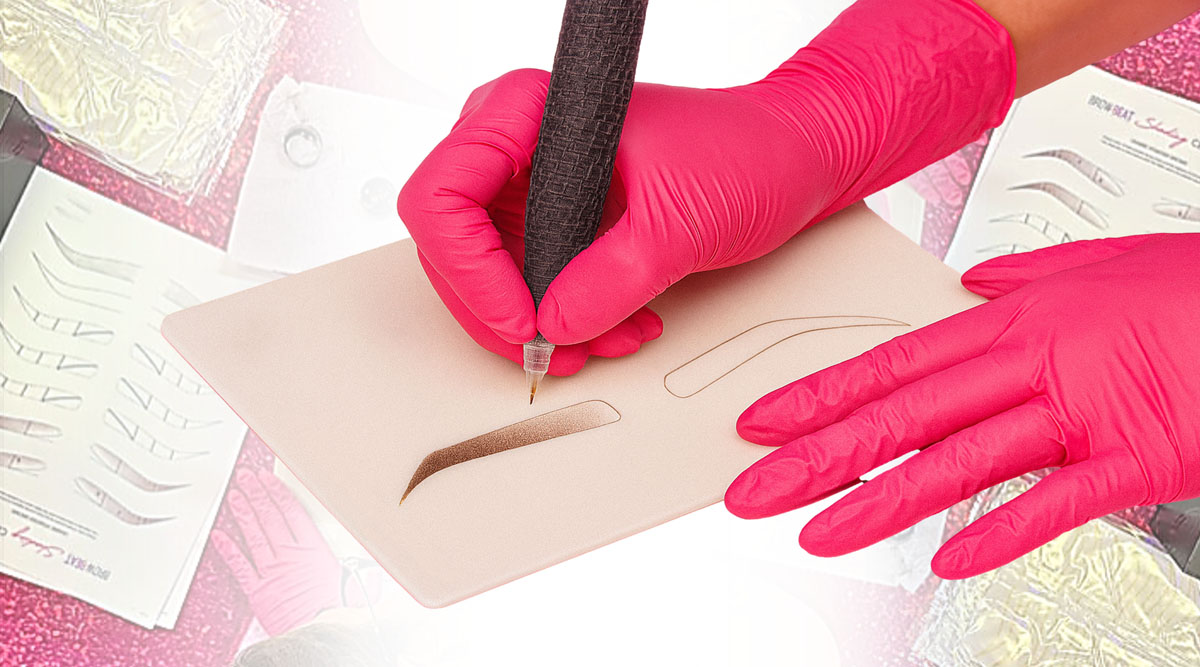
Before students try to remember the workflow while simultaneously controlling a PMU machine, BrowBeat teaches the process through a paper exercise. The paper exercise gives students a place to think about direction, passes, counting, progression and transitions without also managing the physical variables of the machine.
This is not practice for the sake of filling time. It separates the thinking from the execution long enough for students to understand what they are supposed to do.
The Paper Exercise Teaches the Formula
Students use the paper exercise to understand how the shading workflow is organized before moving to a practice surface with the machine. They can follow the progression, think through the three connected areas and understand how the passes are counted without wasting machine-practice time trying to remember the order of the process.
Once the formula is familiar, the student has more attention available for the physical technique.
Moving From Paper to Silicone Practice
After students understand the workflow on paper, they move to silicone and begin applying the process with the PMU machine. This adds the physical layer that paper cannot provide. The student now has to connect the formula with machine movement, cartridge control and the physical variables learned during machine-shading education.
Because the workflow has already been introduced, the student is not trying to solve every problem at the same time. They know where the technique is going and can concentrate more effectively on executing it.

Understanding the Workflow Makes Practice More Productive
Practice time is more useful when the student understands what they are practicing. Without a process, a beginner can spend a large portion of an exercise simply trying to remember where to begin, where to go next or how much work has already been performed.
BrowBeat teaches the workflow first so the silicone exercise can focus more directly on connecting the student’s machine control with the intended Powder Brow technique. Understanding does not eliminate the need for repetition. It makes that repetition more purposeful.
Technique and Machine Control Come Together on Silicone
Machine control and Powder Brow technique are separate learning concepts, but practical shading eventually requires both at the same time. The student needs enough control to operate the machine while also following the shading workflow, counting passes, monitoring density and maintaining the intended progression through the brow.
This is where the earlier machine foundation becomes useful. Instead of relearning the equipment, the student can begin applying that control to the actual technique.
Students Learn to Evaluate the Brow While Building It
A formula does not remove the need to look at the work. Students learn to evaluate whether the brow is moving toward the intended result, whether relative density is developing appropriately, whether the transitions remain connected and whether additional layering is needed.
The count provides information. The visual result provides information. The artist uses both. This is how advanced powder brow shading skills develop.
When Is an Ombré Powder Brow Finished?
A Powder Brow is not finished simply because the artist reaches a particular number of passes. The endpoint is determined by the intended result and the level of saturation and definition that has been appropriately developed through the technique.
This is why BrowBeat does not teach students to stop automatically at eight passes, ten passes or any other universal number. Passes organize the process. They do not replace visual evaluation.
Foundational Powder Brow Technique Comes Before Advanced Refinement
Once students understand how to construct the technique, they can begin refining it with greater precision. Advanced development can focus more closely on consistency, control, saturation, seamless gradients and adapting execution as different working situations are encountered.
Those refinements are most useful after the artist already understands the foundational workflow. BrowBeat first gives students a process they can repeat and evaluate before expecting advanced precision.
Understand the Shading Process Before Perfecting It
The Powder Brow technique becomes much easier to learn when the student has a process to follow. BrowBeat Certification teaches students to begin with the intended result, progress from the tail toward the lighter head, count their work and build saturation through controlled layers.
This three-part brow understanding of each section, the tail the body and the head helps students understand where they are within the technique while transition training teaches them to connect those areas without leaving visible divisions. Working in twos or threes gives the layering process additional structure while still allowing different artists to require different total numbers of passes.
Students first learn the formula on paper and then take that understanding to silicone, where the shading workflow and PMU machine control come together. The process does not replace artistic judgment. It gives the developing artist a repeatable structure from which that judgment can grow.
That is the foundation BrowBeat uses to teach the Ombré Powder Brow technique: understand what you are trying to achieve, understand the process for getting there, and then build the result deliberately.
Frequently Asked Questions About Powder & Ombré Brow Technique Training
What is the Powder Brow technique?
The Powder Brow technique uses controlled PMU machine shading to build brow coverage progressively. BrowBeat teaches students a structured workflow based on direction, counted passes, layering, relative density and transitions rather than treating shading as random movement through the brow.
How does BrowBeat teach Ombré Powder Brow shading?
BrowBeat first teaches students the shading workflow as a process. Students learn how the brow progresses, how passes are counted, how saturation is layered and how different areas transition. They work through the formula on paper before applying it with the PMU machine on silicone.
Where do you start shading an Ombré Powder Brow?
Within the BrowBeat technique, students begin at the tail and progress toward the head of the brow. The head remains the lightest area of the finished Ombré design.
Why is the front of an Ombré Powder Brow lighter?
The softer head is part of the density progression that creates the Ombré effect. BrowBeat teaches students to maintain less visual density at the head while allowing greater definition through other areas of the brow.
What is a pass in Powder Brow shading?
Within BrowBeat’s workflow, one complete progression from the tail toward the head is counted as a pass. Counting gives students a way to track how much work has been performed while the brow is being built through layers.
How many passes does an Ombré Powder Brow need?
There is no universal pass count. Different artists can create different amounts of saturation with each pass because physical execution varies. BrowBeat teaches students to count their work while evaluating the developing result rather than trying to reach one predetermined number.
What does layering mean in Powder Brow shading?
Layering means developing the shading progressively through repeated controlled passes rather than attempting to create the final saturation immediately. The artist evaluates the developing brow and adds additional work as needed.
What is pixelation in Powder Brows?
Pixelation refers to the visual deposits created through controlled machine shading. Those deposits collectively build the shaded appearance and contribute to different levels of density throughout the brow.
What is pixel density in Powder Brow technique?
Pixel density describes how concentrated the visual shading appears within an area. A softer area requires a different visual density from an area intended to carry greater definition.
How is saturation built in Powder Brows?
BrowBeat teaches students to build saturation progressively through layered passes. Students evaluate what each stage has produced and determine whether additional work is needed rather than trying to create full saturation immediately.
Does BrowBeat teach a step-by-step Powder Brow shading process?
Yes. BrowBeat teaches a formula-based workflow so students understand the direction of the technique, counted passes, layering and transitions before trying to execute the entire process with the PMU machine.
Why does BrowBeat teach the workflow before silicone practice?
Understanding the process first allows students to use silicone practice more productively. They already know the direction, counting system and progression, so they can direct more attention toward physical machine execution instead of trying to remember what comes next.
When is an Ombré Powder Brow finished?
The brow is finished when the intended result and appropriate level of saturation and definition have been achieved through the technique. BrowBeat does not teach students to stop automatically because they reached a predetermined number of passes.