OMBRE POWDER BROWS VS MICROBLADING TRAINING
Microblading and Ombré Powder Brows are both permanent makeup brow techniques, but learning them develops very different skills. Microblading teaches an artist to create individual hair strokes manually. Ombré Powder Brows teach an artist to create shaded coverage with a PMU machine.
For a prospective student, that distinction matters. Choosing between the techniques is not simply choosing between two finished brow styles. It is choosing between two different methods of working, two different tool systems and two different sets of physical skills.
BrowBeat Certification teaches the techniques separately so students understand what each one contributes. Microblading develops manual hair-stroke skills. Ombré Powder Brow training develops machine-shading skills. Learning both can also give a developing artist more flexibility because one technique does not need to be forced onto every brow.
Understanding the differences first makes it much easier to decide what you actually want to learn.
Microblading and Ombré Powder Brows Are Different Skills
The simplest distinction is:
Microblading = manual hair strokes.
Ombré Powder Brows = machine shading.
Those two definitions explain much of the difference between the training.
A Microblading student is learning how to design and manually create individual strokes that work together as a believable hair-stroke pattern. A Powder Brow student is learning how to control a powered PMU machine and progressively build shaded coverage.
Both require control, planning and practice. The physical skill being developed is different.
Microblading Creates Individual Hair Strokes
Microblading uses a manual hand tool and a grouped blade configuration. The artist physically creates each stroke through movement of the hand.
That means the student needs to think about individual stroke placement as well as the larger pattern. Direction, spacing and the relationship between neighboring strokes all contribute to the finished design.
The student is not simply learning how to make a line. They are learning how multiple individual strokes work together inside a mapped brow. That pattern-based thinking is one of the central learning demands of Microblading.
Ombré Powder Brows Create Shaded Coverage
Ombré Powder Brows use a powered PMU machine and cartridge to create shading rather than individual manual hair strokes. During machine shading training students learn how machine movement creates pixels and how those deposits are progressively layered to develop the intended density through the brow.
The technique requires the artist to think about relative saturation, softness and transitions rather than the placement of individual hair strokes. The result is a different visual language and a different physical method of creating the brow.
Manual Hair Strokes vs Machine Shading
Microblading gives the artist direct manual control of the blade. Ombré Powder Brows require the artist to coordinate their own hand movement with the powered movement of the PMU machine. That changes what the student needs to concentrate on.
With Microblading, much of the learning centers on the relationship between the manual tool and the individual stroke being created.
With machine shading, the artist also needs to understand how the machine, cartridge and physical movement interact while shaded coverage is being built. Neither method is simply another version of the other.
Microblading Hand Tool vs PMU Machine
The equipment itself creates one of the clearest differences between the two skills. Microblading uses a manual handle fitted with a Microblading blade. BrowBeat students learn what the blade specifications mean and how hard and flexible construction affect the manual tool.
Ombré Powder Brows use a PMU machine fitted with a cartridge. Students learn the machine setup and develop an understanding of different cartridge configurations before applying that equipment to machine shading.
The purpose of this comparison is not to determine which tool is better. Each tool belongs to a different technique.

foundation
Building
Classroom theory establishes the understanding students need before exploring ombré powder brows vs microblading training comparisons. Foundational instruction clarifies the difference between powder brows and microblading while supporting technique comparison for artists evaluating learning direction. This early stage helps students move beyond asking which is better powder brows or microblading toward informed confidence when beginning semi-permanent makeup education.
tool
First
Training begins with manual hairstroke work so students understand stroke direction, spacing, and pattern formation. This foundational step supports clarity when comparing ombré powder brows vs microblading training and helps future artists recognize the difference between powder brows and microblading movement styles.


machine
Second
After manual strokes, students transition into machine shading to experience powder brow gradient creation firsthand. This progression supports powder brows vs microblading training understanding while helping learners visualize shading as density layering rather than stroke work.
microblading
& Ombre
An exploration of strokes and shading helps students grasp the difference between powder brows and microblading visually and technically. This technique comparison for artists clarifies how line-based microblading contrasts with pixel-based shading, reinforcing that ombré powder brows vs microblading training represents complementary skill development during comprehensive Texas brow education.


all brow
Skills
Mapping education spans strokes, shading, and combination techniques, demonstrating structural consistency across services. Students see how design principles remain stable regardless of treatment type, supporting microblading and ombré powder brows at BrowBeat Certification Texas.
mapping
Exercise
Partner mapping introduces real facial variation, allowing students to apply structural concepts across diverse bone structures. This progression supports learners comparing ombré powder brows vs microblading training and reinforces that mapping competency remains central regardless of whether artists pursue stroke-based, shading-based, or combination brow techniques.


simulation
Exercises
Semi-permanent makeup simulations provide guided practice environments where students apply strokes, shading, and combination methods without client pressure. These exercises support powder brows vs microblading training comprehension and help future artists answer which is better powder brows or microblading by experiencing movement differences.
in-person
Assistance
Trainer-led guidance ensures immediate feedback during both stroke and shading practice, supporting student confidence throughout ombré powder brows vs microblading training progression. In-person assistance within BrowBeat’s Texas training settings helps learners refine technique, movement and pressure control across brow methodologies.


to
Choose
Exposure to microblading, ombré powder brows, and combo brows allows students to move beyond choosing between microblading and powder brows and toward comprehensive skill awareness. Within a Texas semi-permanent makeup training environment, this integrated approach supports powder brows vs microblading for artists exploration while demonstrating how three certifications together create a confident and cohesive entry into brow education.
before
& After
These microblading before and after results reflect the detailed stroke artistry students learn when exploring ombré powder brows vs microblading training. Seeing the difference between powder brows and microblading visually helps future artists understand hairstroke realism while recognizing how in-person Texas certification training supports confident stroke placement, pattern flow, and natural brow design outcomes.


before
& After
This ombré powder brows before and after result showcases shading density transitions and gradient structure developed during powder brows progression training. Students questioning which is better powder brows or microblading often gain clarity through outcomes like these, demonstrating how machine shading education in Texas certification settings supports soft cosmetic brow finishes.
before
& After
This combo brows transformation illustrates how strokes and shading merge to create dimensional brow results. Observing this blended technique within a Texas semi-permanent makeup training environment helps learners visualize how integrated certification across multiple brow methods expands creative flexibility and treatment adaptability.

Microblading Blades and PMU Cartridges Are Not the Same Thing
Both tools involve needles, but their construction and operation are different. A Microblading blade consists of grouped needles held within a manual hand tool. The artist moves that blade directly to create the stroke.
A PMU cartridge operates within a powered machine. The machine creates the needle movement while the artist controls the device and guides the technique. Students therefore need separate equipment education for each method rather than assuming familiarity with one automatically explains the other.
Hair-Stroke Design and Shading Design Require Different Thinking
The difference extends beyond the equipment. A Microblading artist needs to think in strokes. Where does this stroke begin? Which direction should it travel? How much space belongs between it and the next stroke? How does the pattern transition through the brow?
A Powder Brow artist needs to think in shading. How much density is developing? Where should the brow remain softer? How does one shaded area transition into another? Does the developing saturation match the intended result? Both require visual planning, but the artist is solving a different design problem.
Microblading Requires Hair-Stroke Pattern Control
Microblading patterns contain multiple individual decisions. Students learn stroke direction, spacing, pattern flow and variations through different areas of the brow. Each stroke needs to make sense individually while also belonging to the complete design. This can create a substantial initial learning demand because the student is coordinating manual control with pattern thinking at the same time.
BrowBeat therefore breaks the Microblading education into structured steps so students can understand the pattern before expecting themselves to execute the entire technique fluidly.
Powder Brows Require Machine and Density Control
Powder Brow students face a different challenge. Instead of planning every individual hair stroke, they need to learn how a powered machine creates shading and how that shading is progressively developed into the finished brow. Machine control, pixelation, counted passes, layering and relative density become central concepts taught during Powder Brow techniques training.
BrowBeat gives students a formula-based shading workflow so they have a process for building the technique rather than simply being told to shade until the brow looks finished.
Pattern Thinking vs Density Thinking
One useful way to understand the training difference is to think of Microblading as primarily developing pattern thinking and Powder Brows as developing density thinking.
Microblading students are continually considering how individual strokes relate to one another.
Powder Brow students are continually considering how the developing shading in one area relates to the density in another.
Both artists are building one complete brow, but the units they are working with are different.

The Techniques Move Through the Brow Differently
BrowBeat teaches the two techniques with different directional workflows.
In BrowBeat’s Microblading Certification, the artist progresses from the head toward the tail while creating the hair-stroke pattern.
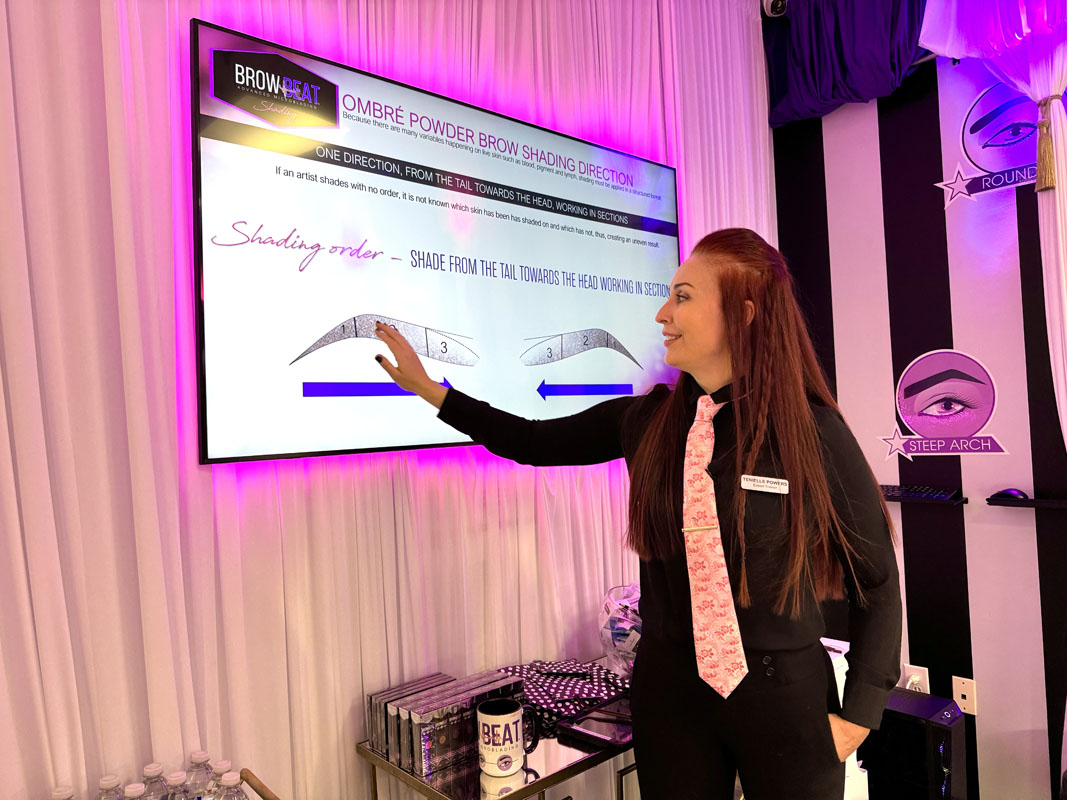
In BrowBeat’s Ombré Powder Brow Certification, the shading workflow progresses from the tail toward the head, with the head remaining the lightest area.
This is another reason students benefit from treating them as separate techniques rather than trying to apply the rules of one directly to the other.
The Microblading Learning Process
BrowBeat teaches Microblading progressively because students need to understand both pattern and manual execution. Students learn the design and stroke concepts in controlled stages, develop familiarity with the manual tool and practice the technique before bringing the complete treatment flow together.
The deeper Microblading curriculum includes mapping, hair-stroke pattern education, blade knowledge, pigment loading and structured practical work.
The important comparison here is that the learning process is centered on understanding and controlling individual manual hair strokes.
The Ombré Powder Brow Learning Process
Powder Brow training begins with a different foundation. Students first need to understand the PMU machine, cartridge and physical machine-control concepts. They then learn the formula BrowBeat uses to construct the shaded brow.
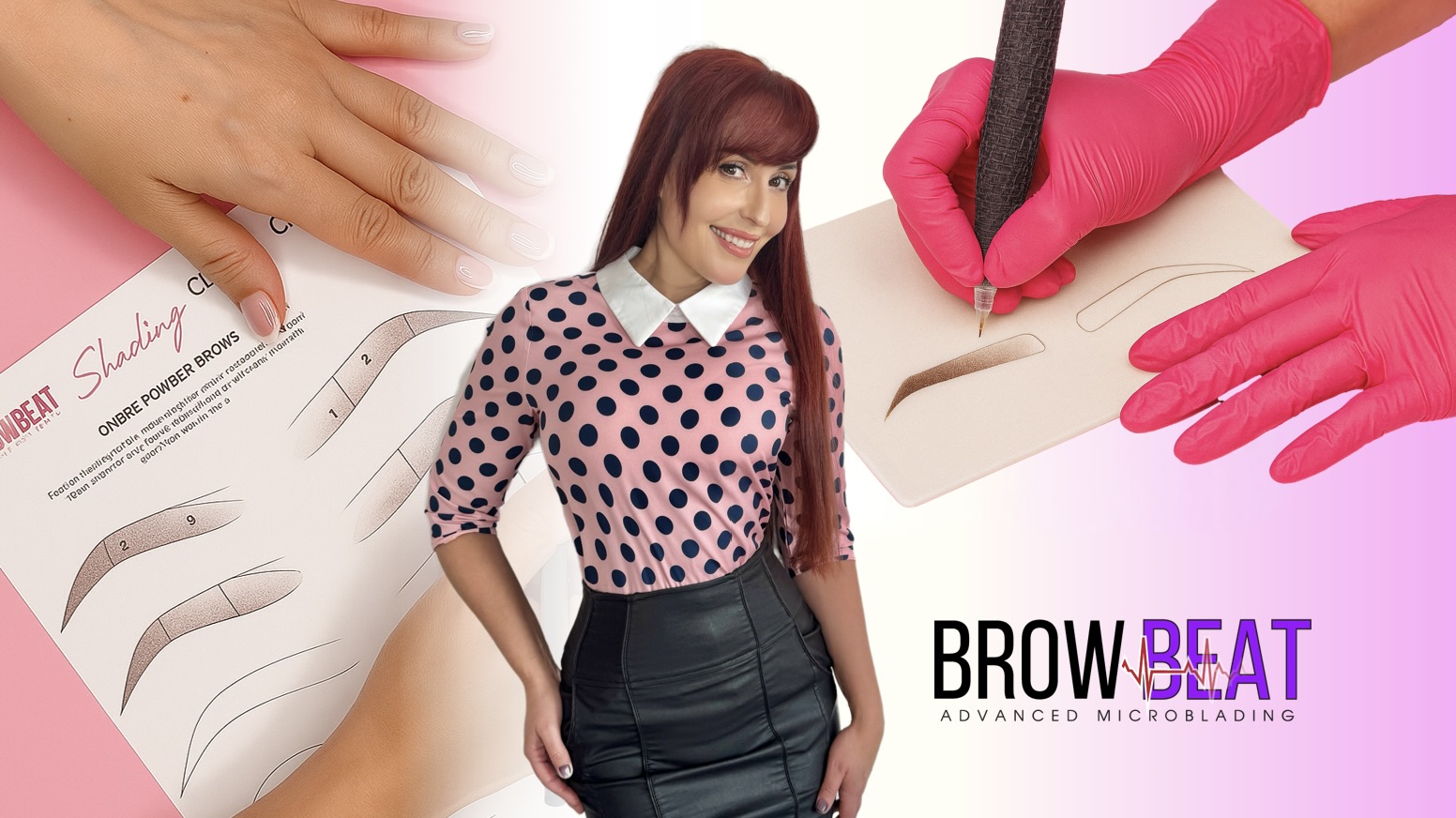
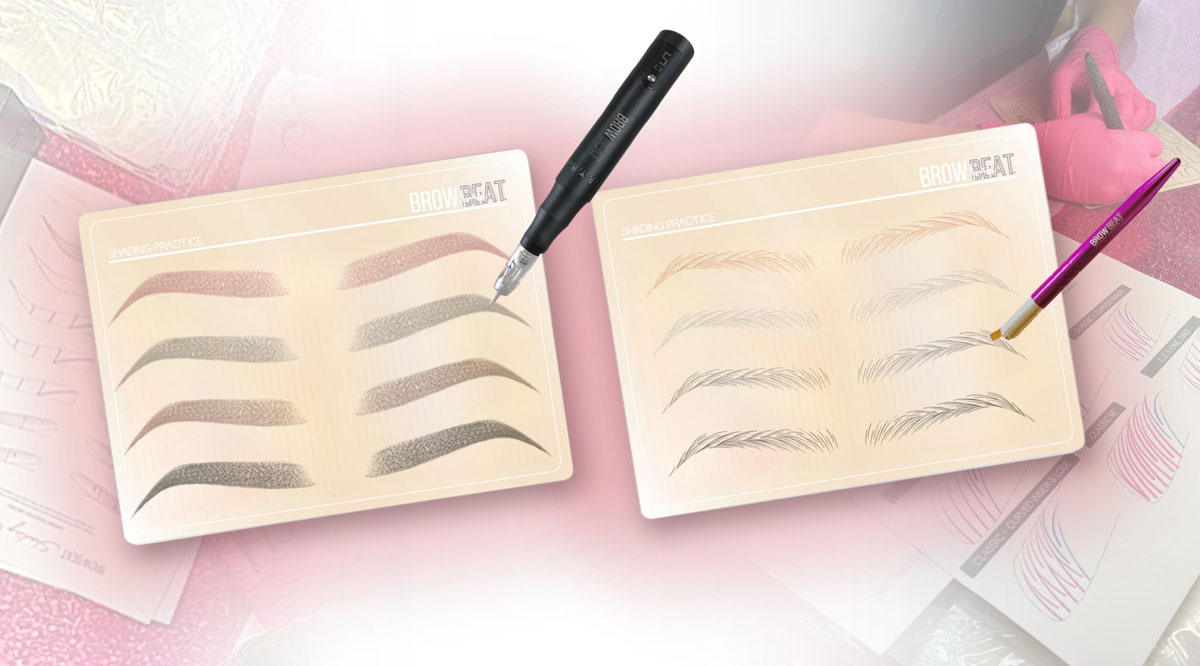
The shading workflow is first introduced on paper so students can understand the process before adding the complexity of operating the machine. Students then move to silicone and begin applying the formula through machine shading. The learning process is centered on controlling machine-generated shading and building saturation progressively.
Microblading Can Have More Pattern Complexity at the Beginning
For many students, Microblading presents substantial visual complexity because the artist needs to understand the placement, direction and spacing of individual strokes while also learning manual control.
A single misplaced stroke can affect the relationship between the strokes around it, so students need to develop both pattern awareness and physical precision. This does not mean every student will find Microblading harder than machine shading. People connect with physical skills differently. It does explain why Microblading can require significant pattern study and continued practice as the student develops.

Powder Brow Shading Can Feel More Straightforward Conceptually
Some beginners find the Powder Brow concept easier to organize once they understand BrowBeat’s structured shading workflow. The student is not designing a complete collection of individual hair strokes. Instead, they learn how to use the machine and progressively build shaded density according to a defined process.
That does not make the technique effortless. Machine control, pixel creation, layering, transitions and saturation still require physical skill and continued practice. The challenge is simply different.
Which Is Easier to Learn: Microblading or Powder Brows?
There is no universal answer. A student who naturally connects with detailed pattern work may enjoy the structure of Microblading. Another may connect more quickly with the repetitive physical rhythm and progressive shading of Powder Brows.
Microblading can involve greater initial complexity around individual stroke patterns and spacing. Powder Brow shading can feel more straightforward conceptually for some students once the workflow is understood, while still requiring them to develop control of a powered machine. The better question is which type of skill the student wants to develop.
The Working Process Is Different Too
Learning difficulty and the working process should not be treated as the same question. A technique that takes more initial pattern study does not necessarily require a longer working process in every appointment. Likewise, a technique that feels easier for a particular student to understand conceptually can involve progressive layering during the actual shading process.
Microblading and Powder Brows therefore differ both in how the student learns them and in how the artist physically builds the finished work.
BrowBeat teaches students to understand those differences rather than ranking the techniques by one simple measure of difficulty or speed.
Should I Learn Microblading or Ombré Powder Brows?
If the student’s goal is specifically to learn manual hair-stroke work, Microblading develops that skill. If the goal is specifically to learn machine-shaded brows, Ombré Powder Brow education develops that skill.
For someone building broader brow capabilities, the question can become less about choosing a permanent winner and more about understanding what each technique allows the artist to do. Manual hair strokes and machine shading provide different options.

Learning More Than One Brow Technique Creates Flexibility
BrowBeat teaches that developing both manual and machine-based brow skills can give an artist greater flexibility when planning treatments. An artist who knows only one technique can feel pressure to make that technique fit every brow.
Learning more than one approach gives the artist additional ways to respond to different natural brows and different desired results. This can be particularly valuable early in an artist’s career. Having both a hair-stroke skill and a machine-shading skill means the artist is not dependent on one solution for every client.
Microblading Does Not Need to Fit Every Client
Microblading is an important hair-stroke technique, but knowing how to Microblade does not mean Microblading needs to become the answer for every brow. A client may prefer the appearance of soft shaded coverage. Another brow may present a design situation where a shading-based approach gives the artist an option they would not have if manual strokes were their only skill.
Learning Ombré Powder Brows alongside Microblading expands the artist’s technical vocabulary. The artist can then think about what makes sense for the brow and the client’s desired result rather than beginning every appointment with the assumption that the same technique must be used.
Machine Shading Can Be an Important Second Brow Skill
For an artist who begins with Microblading, developing machine-shading skills can provide a valuable second approach to brow work. Learning how to create hair strokes manually and how to create soft or more defined coverage with a PMU machine gives the developing artist two fundamentally different technical abilities.
The value is not simply being able to list more techniques. It is having more than one way to think about a brow.
Learning Both Does Not Mean Using Both on Every Brow
Having multiple skills does not mean every client needs multiple techniques. Microblading can be performed as a hair-stroke technique. Ombré Powder Brows can be performed as a pure shading technique.
The artist’s broader education gives them options, but the selected technique should still respond to the brow and the intended result. If hair strokes and shading are intentionally integrated into one finished brow, the technique has moved into Combo or Hybrid Brow territory.

Do You Need to Learn Microblading Before Powder Brows?
There is no universal rule that an artist must master Microblading before learning Ombré Powder Brows. The two techniques develop different physical skills. Microblading teaches manual hair-stroke control, while Powder Brows teach PMU machine shading.
Do You Need to Learn Powder Brows Before Microblading?
No. Machine-shading experience is not a universal prerequisite for learning manual Microblading. Again, the techniques have different foundations. Understanding one can broaden an artist’s overall brow knowledge, but it does not replace learning the physical skill required for the other.
Why Learning Manual and Machine Skills Can Strengthen Brow Education
Manual and machine techniques teach the artist to think about brows differently.
Microblading develops awareness of individual strokes, pattern direction and spacing. Powder Brow training develops awareness of machine control, pixels, relative density and shading transitions. Learning both exposes the artist to two different ways of constructing a brow and two different forms of physical control.
That broader understanding can help a developing artist avoid treating one technique as the answer to every situation.
How BrowBeat Keeps the Techniques Separate During Training
BrowBeat does not teach Microblading and Ombré Powder Brows as though one is simply a variation of the other.
Students learn the manual hair-stroke system as its own technique and the machine-shading system as its own technique. Each has its own equipment, movement, workflow and visual objective.
Keeping those foundations clear makes it easier for students to understand what they are actually doing when they move between manual and machine work.
When Hair Strokes and Shading Become One Technique
There is an important distinction between knowing both Microblading and Powder Brows and intentionally combining hair strokes and shading inside one finished brow. The first describes an artist who has learned two separate skills.
The second describes the Combo or Hybrid Brow technique.
That distinction also separates Combo Brows from BrowBeat’s broader multi-technique certification. Learning Microblading, Ombré Powder Brows and Combo Brows as three techniques.
Understand the Difference Before Choosing What to Learn
Microblading and Ombré Powder Brows give an artist two very different ways to approach permanent makeup brows. Microblading develops manual control and hair-stroke pattern thinking. The artist learns to work with individual strokes, direction, spacing and the relationship between those strokes within the complete design.
Ombré Powder Brow training develops machine control and density thinking. The artist learns to work with a PMU machine, build shaded coverage progressively and manage the relationship between softer and more defined areas.
For BrowBeat, there is also a practical reason to understand more than one approach. An artist who develops both manual and machine-based skills has more flexibility than an artist who feels they must make one technique fit every brow. That can be particularly useful early in a career, when having a second technical approach gives the artist another way to respond to different brows and different client goals.
Learning both does not mean using both on everyone. It means understanding the differences well enough to have options.
Frequently Asked Questions About Ombré Powder Brows vs Microblading Training
What is the main difference between Microblading and Ombré Powder Brows?
Microblading creates individual hair strokes with a manual blade and hand tool. Ombré Powder Brows create shaded coverage with a PMU machine and cartridge. Students therefore develop different physical and visual skills when learning each technique.
Is Microblading manual or machine-based?
Microblading is a manual technique. The artist directly controls the hand tool and blade to create individual hair strokes.
Are Ombré Powder Brows done with a machine?
Yes. Ombré Powder Brows are created through machine shading. The artist controls a powered PMU machine and cartridge to progressively build shaded coverage.
What skills do you learn in Microblading training?
Microblading education develops manual tool control, hair-stroke direction, spacing, pattern construction and the ability to place individual strokes within a planned brow design.
What skills do you learn in Powder Brow training?
Powder Brow education develops PMU machine control and teaches students how machine shading is progressively built through pixels, layering, density and transitions.
What is the difference between Microblading tools and Powder Brow tools?
Microblading uses a manual handle and grouped blade configuration. Powder Brows use a powered PMU machine and cartridge. Each tool system requires its own setup, understanding and physical control.
Are Microblading blades the same as PMU cartridges?
No. A Microblading blade is a grouped needle configuration used within a manual hand tool. A PMU cartridge operates within a powered permanent makeup machine.
Is Microblading harder to learn than Powder Brows?
Students can experience the two learning curves differently. Microblading can involve substantial complexity around individual stroke direction, spacing, patterns and manual precision. Some students find Powder Brow shading easier to organize conceptually once they understand the structured workflow, but machine control and consistent shading still require practice.
Are Powder Brows easier for beginners than Microblading?
Not universally. Different students connect with different physical skills. BrowBeat teaches each technique through a structured process so beginners can understand what they are learning rather than assuming one technique should feel easier.
Which takes more practice, Microblading or Powder Brows?
Both require continued practice, but the practice focuses on different skills. Microblading develops individual stroke and pattern control, while Powder Brow practice develops machine control and consistent shaded coverage. The amount of repetition an individual student needs can vary.
Do Microblading and Powder Brows move through the brow in the same direction?
No. Within BrowBeat’s systems, Microblading progresses from the head toward the tail, while Ombré Powder Brow shading progresses from the tail toward the head.
Should I learn Microblading or Powder Brows?
If the primary skill you want is manual hair-stroke work, Microblading develops that foundation. If you want to learn machine-shaded brows, Ombré Powder Brow training develops that foundation. Artists interested in broader brow capabilities can benefit from understanding both types of skill.
Is it useful for a PMU artist to know both Microblading and Powder Brows?
Yes. Understanding both gives an artist a manual hair-stroke skill and a machine-shading skill. That broader foundation provides more options when evaluating different brows and desired results rather than relying on one technique for every client.
Why can learning multiple brow techniques help a new artist?
Early in an artist’s development, having more than one technical approach can create useful flexibility. If Microblading is not the approach the artist wants to use for a particular brow or desired result, machine shading provides another skill rather than requiring the artist to make one technique fit every situation.
Is Combo Brow training the same as learning Microblading and Powder Brows?
No. Microblading and Powder Brows can be learned as separate techniques. Combo Brow education specifically teaches how hair strokes and shading work together within one finished brow.
Is BrowBeat's 3-in-1 Brow Certification the same as Combo Brows?
No. Combo Brows are one technique combining hair strokes and shading. BrowBeat’s 3-in-1 Brow Certification refers to broader education in three distinct brow techniques: Microblading, Ombré Powder Brows and Combo Brows.