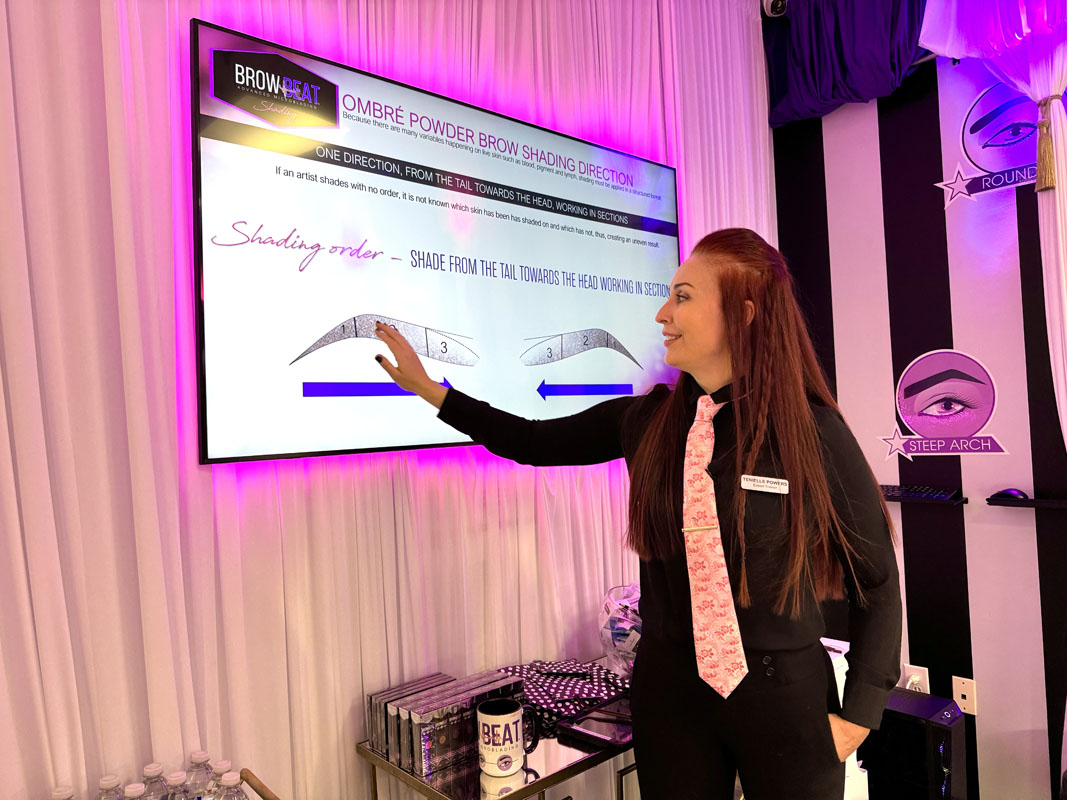
PMU correction instructor presenting previous eyebrow tattoo assessment examples on a large classroom screen.

MICROBLADING & TATTOO CORRECTION TRAINING IN TEXAS

Permanent makeup artists spend a great deal of time learning how to create beautiful brows on a relatively open canvas.

But an artist does not work on blank canvases forever.

Eventually, your own clients come back.

Maybe you first worked on them years ago.

They have had several treatments since then.

The color has changed.

The strokes are no longer as distinct as they once were.

The density has built.

The shape that looked right years ago may no longer feel as soft or modern today.

Or perhaps the client sitting in front of you is not your previous client at all.

She moved.

Her former artist moved.

Her artist is no longer in business.

She no longer wants to return to the person who originally performed the work.

Whatever the reason, she already has permanent makeup.

Now she is sitting in your chair.

That is the part of a PMU career that foundational technique training does not always prepare artists for.

At BrowBeat Certification, we created our advanced Microblading & Tattoo Correction training around that gap.

Correction is not only about rescuing obviously bad permanent makeup.

Sometimes previous work was good.

It has simply aged.

Sometimes it has been treated repeatedly over a number of years and the artist is no longer dealing with one clean layer of pigment.

Sometimes the previous work belongs to another artist.

Sometimes it is your own.

Either way, the question changes.

You are no longer asking:

What brows would I create on a blank canvas?

You are asking:

What is already here, what has changed, and what is the most appropriate correction approach now?

That is advanced PMU decision-making.

There Is a Gap Between Creating New Brows and Working With Previous PMU

New-technique education teaches artists how to create.

Correction education teaches artists how to inherit.

You inherit the pigment that is already there.

You inherit the previous shape.

You inherit the existing strokes.

You inherit the density.

You inherit the color shift.

You inherit every treatment the brow has already received.

And then you have to decide what to do with it.

That creates a very different professional problem from starting fresh.

An artist can be highly competent at Microblading, Ombré Powder Brows or Combo Brows and still find previous work challenging because the decision-making is different.

You are not simply designing what you want to create.

You are evaluating what can realistically be created from what is already present.

This is why BrowBeat treats correction as advanced permanent makeup education rather than permanent makeup certification courses.

microblading correction certification focused on saturation and undertone assessment
refresh vs.

true

Correction

A faded brow may need a refresh. A saturated, discolored brow requires correction. Tattoo correction training Texas teaches artists how to distinguish between simple maintenance and structural revision. This brow tattoo correction course breaks down pigment load, undertone distortion, and density imbalance before intervention. Microblading correction certification focuses on targeted color correction training, not automatic re-stroking. PMU correction education begins with diagnosis, not assumption.

correction is a

Different

Discipline

Initial application and corrective work are not the same skillset. Tattoo correction training Texas teaches assessment before action — analyzing saturation level, migration, and tissue response. This brow tattoo correction course trains artists to restructure pigment. Microblading correction certification emphasizes strategic color correction training and pigment recalibration. PMU correction education requires diagnostic thinking, not decorative overlay.

color correction training teaching pigment mixing not covering in brow correction
pigment does not cover pigment

it

Mixes

A core principle in tattoo correction training Texas: pigment does not cancel pigment — it visually mixes. When brown is placed over red, the result is red-brown. When strokes are added over gray, they read as muddy gray brow. This brow tattoo correction course teaches a neutralization strategy before reapplication. PMU correction education prioritizes controlled color correction training over cosmetic concealment.

simulation exercise for

color

Correction

Blue, red, and gray brows cannot be corrected by placing brown over the top — pigment mixes, it does not cancel. In advanced tattoo correction training Texas, students learn how to properly neutralize unwanted tones before adding new color. Through hands-on simulation exercises in a structured brow tattoo correction course, artists develop real correction control. True microblading correction certification focuses on strategic color correction training.

Blue, red, and gray eyebrow color correction example used in tattoo correction training Texas
tattoo correction training Texas explaining risks of microblading over microblading
the industry problem: layering

instead of

Correction

The PMU industry often solves faded microblading by adding more strokes. In reality, repeated layering increases pigment density, visual blur, and distortion. Tattoo correction training Texas teaches that microblading over microblading does not restore structure — it compounds saturation. This brow tattoo correction course addresses the biological and optical limits of layered pigment. Microblading correction certification replaces guesswork with controlled color correction training.

microblading over microblading?

not so

Fast

In tattoo correction training Texas, we teach that microblading over existing microblading compounds pigment density and visual distortion. Old strokes do not disappear — they expand, shift, and mix optically with new pigment. This brow tattoo correction course explains why repeated stroke layering increases saturation and blur. Microblading correction certification focuses on color correction training and controlled shading — not stacking strokes.

brow tattoo correction course explaining why microblading over microblading fails
brow tattoo correction course managing tattoo and microblading combined pigment
when brows have both

tattoo &

Microblading

Many clients present with layered techniques. Tattoo correction training Texas prepares artists to handle conflicting pigments from tattoo and microblading combined. This brow tattoo correction course explains how to identify dominant undertones and rebalance them through color correction training and structured shading approaches.

correction training

kit

Included

Advanced tattoo correction training Texas includes a comprehensive kit designed specifically for structured color correction education. Students enrolled in the brow tattoo correction course receive professional tools and pigments selected to support hands-on PMU correction education. This kit is built for real correction work — reinforcing the technical skills taught through microblading correction certification.

Professional microblading and brow tattoo correction training kit included in tattoo correction training Texas certification course
Red eyebrow correction from previous microblading using professional color correction techniques in tattoo correction training Texas
red microblading

color

Correction

Red brows happen when warm pigment resurfaces over time. Placing brown over red will only create a muddy red-brown. Proper color correction training teaches artists how to neutralize warmth first before redesigning shape or density. In advanced tattoo correction training Texas, students learn that correction is about rebalancing using color theory — not simply layering more pigment.

gray merged strokes

color

Correction

Repeated microblading can create gray buildup as saturation increases. These brows can often be softened and visually lightened using controlled peach-based correction techniques. A structured brow tattoo correction course teaches artists how to assess pigment load and apply targeted correction instead of adding more strokes. True microblading correction certification focuses on recalibration, not repetition.

Gray buildup from repeated microblading treatments corrected using peach-based tone rebalancing techniques
Fifteen-year-old gray eyebrow tattoo being assessed for color correction in advanced PMU correction education
gray tattoo

color

Correction

Older gray tattoos can often be color corrected using similar neutralizing techniques, as long as the pigment is not overly dense or fully saturated. In professional tattoo correction training Texas, artists learn to evaluate depth and solidity before proceeding. Effective PMU correction education teaches when correction is appropriate — and when expectations must be carefully managed.

softening & lightening

color

Correction

A powder brow that is darker than expected may be softened through controlled correction techniques. Peach-based adjustments can help visually rebalance cool tones, though results depend on saturation and skin response. Advanced color correction training emphasizes subtle shifts over time rather than dramatic changes in a single session.

Dark Gray Powder Brow Tone Softening – Color Correction Training

Correction Does Not Automatically Mean the Previous Brows Were Bad

The word correction can make people imagine one thing: badly performed permanent makeup that needs to be rescued.

That is only one category.

Immediate problems can certainly exist.

But a large part of professional correction work develops much more gradually.

Permanent makeup ages.

Clients return.

Additional treatments are performed.

Pigment remains in the skin while new pigment is introduced.

Strokes that were once distinct can become less visually separate.

Color can shift.

Density can increase.

Styles change.

A brow shape that once felt current can eventually feel heavier or less soft than the client now prefers.

None of that automatically means the original work was bad.

It means the artist is no longer working with the same starting point.

A client you have worked on repeatedly over many years can eventually become a correction case even though the previous work is your own.

You may call the appointment a refresh.

But technically, the artist can still be dealing with many of the same questions found in correction:

What pigment remains?

What color has it become?

How much density has accumulated?

What shape exists now?

Where does the brow begin and end?

How does the arch sit?

Does the design still feel appropriate for the client today?

What can be added?

What should not simply be added again?

That is a much larger professional subject than “fixing bad brows.”

Your Own Previous Work Can Become Correction Work

This is something artists need to think about long before they have been in the industry for ten years.

Your client history grows with you.

A new artist can spend the early part of a career seeing many first-time permanent makeup clients.

Years later, those same people begin returning with a history.

The brow you are looking at may contain decisions you made several treatments ago.

That does not make those decisions wrong.

It means the brow has evolved.

The client’s face has aged.

Her style can change.

Your own artistic judgment can develop.

Techniques can change.

And the pigment already in the skin becomes part of every future decision.

Advanced correction education prepares artists for that stage of their career too.

Correction is not only a skill for taking over another artist’s work.

It is a skill for managing the long-term reality of your own work.

Instructor presenting blue-toned previous brow pigment during PMU correction education.

What Is Microblading & Tattoo Correction Training?

Microblading & Tattoo Correction training is advanced permanent makeup education focused on assessing and correcting previous or existing PMU.

You may see related education described as PMU correction training, permanent makeup correction certification, Microblading correction training, cosmetic tattoo correction training, brow tattoo correction training or eyebrow tattoo correction education.

The terminology varies because previous brow work can originate from different techniques.

The central problem is the same:

There is already pigment in the skin.

The artist needs to understand it before deciding what happens next.

This is not foundational Microblading training.

BrowBeat’s Correction certification does not teach a new student how to create Microblading strokes from the beginning.

Microblading appears in the course name because previous Microblading is one of the types of existing work an experienced artist can encounter and need to correct.

The corrective procedures taught within BrowBeat’s Correction training are performed with the PMU machine.

Why PMU Correction Is an Advanced Skill

A foundational PMU student is learning how to create.

An advanced correction student is learning how to evaluate before creating anything else.

That difference matters.

The artist already needs a technical foundation.

Correction adds another layer of reasoning.

What is already in the skin?

How old is the work?

How has the color changed?

How much density remains?

What does the previous shape look like?

Are old strokes still visible?

Is the coverage consistent?

Is the existing work appropriate for direct correction?

What is realistically possible from this starting point?

An advanced correction artist does not begin by deciding what technique they feel like performing.

They begin by understanding the case.

Correction Is a Decision-Making Course

The technical skills matter.

But the larger skill is knowing what decision to make.

At BrowBeat, our correction framework begins with assessment:

Assess what is there.

Then identify the problem.

Then determine the appropriate correction approach.

That sounds simple.

In practice, it asks the artist to stop treating all previous permanent makeup as one category.

One brow can primarily have a color problem.

Another can have inconsistent coverage.

Another can have old Microblading strokes that remain visually strong.

Another can have several issues at the same time.

And another may not be appropriate for direct correction at all.

The skill is learning to recognize the difference.

What Do You Learn in PMU Correction Training?

BrowBeat’s advanced correction education teaches artists to approach previous work as a series of connected assessment and correction decisions.

The curriculum includes several major areas.

Corrective Color Reasoning

Previous permanent makeup can change color as it ages.

The artist needs to identify the color that is actually present before deciding what should be added.

BrowBeat teaches a missing-color approach:

What color is there?

What color is missing?

What corrective color or approach moves the brow toward the intended balance?


Assessment of Previous and Old PMU

Before direct correction, the artist needs to evaluate the work that already exists.

Color is part of that assessment, but it is not the only consideration.

The artist also needs to look at shape, density, saturation, previous strokes, coverage and the overall condition of the healed work.

Most importantly, the artist needs to decide whether the case is appropriate for direct correction.


Instructor presenting patchy previous eyebrow tattoo coverage and visible gaps on a classroom screen.

Patchy and Uneven Coverage

Previous PMU can heal or age with areas of inconsistent coverage.

One area can retain more pigment.

Another can appear lighter.

Gaps can remain between previous strokes or sections of older pigment.

This is a coverage problem—not automatically a shape-asymmetry problem.

For detailed education on assessing and correcting inconsistent coverage, continue to our Correcting Patchy & Uneven PMU Training guide.

Corrective Machine Shading and Dark Previous Strokes

Corrective procedures in BrowBeat’s Correction certification are performed with the PMU machine.

Artists learn to think about how corrective shading works with existing pigment, including situations where previous Microblading strokes remain visible or dark.

The detailed physical mechanics of corrective machine work belong to our Advanced Corrective Machine Shading & Dark-Stroke Training guide.

Correction Starts With What Is Already There

The easiest way to make a poor correction decision is to look past the previous work and think only about the new result you want to create.

The existing work is the starting point.

Look at it.

What color is present?

How much pigment remains?

Where is it dense?

Where is it lighter?

What shape exists?

Where does the brow begin?

Where does it end?

How does the arch sit?

What happens between the first and second reference points?

Does the design still feel appropriate for the client’s face and style?

What previous strokes remain visible?

Has the brow been worked on repeatedly?

Those observations create the correction plan.

The artist is not correcting the word Microblading.

They are correcting the individual result in front of them.

Shape Is Part of Correction Assessment

Previous permanent makeup can have a color problem and still have a good shape.

It can have an acceptable color and a shape that no longer feels right.

It can have both.

This is why advanced assessment needs to look at the brow as a complete design.

Where does it start?

Where does it finish?

Where is the arch?

How straight or curved is the transition through the brow?

Does the shape still feel soft enough for the client?

Does it still make sense on the face today?

The purpose of this assessment is not to imply that every old shape can simply be redesigned by working over it.

It is to recognize shape as one of the factors an experienced artist needs to evaluate before deciding whether direct correction is appropriate.

Detailed case assessment and correction planning belong to our Previous & Old PMU Assessment & Correction Planning guide.

Corrective Color Begins With What Is Missing

Color-shifted previous PMU can appear red, orange, grey, blue, purple or otherwise different from the intended brow color.

The temptation is to memorize a correction chart.

We want students to understand the reasoning underneath it.

Start with the color that is present.

Then ask what is missing.

If the goal is to move the brow back toward an appropriate brown balance, the artist needs to understand which color relationship is incomplete.

That gives the corrective pigment decision a reason.

It is not:

“This is red, so memorize this bottle.”

It is:

“This is what I see. This is what is missing. This is why the corrective direction makes sense.”

For the full educational framework—including red, orange, grey, blue, purple and shifted previous pigment—continue to our PMU Color Correction & Missing-Color Theory Training.

Previous Work Can Be Yours or Someone Else’s

Correction education becomes much more useful when artists stop thinking of previous work as synonymous with another artist’s mistake.

Sometimes it is another artist’s work.

Sometimes it is yours.

Sometimes the client loved the original result.

Sometimes she has simply lived with permanent makeup for years.

Sometimes several treatments have accumulated.

The question is not who performed the previous procedure.

The question is what exists now.

This removes blame from the assessment and puts the artist’s attention where it belongs:

On the current brow.

Not Every Previous Brow Should Be Corrected Directly

Advanced correction training needs to teach judgment, not just technique.

There are cases where an artist needs to recognize that simply adding more pigment is not the appropriate decision.

Previous work can be too dense, too saturated or otherwise unsuitable for direct correction.

The responsible question is not:

“How can I make myself work over this?”

It is:

“Is direct correction appropriate for this case?”

That is part of advanced case selection.

Our Previous & Old PMU Assessment & Correction Planning guide explores that decision in greater depth.

Instructor showing orange-shifted eyebrow tattoo examples on a classroom presentation screen.

PMU Correction Is Not Tattoo Removal

Direct correction and pigment removal are not the same process.

Correction works with the existing permanent makeup when the case is appropriate for corrective work.

Removal or lightening is a separate intent focused on reducing existing pigment.

BrowBeat’s Microblading & Tattoo Correction certification is correction education.

We do not describe corrective pigment or machine shading as though it removes old pigment from the skin.

That boundary is important for both the artist and the client.

Patchiness Means Coverage—Not Automatically Shape

When previous work is described as patchy or uneven, students need to identify what is actually uneven.

Is pigment coverage inconsistent?</p

Are there gaps between areas of retained pigment?

Has one section faded more than another?

Is the density inconsistent across the brow?

Those are coverage questions.

They should not automatically be turned into a completely different shape problem.

The distinction matters because the correction plan depends on identifying the actual issue rather than responding to a vague description such as “uneven brows.”

For deeper education on coverage problems, see our Correcting Patchy & Uneven PMU Training guide.

Corrective Procedures Use the PMU Machine

BrowBeat’s Correction certification is machine-based corrective education.

This is an important distinction because the word Microblading appears in the course name.

Students are not learning foundational Microblading strokes in this course.

They are learning how to assess and correct previous Microblading and other existing permanent makeup using corrective PMU machine techniques.

The machine allows the artist to approach corrective shading, coverage, density, blending and other technical aspects of working with previous pigment.

Those physical mechanics require their own advanced skill set.

Movement matters.

Pressure matters.

Depth matters.

Density matters.

Saturation matters.

Layering matters.

And the way corrective shading transitions into previous work matters.


Dark Previous Microblading Requires Judgment

Dark previous strokes create a different starting point from light, open previous work.

The artist needs to evaluate what is actually present before deciding whether direct correction makes sense.

How dark are the strokes?

How dense is the existing pigment?

How much separation remains?

What color is present?

How much additional pigment can reasonably be introduced?

The existence of a correction technique does not mean every dark previous brow is automatically a candidate for direct corrective work.

This is where advanced assessment and machine judgment meet.

For the physical execution side of dark-stroke correction, see our Advanced Corrective Machine Shading & Dark-Stroke Training guide.

Instructor presenting an aged eyebrow tattoo shape for advanced correction assessment.

Correction Is About Integration, Not Pretending the Previous Work Is Gone

Previous pigment does not disappear simply because the artist introduces corrective work.

The existing work remains part of the visual problem the artist is solving.

That is why correction requires integration.

The artist needs to understand how new corrective pigment relates to what is already visible.

How does the new work blend with the old?

How does additional coverage change the density?

How does the corrective color interact with the existing healed color?

How can the result be enhanced without pretending the previous layers are no longer there?

This is a very different mindset from starting on untouched skin.

Aged Permanent Makeup Can Become an Advanced Design Problem

Color is not the only thing that changes over time.

The client changes too.

A client who first received permanent makeup years ago may return at a different stage of life.

Her preferences may be different.

Her face may have changed.

She may now want something softer.

A shape that once felt current may no longer feel like her.

The artist therefore needs to evaluate more than whether pigment is still visible.

Does the existing design still serve the client?

Where does it begin and end?

How does the arch relate to the rest of the brow?

How strong is the structure?

How much flexibility does the existing pigment actually leave?

These are advanced planning questions.

They do not guarantee that every desired design change can be achieved through direct correction.

They help the artist decide what is realistic.

Advanced Correction Training for Working PMU Artists

BrowBeat’s Microblading & Tattoo Correction certification is designed as advanced education for working PMU artists.

This is not where a brand-new student learns foundational permanent makeup.

It is not where someone learns what a PMU machine is for the first time.

And it is not foundational Microblading training.

The course builds on previous permanent makeup education and machine experience.

The artist arrives with a foundation.

Correction adds a new layer:

What do I do when the canvas is no longer blank?

Specific experience requirements, prerequisites and course suitability belong to our Advanced Correction Course Requirements & Who It’s For guide.

Correction as Continuing Education for PMU Artists

Correction becomes increasingly relevant as an artist’s career develops.

The longer you work, the more previous permanent makeup exists in the market.

And the more of your own clients develop a treatment history.

That makes correction a natural area of continuing education.

The artist is no longer learning only how to produce a new technique.

They are developing the ability to manage the life cycle of permanent makeup.

What happens years later?

What happens after repeated treatments?

What happens when color changes?

What happens when old strokes remain?

What happens when the client wants a softer or more current result but existing pigment limits the options?

Those are questions working artists eventually encounter whether the previous work belongs to them or somebody else.

Hands-On, Instructor-Led PMU Correction Education

Correction combines visual assessment with technical execution.

Artists need to learn how to identify the problem and then understand how the correction approach connects to what they see.

That makes instructor-led education particularly valuable.

A student can identify that a brow looks “off” without yet being able to explain why.

Is it color?

Coverage?

Density?

Shape?

Old strokes?

More than one issue?

Practical correction education helps artists slow that assessment down and separate the problems before deciding how to proceed.

Where practical exercises are used, BrowBeat keeps training grounded in the confirmed educational formats appropriate to the course rather than describing the certification as live-model training.

Microblading & Tattoo Correction Training in Dallas, Texas

BrowBeat Certification provides advanced Microblading & Tattoo Correction training in Dallas, Texas.

The program is designed for working permanent makeup artists seeking professional correction education rather than foundational PMU training.

Students searching for PMU correction training, Microblading correction courses, permanent makeup correction certification or cosmetic tattoo correction education in Texas are often looking for the same broader professional skill:

How do I work intelligently with permanent makeup that is already there?

BrowBeat’s Dallas training approaches that question through assessment, corrective color reasoning, previous-work planning and machine-based corrective technique.

For artists in Dallas–Fort Worth or those traveling to Texas for advanced PMU education, the location provides an in-person option for developing correction-specific skills.

Instructor presenting before-and-after eyebrow correction results on a classroom screen.

Choosing an Advanced PMU Correction Course

When comparing correction courses, look beyond the word advanced.

Ask what the course actually teaches the artist to do.

Does it teach assessment before execution?

Does it teach artists to evaluate previous healed work?

Does it address case selection?

Does it acknowledge that not every previous brow is appropriate for direct correction?

Does color education teach reasoning, or only memorized recipes?

Does the program distinguish correction from removal?

Does it explain that previous work can be your own as well as another artist’s?

Does it teach machine-based corrective execution?

Does it help artists distinguish a color problem from a coverage problem?

Those questions tell you much more about a professional PMU correction program than the course title alone.

What Makes Correction Different From Learning Another Brow Technique?

Learning a new brow technique expands what an artist can create.

Learning correction expands what an artist can understand.

That is a different kind of professional development.

The artist is not simply adding another finished brow style to a menu.

They are learning how to look at previous work, identify what is happening and decide which corrective path—if any—is appropriate.

This is why correction can influence the way an artist thinks about all of their future work.

Every new brow eventually becomes previous work.

Every treatment becomes part of that client’s history.

And every decision made today changes the starting point the artist will inherit later.


Explore the Microblading & Tattoo Correction Curriculum

The Correction certification Hub gives artists the complete picture. Each guide below goes deeper into one part of advanced corrective education.

Correction Is Part of a Long-Term PMU Career

The longer you work in permanent makeup, the more likely you are to encounter previous work.

Some of it will belong to other artists.

Some of it will belong to you.

Some clients will arrive because they moved.

Some because their previous artist is no longer available.

Some because they want a different approach.

And some will simply be your own long-term clients returning years later with a treatment history.

That is why correction is bigger than fixing obviously bad brows.

It is part of understanding what happens to permanent makeup over time.

The artist needs to know how to look at what remains, understand the color, assess the shape, evaluate density and previous strokes, recognize coverage problems and determine whether direct correction is appropriate.

Then—and only then—does execution begin.

Assess what is there → identify the problem → determine the appropriate correction approach.

That is the foundation of BrowBeat’s Microblading & Tattoo Correction education.

Microblading & Tattoo Correction Certification FAQs


What is PMU correction training?

PMU correction training is advanced permanent makeup education focused on assessing and correcting previous or existing work. Students learn to evaluate what is already present, identify the correction problem and determine an appropriate approach rather than treating the brow as a blank canvas.

Microblading & Tattoo Correction certification is professional correction education for artists working with previous Microblading, permanent makeup and cosmetic brow tattooing. BrowBeat’s course focuses on advanced assessment, corrective color reasoning and machine-based correction.

No. BrowBeat’s Correction certification does not teach foundational Microblading. Microblading is part of the course name because previous Microblading is one type of existing work artists learn to assess and correct.

Yes. Corrective procedures taught in BrowBeat’s Correction certification are performed with the PMU machine. Detailed corrective machine mechanics belong to our Advanced Corrective Machine Shading & Dark-Stroke Training guide.

Yes. BrowBeat’s Correction certification is advanced education for working PMU artists with previous permanent makeup and machine experience. It is not foundational beginner training.

No. BrowBeat’s Correction certification is designed for working artists with prior PMU experience. See our Advanced Correction Course Requirements & Who It’s For guide for detailed eligibility information.

Students learn to assess previous work, reason through corrective color, identify coverage problems and understand machine-based corrective approaches. The larger skill is deciding what the existing brow requires before beginning corrective execution.

Yes. Corrective color is part of BrowBeat’s Correction education. Students learn to assess the existing healed color, identify what color is missing and determine an appropriate corrective direction.

Missing-color theory asks the artist to identify the color already present and determine which color relationship is missing before selecting a corrective pigment. Detailed education belongs to our PMU Color Correction & Missing-Color Theory Training guide.

Yes. Previous and old Microblading are important correction scenarios because existing strokes, pigment, density, color and shape all need to be evaluated before deciding what can appropriately be done next.

No. An experienced artist needs to assess whether previous work is appropriate for direct correction. Dense, saturated or otherwise unsuitable previous work should not automatically be worked over simply because a correction technique exists.

No. Direct correction does not remove existing pigment. Correction works with previous pigment when the case is appropriate, while removal or lightening is a separate procedure and search intent.

No. PMU correction and tattoo removal are different. Correction works with existing permanent makeup to improve an appropriate case; removal or lightening is intended to reduce existing pigment.

Yes. Correction does not automatically mean the original work was bad. Previous PMU can age, accumulate through repeated treatments, change color or become less aligned with the client’s current preferences, creating new assessment and correction decisions over time.

Yes. As an artist’s client history grows, their own long-term clients can eventually present with multiple treatments, aged pigment, changing color or design considerations. Correction skills apply to previous work whether it was originally performed by you or another artist.

Yes. Patchy, inconsistent or incomplete pigment coverage is one correction category. Detailed coverage-specific education belongs to our Correcting Patchy & Uneven PMU Training guide.

Dark previous strokes require careful assessment of pigment density, saturation, color and suitability for direct correction. Machine execution for appropriate dark-stroke cases is covered in our Advanced Corrective Machine Shading & Dark-Stroke Training guide.

Corrective machine shading is PMU machine work used within appropriate correction cases to build, blend or integrate corrective pigment with existing brow work. The detailed physical mechanics belong to the corrective machine-shading child.

Yes. BrowBeat Certification provides advanced Microblading & Tattoo Correction training in person in Dallas, Texas for working PMU artists.

BrowBeat Certification offers advanced PMU correction training in Dallas, Texas for working permanent makeup artists seeking professional correction education.

BrowBeat Certification provides in-person Microblading & Tattoo Correction training in Dallas. The course focuses on assessing and correcting previous work rather than teaching foundational Microblading.

Training-cost questions belong to our dedicated Microblading & Tattoo Correction Course Cost & Training Pricing guide, where artists can evaluate correction-course pricing without confusing education cost with consumer correction-service pricing.

BrowBeat’s Correction certification is advanced training for working PMU artists with prior permanent makeup experience. Detailed prerequisites, existing-skill expectations and eligibility are covered in our Advanced Correction Course Requirements & Who It’s For guide.

Yes. Correction is advanced professional education that helps working PMU artists develop skills for assessing and working with previous permanent makeup, including their own aging work and work originally performed by another artist.

Look for education that teaches assessment before execution, case selection, corrective color reasoning, the distinction between correction and removal, and machine-based corrective technique. A strong correction course should also acknowledge that not every previous brow is appropriate for direct correction.