MICROBLADING PRACTICE METHODS FOR BEGINNERS
Learning Microblading requires more than understanding what a good hair stroke should look like. The student also has to train the hand to create those strokes with increasing consistency, place them intentionally and connect individual strokes into patterns that make sense within a brow.
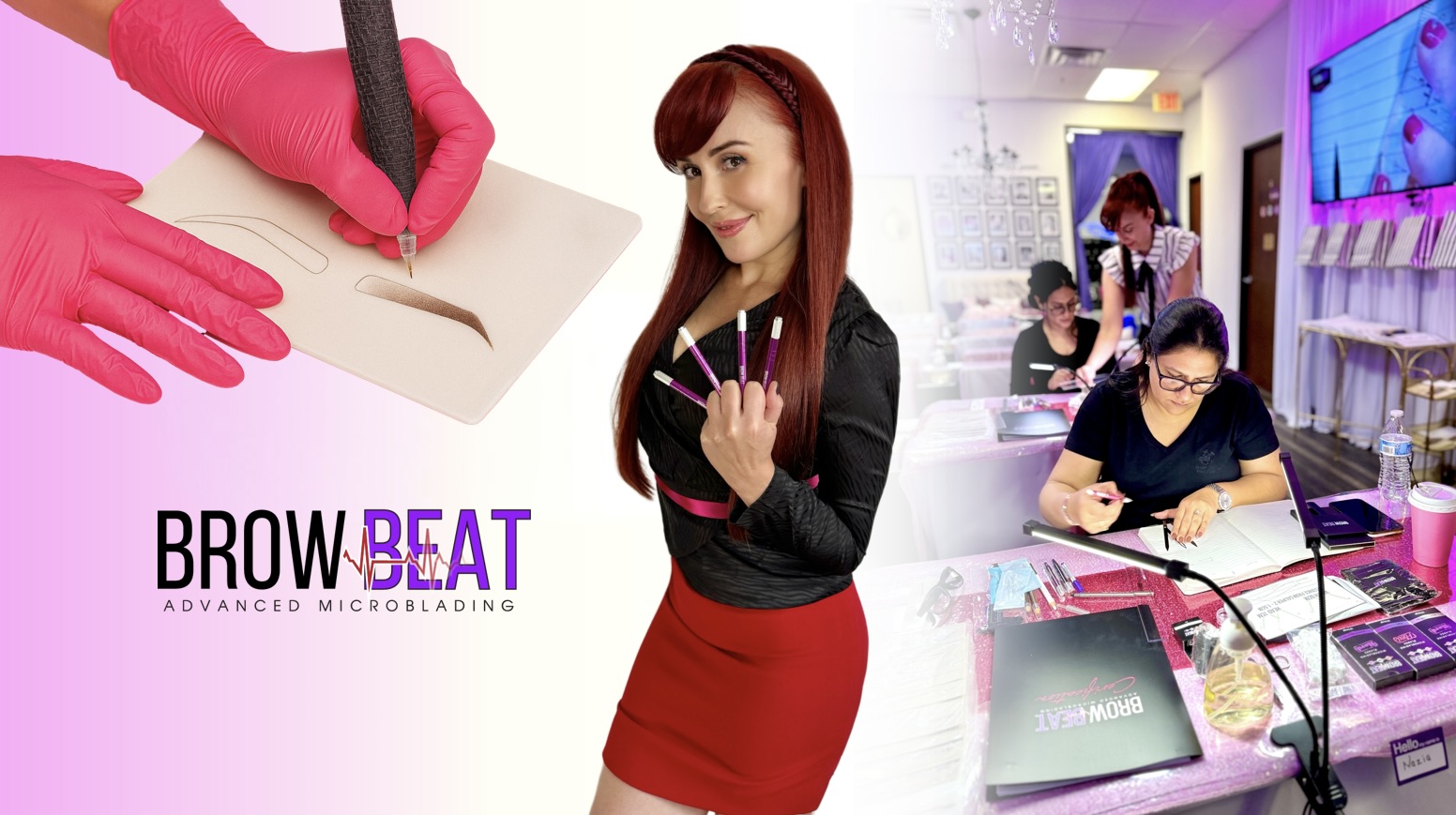
BrowBeat Certification develops that skill progressively. Students begin with paper exercises, move into silicone practice and then work on silicone brow headbands that place the practice area in a more realistic facial position. Each stage has a different purpose, so students are not simply repeating the same exercise on three different surfaces.
The most useful Microblading practice is deliberate. A student should know what they are trying to improve, look critically at the result and make a specific adjustment on the next attempt. Repeating a movement without understanding what needs to change can reinforce the same problem rather than correct it.
For beginners, this approach makes practice much more manageable. Instead of trying to create a complete, polished brow immediately, students can develop individual parts of the skill and gradually learn how those parts work together.
Why Microblading Requires Repetition
Microblading is a manual hair-stroke technique. The artist is controlling the hand tool directly, which means visual understanding and physical control have to develop together.
A student can understand exactly where a stroke belongs and still struggle to reproduce it consistently. The eye may recognize the intended direction while the hand creates something different. That gap between knowing and doing is one of the reasons practical repetition matters.
With purposeful practice, the student begins developing familiarity. Stroke patterns become easier to recognize, movements become less foreign and the student gains more information about their own tendencies. They may notice that one direction is consistently more difficult, that spacing changes in a particular part of the pattern or that the overall flow becomes less controlled when they rush.
Those observations give practice direction. Instead of simply trying again, the student knows what the next attempt is supposed to improve.

practice
Method
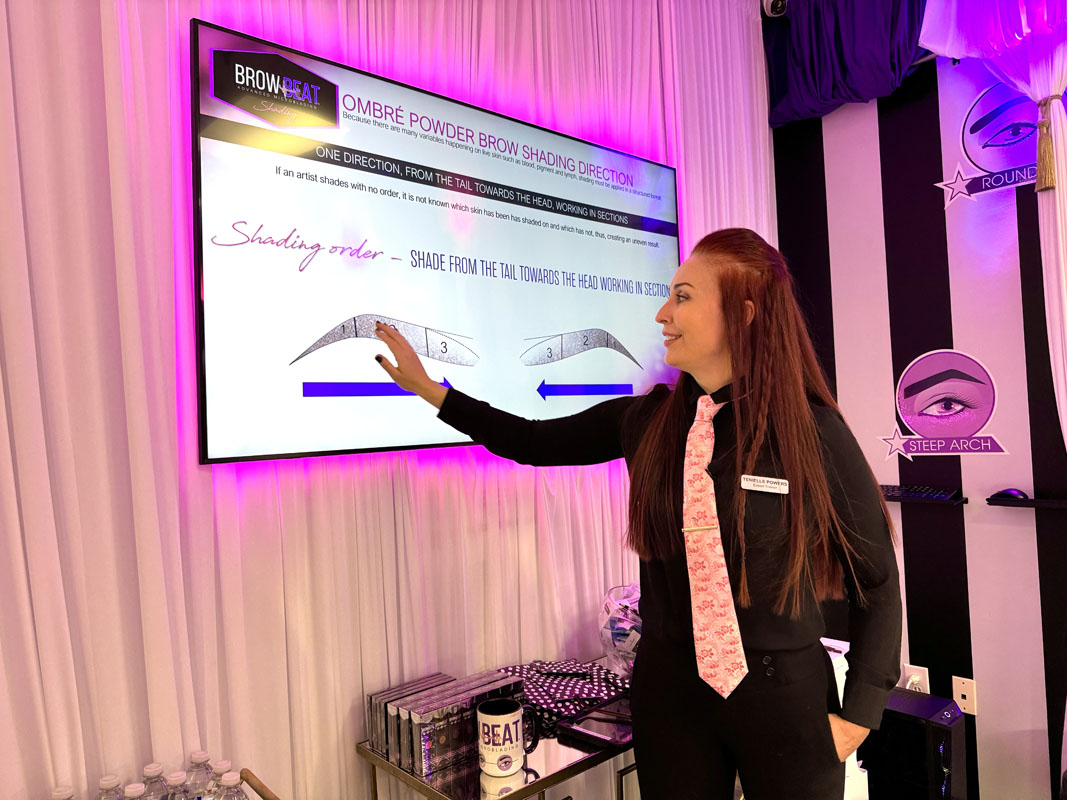
Mapping on paper represents one of the most effective microblading practice methods for beginners. During this session, students explore universal brow language and reference point placement while engaging in microblading training practice exercises designed to support understanding of how to practice microblading before stroke work begins.
practice
Exercise
Golden ratio mapping activities highlight microblading training practice exercises that reinforce proportional awareness. This practice moment demonstrates how microblading practice methods extend beyond strokes, showing students the best way to practice microblading through structured brow design preparation.


practice
Training
Sketching the brow is an important step within microblading practice methods that supports pattern visualization. Through these microblading training practice exercises, students explore how to practice microblading with intention while developing visual structure awareness that supports later stroke placement.
in
Training
Introducing the stroke pattern provides clarity on microblading practice techniques used throughout the day. This instructional moment reflects how microblading practice methods begin with understanding pattern components, allowing students to learn how to practice microblading through structured repetition.


practice
Exercise
Head pattern exercises represent focused microblading training practices designed to build directional control. Practicing these elements demonstrates microblading practice methods centered on repetition, reinforcing the best way to practice microblading through isolated pattern learning.
practice
Session
Upper and lower stroke exercises highlight microblading practice methods that emphasize directional variation. This practice session reflects microblading training practice exercises supporting understanding of how to practice microblading while reinforcing pattern balance.


practice
Exercise
Inner stroke repetition represent advanced microblading practice techniques within beginner training. These microblading training practice exercises demonstrate the best way to practice microblading by focusing on fine movement control and spacing awareness.
Brow
Shape
Practicing inside a defined brow shape reflects microblading practice techniques integrating mapping and strokes. This exercise demonstrates microblading training practice exercises designed to help students understand how to practice microblading within structural boundaries.


microblading
Practice
Blonde brow examples help beginning students develop Microblading practice skills where lighter pigment and fine hair strokes require careful visual control. Students can study stroke spacing, direction, pattern flow and softer color choices while building the precision needed to create balanced, natural-looking brow patterns.
pattern
Practice
Brunette brow examples give students a clear setting for practicing Microblading stroke patterns, where individual hair strokes, spacing and directional changes are easy to study. Beginners can concentrate on creating an organized pattern with natural flow while developing the repetition and manual control needed for more consistent Microblading work.


practice
Method
Medium-melanin brow examples give students another way to develop their Microblading practice methods while observing how stroke patterns and pigment choices appear across different brows. Beginners can focus on consistent spacing, directional flow and controlled hair-stroke placement while strengthening the practical skills introduced during Microblading training.
method
Study
High-melanin brow examples allow students to study Microblading hair-stroke patterns across deeper brow and skin tones while continuing to develop placement, spacing and directional control. Practice exercises help beginners understand how a well-structured stroke pattern remains important across different clients while building stronger visual judgment and Microblading technique.

Good Microblading Practice Has a Specific Goal
“Practice Microblading” is a very broad instruction. A beginner benefits from breaking that instruction into smaller objectives. One exercise can concentrate on stroke direction. Another can focus on spacing. Another can develop placement within a pattern. Once those individual elements become more familiar, the student can work on combining them without losing control of one component while concentrating on another.
This makes it easier to identify what is actually improving. If every practice session consists only of creating complete brows from beginning to end, a student can see that something looks wrong without necessarily understanding which part of the technique is causing the problem.
Focused practice creates a clearer feedback loop: identify the weakness, isolate it, repeat it with intention and then bring the improved skill back into the larger pattern.
Understand the Stroke Before Trying to Perfect It
Before a beginner can consistently reproduce a Microblading stroke, they need to understand what that stroke is doing within the brow. Hair strokes have direction and placement. They relate to neighboring strokes and contribute to the overall pattern. A technically neat stroke is not automatically a useful Microblading stroke if it travels in the wrong direction or interrupts the flow of the design.
This is why BrowBeat Microblading Certification begins with visual understanding rather than asking students to immediately concentrate on the manual tool. The student first develops a clearer idea of what they are trying to create, then begins training the hand to reproduce that intention.
When visual understanding comes first, practical mistakes become easier to evaluate because the student has something meaningful to compare them against.
Microblading Paper Practice
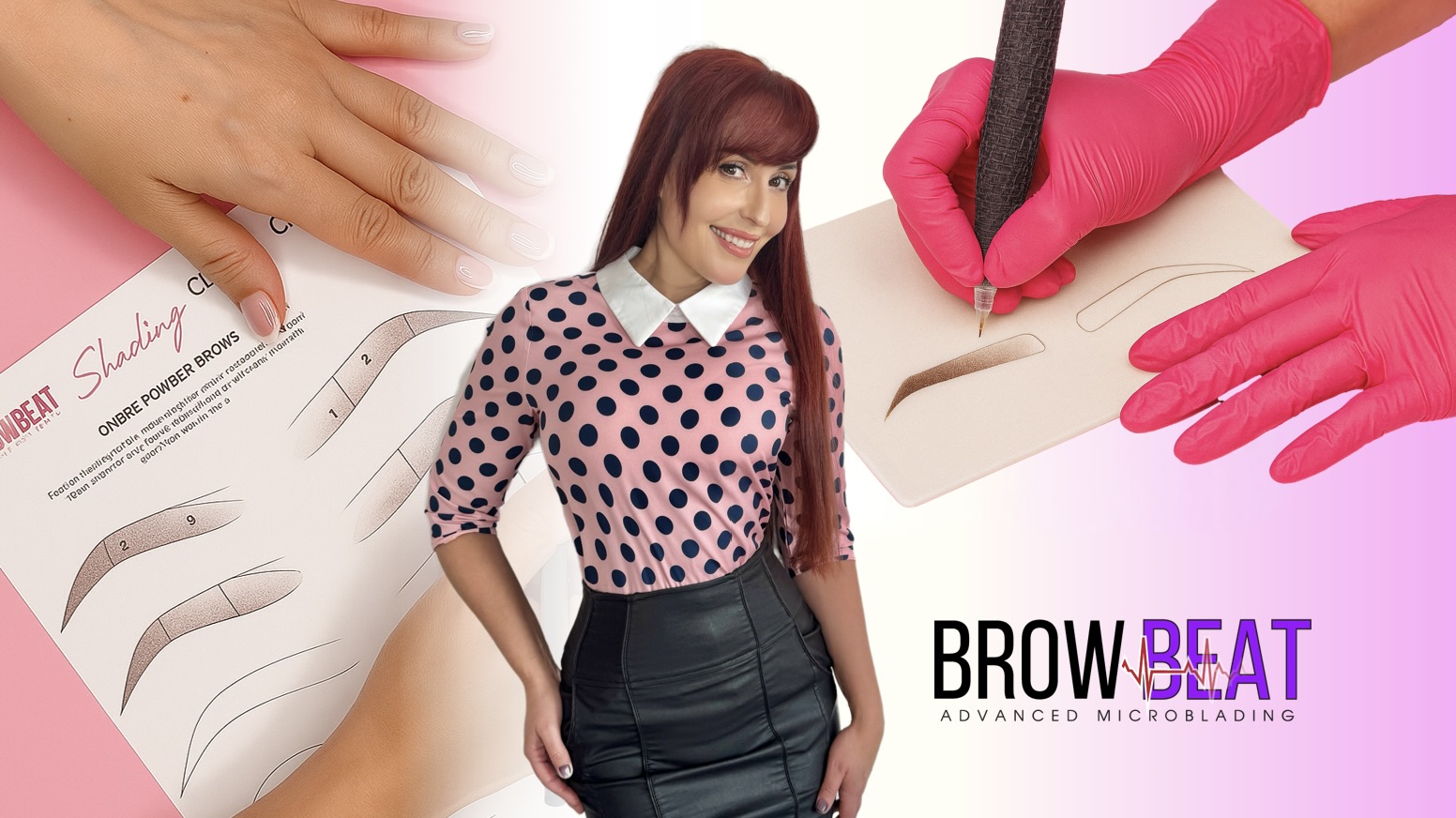
Paper is the first stage of BrowBeat’s Microblading practice progression because it allows students to concentrate on the visual structure of hair-stroke work without simultaneously managing the physical demands of the manual tool on silicone.
Students can repeat strokes, examine direction and begin understanding how individual lines develop into patterns. They can also see more clearly when spacing becomes inconsistent or when a stroke interrupts the intended flow. Paper practice should not be dismissed because it appears simple. For guiding a beginner in Microblading training, reducing complexity is useful. It allows one part of the skill to receive attention before another variable is introduced.
The objective is not to become excellent at drawing eyebrows on paper. The objective is to develop visual understanding that will support the physical Microblading work that follows.
What Paper Exercises Help Students Develop
Paper exercises give students room to concentrate on several important relationships within Microblading hair-stroke work. They can study direction, spacing, placement and the way strokes transition through a pattern without being distracted by the physical resistance of a practice surface.
Students can also compare repetitions more easily. When several attempts are visible beside one another, differences become obvious. One pattern may have stronger flow, another may become crowded, while another may lose structure because the stroke direction changes unexpectedly.
That comparison is useful because practice becomes more than producing another page of strokes. The student begins learning how to evaluate the work.
Practicing Hair-Stroke Patterns on Paper
Microblading hair strokes need to function as part of a pattern rather than as isolated lines. Paper gives students a practical way to explore that relationship.
A student can concentrate on how one stroke leads into another, how spacing changes the visual density and how the direction of the pattern develops across the brow. Repetition helps the student recognize when the pattern begins to feel disconnected.
This is also where students can begin distinguishing between copying a pattern and understanding it. Copying can help introduce an unfamiliar structure, but the deeper objective is to recognize why the strokes are positioned and directed the way they are. That understanding becomes increasingly important when the student eventually needs to apply the concept to different brow designs.

Practice Stroke Direction With Intention
Stroke direction affects the visual flow of Microblading. If the direction changes without purpose, individual strokes can begin competing with one another instead of contributing to a coherent pattern.
Beginners benefit from slowing the exercise down enough to see where each stroke is intended to travel before creating it. This keeps practice focused on intentional placement rather than allowing the hand to move automatically before the eye has made a decision.
As the student becomes more familiar with the pattern, that decision-making becomes quicker. The goal is not to rush toward that stage, but to build enough repetition that the relationship between seeing the direction and creating the stroke becomes increasingly familiar.
Practice Consistent Stroke Spacing
Spacing is another area where small inconsistencies can change the appearance of an entire pattern. Strokes that become crowded can lose definition, while excessive gaps can make the pattern feel disconnected. Practicing spacing helps students develop awareness of the negative space between strokes rather than concentrating only on the strokes themselves.
This is an important shift in how a beginner sees the work. The student is no longer asking only, “Is this stroke good?” They are also asking, “Does this stroke belong where I placed it, and does the space around it support the pattern?” That broader visual awareness helps the student move from creating individual strokes toward understanding a complete Microblading pattern.
Stroke Placement Matters as Much as the Stroke Itself
A well-formed stroke in the wrong place can still weaken the pattern. Placement practice teaches students to consider the relationship between the individual strokes and the structure around it. Each stroke needs a reason for being where it is rather than being added simply because there appears to be an empty space.
This is where earlier visual exercises become valuable. Students already have a reference for what the pattern is trying to accomplish, so they can begin evaluating whether their manual work supports that structure. The deeper brow mapping training for microblading students and brow-design system remains a separate skill, but practice helps students understand that technical execution always happens inside an intentional design.
Why Repeating a Bad Stroke Is Not Useful Practice
Repetition by itself does not guarantee improvement. If the student creates the same unwanted result repeatedly without identifying why it is happening, the exercise can simply make the unwanted habit more familiar. Useful repetition includes evaluation. The student creates the stroke, looks at the result and identifies what should change before repeating it.
Sometimes the correction is visual: the direction or placement needs adjustment. Sometimes the student needs instructor feedback because the problem is connected to a physical habit they cannot easily see while concentrating on the exercise.
The important principle is that the next repetition should have a purpose. Practice becomes much more productive when students know what they are trying to change.

Moving From Paper to Silicone Practice
Once students understand the visual concepts they have been practicing on paper, silicone introduces the physical Microblading technique. This transition changes the exercise substantially. The student now has to coordinate the manual hand tool with the movement they have been studying visually. The result depends not only on knowing what the stroke should look like but also on being able to guide the tool through the intended movement.
The student can still concentrate on the same concepts—direction, spacing, placement and pattern—but now those ideas have to survive physical execution. This is where beginners often discover that understanding something and reproducing it with the hand are two separate stages of learning.
What Changes When You Practice Microblading on Silicone?
Silicone gives students a practice surface that allows them to work with the manual Microblading tool and begin developing the physical coordination behind the technique.
The student now receives immediate visual evidence of how the movement translated through the tool. A stroke that looked simple on paper can feel very different when it has to be created manually on a practice surface.
This stage helps students become more aware of consistency. Instead of producing one successful stroke and moving on, they can repeat the movement and compare the results. If every attempt looks different, the skill is not yet consistent even if one stroke happened to work well. That comparison gives the student a more realistic picture of what still needs practice.
One Good Stroke Is Not the Same as Consistency
Beginners naturally notice their best attempts. A particularly clean stroke can feel like evidence that the skill has finally clicked. It is evidence of progress, but consistency asks a different question: can the student produce controlled work repeatedly rather than occasionally?
This is why Microblading practice needs multiple repetitions. The student is looking for patterns across the work rather than judging ability from one unusually strong or weak attempt. As the results become more consistent, the student gains better evidence that the movement is becoming familiar rather than depending on chance.
Practice Complete Patterns as Well as Individual Strokes
Isolated stroke exercises are useful because they allow students to concentrate on one movement. Eventually, however, those strokes need to function together.
Complete pattern practice asks the student to maintain direction, spacing and placement across a larger sequence. A student who can create several strong individual strokes may discover that consistency becomes more difficult when attention has to be sustained throughout the complete pattern.
Both types of practice are valuable. Isolated exercises help address a specific weakness, while complete patterns show whether the individual skills remain stable when they have to work together. A useful practice routine moves between the two rather than assuming every session needs to consist entirely of complete brows.

Learn to Evaluate Your Own Microblading Practice
Instructor feedback is extremely valuable during training, but students also need to begin developing the ability to examine their own work. Useful questions include whether the stroke direction supports the pattern, whether spacing remains controlled, whether placement feels intentional and whether the overall pattern maintains a coherent flow.
The student can compare the current attempt with earlier work rather than comparing every beginner exercise with the portfolio of an experienced artist. That makes improvement easier to see and weaknesses easier to identify. Self-evaluation does not replace instruction. It helps students continue using what they learned once they are practicing independently.
When to Move From Flat Silicone to the Brow Headband
The silicone brow headband adds another level of difficulty, so it makes sense after students have already developed some familiarity with the stroke patterns and manual technique on a flat practice surface. The headband is not simply a more interesting piece of silicone. It changes the working position.
The student now has to manage the technique while looking at the brow from a more realistic angle, positioning their body around the practice area and adjusting themselves as they move through the work.
Adding those demands after the basic movement has already been introduced allows the student to concentrate on adapting the skill rather than trying to learn every part of it simultaneously.
Silicone Brow-Headband Practice Adds Realistic Positioning
Flat silicone gives students a controlled surface for developing the manual Microblading movement. The silicone brow headband asks them to take that developing skill and use it in a position that more closely reflects how an artist physically works around a brow.
Once the headband is in place, the student has to consider more than the stroke itself. Their viewing angle changes as they move through different areas of the brow, their body position matters and they need to recognize when repositioning themselves creates a better working angle than trying to force the hand to work awkwardly.
This makes headband practice an important stage in the progression. The student is still working on silicone, where repetition and correction are possible, but the practice environment is no longer completely flat and convenient. The additional challenge helps students begin connecting manual Microblading skill with the physical realities of working around a face-shaped surface.
What the Brow Headband Adds That Flat Practice Cannot
Flat practice is useful because it removes complexity. Headband practice is useful because it deliberately adds some of that complexity back. A flat silicone sheet stays in the position the student chooses.
A brow in a facial position requires the student to adapt. Different areas of the brow can be easier to see and approach from different positions, so the student begins learning that they are responsible for moving themselves around the work rather than expecting every part of the brow to be equally accessible from one position.
The headband also makes it easier to understand the relationship between the individual exercise and the complete treatment flow. The student is no longer looking at a disconnected row of practice strokes. They are applying the skills within a recognizable brow position and working through the process in sequence.

Practicing the Complete Microblading Treatment Flow
Individual exercises are valuable while a student is developing specific skills, but Microblading eventually requires those skills to function within a complete process.
BrowBeat uses the silicone brow headband to help students practice the Microblading treatment flow after they have already worked through the relevant steps on paper and developed manual familiarity on silicone. The student can then concentrate on how the different parts of the process connect rather than encountering the complete sequence for the first time.
This type of practice tests a different form of understanding. The student needs to remember what comes next, maintain organization and continue applying the manual skill while moving through the larger workflow.
Practicing the complete flow does not replace isolated exercises. The two forms of practice answer different needs. A focused exercise develops a particular weakness, while treatment-flow practice helps the student integrate the individual skills into a connected process.
Body Position Is Part of Practical Microblading Skill
Students can become so focused on what the hand is doing that they overlook the position of the rest of the body. The silicone brow headband helps make that relationship more obvious.
If the student cannot comfortably see or approach part of the brow, the answer is not always to force the hand into the same position. Repositioning around the practice area can create a more workable view and allow the student to approach the exercise more deliberately.
Developing this awareness during practice is useful because it encourages the student to think about the complete physical environment rather than treating Microblading as a skill that exists only at the fingertips.
Instructor Feedback Makes Practice More Specific
One of the difficulties of learning a new manual skill is that students cannot always see their own habits while they are concentrating on the result.
During BrowBeat’s in-person practical training, instructors observe students as they work and help identify what needs attention. Feedback gives the student a more specific objective for the next repetition instead of leaving them with the vague feeling that something does not look right.
The student can then make an adjustment and immediately compare the next attempt. This creates a useful cycle: practice, observe, receive feedback, adjust and repeat. As students gain experience, they begin recognizing more of these patterns themselves. Instructor feedback helps develop that awareness while the skill is still new.
Practice the Weakest Part Instead of Avoiding It
It is natural to prefer exercises that already feel comfortable. They produce better-looking results and can make a practice session feel more successful. Skill development often requires the opposite approach.
If stroke direction becomes inconsistent in one part of a pattern, that area deserves focused practice. If spacing repeatedly becomes crowded, the student can isolate spacing rather than continuing to produce complete brows with the same issue. If the flat silicone work feels comfortable but positioning on the headband creates difficulty, realistic positioning needs more attention.
The purpose of practice is not to repeatedly prove what the student can already do. It is to strengthen the areas that are not yet consistent.
Do You Need to Practice a Complete Brow Every Time?
No. Complete-brow practice is useful, but it is not necessarily the most efficient way to address every weakness. If the student is struggling with one specific part of the skill, a focused exercise can give that problem more repetitions in less time. Practicing individual strokes, short pattern sections, direction changes or spacing can isolate the area that needs attention.
The student can then return to a larger pattern and see whether the improvement remains when several skills have to work together. This movement between isolated practice and integrated practice makes the session more purposeful than simply completing brow after brow without identifying what is being developed.
How to Structure Microblading Practice After Training
After classroom training, students can continue using the same progression and problem-solving approach they learned during class rather than feeling that they need to invent an entirely new practice system.
A useful session can begin by identifying one or two specific objectives. The student might revisit paper work to clarify a pattern, move to silicone to concentrate on manual execution and later use the brow headband when they want to test the skill within a more realistic position and complete treatment flow.
The practice surface should match the objective. Returning to paper is not moving backward if the problem is visual understanding. Returning to an isolated silicone exercise is not avoiding complete brows if the student is deliberately correcting one technical weakness.
Progress is rarely a perfectly straight line from simpler practice to more complicated practice. Students can move between formats depending on what they need to improve.
How Often Should Beginners Practice Microblading?
There is no useful universal number of hours that guarantees Microblading improvement. Practice quality, consistency and the student’s specific needs matter more.
Regular practice gives the student more opportunities to reinforce what was learned before the movements become unfamiliar again. At the same time, repeatedly practicing without concentration simply to accumulate hours is not the goal.
A shorter session with a clear objective can be more useful than a long session spent repeating the same uncontrolled movement. Students should concentrate on what they are trying to improve and whether the repetitions are actually moving in that direction.
How Long Should a Microblading Practice Session Be?
The useful length of a practice session depends on what the student is working on and whether they can still maintain focused attention. Manual practice becomes less productive when the student is tired enough that concentration and control begin deteriorating. Continuing simply to reach a predetermined number of minutes can reinforce sloppy habits rather than improve them.
The better measure is whether the student is still practicing deliberately. Once the work becomes automatic repetition without useful evaluation, taking a break and returning with better concentration can be more productive.
How Long Does It Take to Improve at Microblading?
There is no responsible universal timeline for becoming good at Microblading. Students begin with different levels of hand-eye coordination, visual awareness and previous experience, and they do not all practice with the same frequency or focus.
Progress is also not always evenly distributed. A student may improve quickly in pattern recognition while needing more time to develop manual consistency. Another may feel comfortable with individual strokes but need additional practice maintaining those strokes throughout a complete brow pattern.
Instead of measuring progress only by the calendar, students can compare their current work with earlier attempts. Greater consistency, stronger pattern flow and fewer repeated mistakes provide more meaningful evidence that the practice is working.
Common Microblading Practice Mistakes
One common mistake is rushing through exercises because the student wants to reach the more realistic practice stage quickly. Skipping foundational work can leave weaknesses that become more obvious when additional complexity is introduced.
Another mistake is practicing only complete brows. Complete patterns are important, but they can make it harder to isolate a recurring problem. Focused exercises allow the student to give a specific weakness more attention.
Students can also fall into the habit of repeating without evaluating. If every attempt produces the same unwanted result, simply producing another twenty attempts is unlikely to solve the problem unless something changes. Chasing speed too early creates another distraction. A beginner benefits more from controlled, intentional practice than from trying to complete exercises at the pace of an experienced artist.
Finally, comparing beginner practice with highly experienced professional work can hide genuine progress. Comparing today’s exercise with the student’s own earlier attempts gives a much clearer picture of what is developing.
Microblading Practice Is About Building Consistency
The purpose of beginner practice is not to produce one perfect stroke or one unusually strong brow pattern. It is to make good decisions and controlled movements increasingly repeatable.
Paper develops visual understanding. Silicone introduces manual execution. Silicone brow-headband practice adds realistic positioning and allows students to work through the treatment flow. Focused exercises isolate weaknesses, while complete patterns test whether individual skills can function together. Each practice format contributes something different. The student improves by understanding what each exercise is designed to develop and using it intentionally rather than simply accumulating repetitions.
Frequently Asked Questions About Microblading Practice Methods For Beginners
What should a beginner practice first in Microblading?
Beginners should first understand the visual structure of the hair strokes and pattern they are trying to create. BrowBeat begins with paper exercises before adding the physical demands of manual Microblading practice on silicone.
Can you practice Microblading on paper?
Yes. Paper practice helps students work on stroke direction, spacing, placement and pattern understanding before using the manual Microblading tool on a practice surface.
What should I practice on paper for Microblading?
Paper exercises can focus on individual strokes, direction, spacing, pattern flow and how strokes relate to one another within a larger structure.
When should Microblading students move from paper to silicone?
Silicone becomes useful once students have begun understanding the visual concepts they are trying to reproduce. It adds manual tool control and allows students to connect visual intention with physical execution.
Is silicone good for Microblading practice?
Yes. BrowBeat uses silicone as part of its Microblading training because it provides a controlled surface for developing manual technique and repeating exercises.
What is Microblading practice skin?
Practice skin is a general term used for synthetic surfaces designed for technical practice. BrowBeat uses silicone practice materials within its training progression.
How can I improve Microblading stroke consistency?
Use repeated practice with a specific objective and compare several attempts rather than judging ability from one successful stroke. Look for recurring differences in direction, spacing, placement and pattern flow, then focus practice on the area that remains inconsistent.
How do I practice Microblading stroke direction?
Begin by understanding where the stroke is intended to travel within the pattern, then repeat that relationship deliberately. The goal is to connect visual direction with increasingly consistent manual execution.
How can I improve spacing between Microblading strokes?
Pay attention to the space between the strokes as well as the strokes themselves. Focused spacing exercises can help students recognize when patterns become crowded or disconnected.
What is a silicone brow headband?
A silicone brow headband places the practice brow on a curved, face-shaped surface. BrowBeat uses it to introduce more realistic positioning and complete treatment-flow practice after students have already worked on paper and flat silicone.
Why practice Microblading on a curved surface?
A curved practice surface requires students to think about viewing angle, body position and how they move around the brow rather than performing every exercise in the same flat desk position.
How long should I practice Microblading at one time?
Practice while you can maintain concentration and purposeful control. Once fatigue causes the work to become careless additional repetitions can become less useful.