COMBO BROW TECHNIQUES TRAINING: HAIRSTROKES + SHADING DALLAS
Combo Brow technique is not simply Microblading followed by some shading. The skill is learning how to bring manual hair strokes and machine shading together so they become one connected brow.
At BrowBeat, students reach Combo Brows after learning the foundations of Microblading and Ombré Powder Brows separately.
They already understand the two components. Understanding what Combo Brows / Hybrid Brows /3D Brows are within Combo Brows training gives them a formula for integrating those skills.
That distinction makes the technique easier to understand. Students do not need to relearn how to create a Microblading stroke or start their machine education again. Instead, they learn where the stroke portion belongs, where the shading takes over and how those areas overlap so the healed result can transition from visible hair-stroke detail into fuller shaded coverage.
BrowBeat teaches one defined workflow so students have a repeatable place to begin.
Combo Brow Technique Is About Integration
Microblading and machine shading can exist as two completely separate permanent makeup techniques. In Combo Brows, they have to work together.
The manual strokes establish hair-like detail toward the front of BrowBeat’s Combo design. Machine shading then builds fuller coverage through the body and tail. Between those areas is an intentional transition where the shading comes over portions of the strokes.
That overlap is important. The objective is not to create a section of obvious Microblading followed abruptly by a section of obvious Powder Brow shading. The components are intended to merge visually as the work heals.
Learn the Two Skills Before Combining Them
BrowBeat teaches Combo near the end of the technical brow sequence for a reason. Students have already learned manual hair-stroke foundations through Microblading. They have also learned machine shading through Ombré Powder Brow education.
That means the Combo lesson can concentrate on integration. The student already understands what a stroke is intended to do. They already understand how Powder Brow shading is layered. Now they need to learn how much of each component belongs in the combined design and how to move from one into the other.
Why BrowBeat Uses a Defined Combo Brow Formula
There are multiple ways to construct a Combo Brow. BrowBeat shows students examples of those variations so they understand that the industry does not use one universal stroke-and-shading arrangement.
But understanding several possibilities and trying to execute several possibilities are different things. A beginner needs a clear starting method.
BrowBeat therefore teaches a defined Combo workflow developed from years of performing different variations of the technique and listening to client feedback about the finished brow appearance they prefer.
The BrowBeat approach creates hair-stroke detail toward the front and transitions into fuller machine shading through the body and tail.
The BrowBeat Combo Brow Workflow
The Combo workflow follows a deliberate sequence. The student begins with the manual hair-stroke portion. That stroke work establishes the front of the brow and begins the transition toward the body.
Once the manual component has been completed, the student moves into the machine-shading portion. The shading is layered from the tail forward using the Powder Brow knowledge students have already developed.
The difference is that a Combo Brow does not require the student to build a separate soft Powder Brow head. The head has already been established through the hair-strokes.
Instead, the shading is progressively brought forward and upward into portions of the existing stroke work so the two components can meet.

fIRST
Texture
Microblading manual tool strokes introduce texture that defines the head structure within combo brow blending techniques. This teaching moment explains how the microblading and shading combination technique begins with stroke creation before transitioning into the hybrid brow shading method for background support.
Second
Texture
Shading machine dots represent the complementary texture within combo brow blending techniques. Students observe how the hybrid brow shading method builds background density, illustrating how to blend strokes and shading through contrast rather than uniform application.


and
Powder
Combo brow technique training brings microblading hair strokes and machine shading together within one finished brow. Students learn how stroke placement creates structure while powder shading adds depth, density, and dimension. Combining these two skills is the foundation of the combo brow technique.
dots
Begin?
Asking where lines and dots start encourages analytical thinking within combo brow blending techniques. Students explore how to blend strokes and shading by determining stroke boundaries and shading zones that support the combo brow blending method.


and
Why?
Discussing stroke quantity introduces strategic decision-making within combo brow techniques. This teaching moment illustrates how the microblading and shading combination technique can come alive with defined stroke patterns.
one
Course
In BrowBeat’s combo brow certification, students learn microblading strokes, ombré powder shading, and how those two techniques come together to create combo brows with balanced dimension.


and
Combo
Presenting three certifications emphasizes skill layering within professional education. This discussion reinforces combo brow blending techniques as the synthesis point where the microblading and shading combination technique becomes fully realized.
combo
Technique
Learning the combo brow technique gives students the ability to bring two foundational skills together: microblading hair strokes and ombré powder brow shading. By learning how to combine both techniques within one brow, students expand the range of brow designs they can create within BrowBeat’s certification training.


blending
Techniques
For blonde brows, the balance between hair strokes and shading can be kept especially soft. Microblading adds visible hair-like detail while light machine shading builds subtle fullness behind the strokes, allowing both techniques to blend into the client’s natural brow.
and
Shading
On mature skin, combo brows can combine carefully placed microblading strokes with soft machine shading to create definition without relying on heavy density. This example shows how the two techniques work together while maintaining a softer, natural-looking brow.


darker
Hair
Dark brow hair provides a stronger natural framework for the combo brow technique. Microblading strokes are placed to blend with the existing hair pattern, while machine shading adds controlled density and helps bring the entire brow together.
combo
Brows
This combo brow example shows how visible hair strokes can be paired with soft machine shading on medium-to-high melanin skin. The strokes create natural brow texture while shading adds fullness and definition without overpowering the finished design.

Begin With the Hair-Strokes
Within BrowBeat’s Combo method, the head of the brow begins with manual hair strokes. Students use the Microblading foundation they have already learned rather than being introduced to an entirely new stroke system during Combo training.
The purpose of those strokes changes slightly in context, however. They are no longer expected to carry the entire brow as they would in a pure Microblading design. They establish the visible hair-stroke detail that will transition into the fuller shaded portion of the Combo Brow.
Creating the Head Hair-Stroke Detail
The head strokes establish the beginning of BrowBeat’s Combo design. This allows the head of the finished brow to retain visible stroke detail rather than beginning as a fully machine-shaded Powder Brow.
From there, the student needs a way to move out of the front stroke pattern and toward the body of the brow. That is where BrowBeat’s conversion strokes become important.
Using Conversion Strokes to Move Into the Combined Design
BrowBeat teaches three conversion strokes and five-to-eight lower strokes as part of the transition from the front hair-stroke area into the fuller combined brow. These strokes help establish the visual pathway between the manual portion and the area that will receive greater machine-shaded coverage.
They are not intended to create a hard dividing line between “Microblading” and “shading.” Their purpose is to help the stroke pattern move naturally toward the area where the two techniques will begin to merge.
The exact stroke mechanics themselves build on the Microblading education students have already completed. Combo training concentrates on how those strokes function within the combined design.
Complete the Manual Component Before Moving Into Shading
BrowBeat keeps the workflow organized rather than constantly switching between the manual tool and the PMU machine. Students complete the planned Microblading component on the right and left brows before moving into the machine-shading stage.
This creates a clear progression: establish the stroke structure first, then build the shaded component around and over the areas where the two need to meet. Keeping the stages organized also makes it easier for a student to understand which part of the technique they are performing and what comes next.
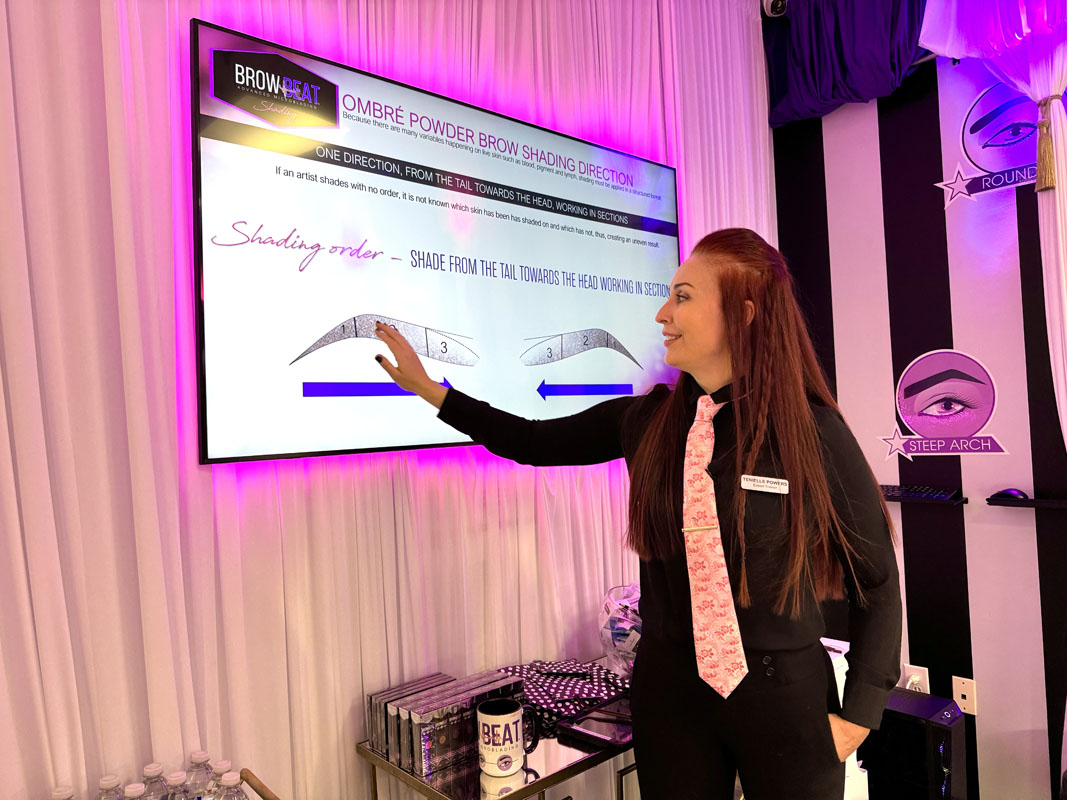
The Shading Begins From the Tail
Once the manual portion is complete, students apply the machine-shading knowledge they learned during Powder Brow training. The shading begins from the tail and progresses towards the head.
But the objective is now different from creating a pure Ombré Powder Brow. In a Powder Brow, the student is responsible for creating the shaded progression all the way toward the head.
In BrowBeat’s Combo method, the head has already been created through manual hair strokes. The machine work therefore needs to build the fuller body and tail and then transition into the existing stroke work rather than replacing it.

Combo Shading Uses the Powder Brow Layering Skill Students Already Know
BrowBeat does not teach students an entirely new machine-shading system for Combo Brows. The fundamental layering knowledge comes from the Powder Brow education they have already completed.
Students understand how shading is progressively built rather than attempting to create the full density immediately. They bring that existing skill into a different design context.
This is an important distinction in BrowBeat’s curriculum: the machine skill is already familiar; the placement and relationship to the strokes are new.
From Lining Into Filling
BrowBeat gives students a structured progression for moving into the shaded portion of the Combo Brow. Students establish the shaded structure by lining the brow and then move into the filling stage. The work remains organized from right to left and from one stage into the next.
Working Right and Left Keeps the Combo Process Organized
BrowBeat teaches students to progress through the two brows in corresponding stages rather than completely finishing one brow before beginning the other.
The manual work is completed right and left. The shaded structure is then established right and left. The filling process continues in the same organized way. This gives the student a repeatable workflow and allows the developing brows to be evaluated alongside one another as the technique progresses.
Working in Twos or Threes
During the shading stage, students return to the structured layering system they learned in Powder Brow training.
BrowBeat refers to this as working in twos or threes: completing two or three passes on one side before moving to the other and continuing the process progressively. The count gives students organization. It helps them know how much work they have performed while they continue evaluating what the developing shading actually looks like.
The objective is not to reach one universal number of passes. The technique is layered until the intended coverage and balance are developing appropriately.
Bring the Shading Forward Into the Stroke Work
This is where the Combo technique begins to look like one connected design rather than two separate procedures. As the shading progresses from the tail toward the head, BrowBeat teaches students to bring that shading into portions of the stroke work.
The machine shading intentionally comes over the ends of some strokes.
That overlap creates the transition.
The beginning of the stroke remains visible from the lower line and through the area where the hair-stroke effect is intended to be seen. As the stroke travels toward the body of the brow, the shading begins to merge with the end of it.
The Stroke Does Not Have to Remain Fully Exposed
A common beginner assumption is that every Microblading stroke needs to remain completely visible from beginning to end once shading is added. That is not how BrowBeat constructs its fuller Combo Brow.
Some of the stroke remains clearly visible where the hair-stroke effect is intended. Farther into the brow, machine shading can overlap the end of that stroke. The stroke and shading are therefore not competing for separate pieces of space. They are allowed to meet.
Why the Overlap Matters to the Healed Transition
BrowBeat teaches the overlap with the healed result in mind. The intention is that the visible beginning of the hair stroke transitions toward the body of the brow, where its end visually merges into the shaded coverage.
This helps prevent the finished design from reading as one obvious block of strokes followed by one obvious block of shading. The two components have a meeting point.
That meeting point is one of the defining technical ideas behind BrowBeat’s Combo workflow.

Stroke-to-Shading Transition Is the Heart of Combo Technique
Simply placing both hair strokes and shading somewhere inside the same mapped brow does not fully explain the Combo technique. The artist needs to understand their relationship. Where does the visible stroke effect begin? How far does it continue? Where does greater shaded density take over? Where do the two overlap so the visual change does not become abrupt?
Those are Combo-specific questions. The technique becomes successful when the artist stops thinking of strokes and shading as separate boxes and begins thinking about the transition between them.
Building a Fuller Combo Brow
BrowBeat’s machine shading Combo Brow training favors a fuller finished brow. The front retains the hair-stroke detail that identifies the manual component, while machine shading builds greater coverage through the body and tail.
This approach developed through years of performing different Combo variations and listening to repeated client feedback about preferred finished appearances.
BrowBeat teaches that experience as a starting method rather than claiming every artist everywhere must create Combo Brows in exactly the same way.
Fuller Shading Should Not Erase the Purpose of the Strokes
Greater shaded coverage does not mean the manual component becomes meaningless. The hair strokes establish the front detail and create the beginning of the transition. The machine shading then merges into portions of those strokes while developing the fuller body of the brow.
The objective is not to hide every stroke beneath shading. It is to allow the visible stroke effect to transition naturally into the area where shading becomes dominant.
Balance Matters More Than Simply Having Both Techniques Present
A Combo Brow is not successful merely because the artist can point to some strokes and some shading. The two components need to belong to the same finished design.
If the stroke section looks disconnected from the shaded section, the artist has technically used both methods but has not necessarily created a convincing transition between them.
BrowBeat therefore teaches students to evaluate the relationship between visible stroke detail and fuller coverage rather than treating the technique as a checklist.
Why BrowBeat Does Not Teach “Add Shading Wherever”
Students already know how to create machine shading by the time they reach Combo. What they need is a reason for where that shading is being placed.
The BrowBeat formula gives the machine work a defined role within the design. Hair strokes establish the head. Conversion strokes begin the movement toward the combined area. Shading develops from the tail towards the head and is brought into the stroke work where the components are intended to merge. That sequence turns two previously learned skills into one planned technique.
Different Combo Methods Exist, but Beginners Need a Starting Point
BrowBeat shows students that Combo Brows can be created in multiple ways. An experienced artist may eventually develop preferences about where they want more strokes, where they want more shading and how much overlap they prefer.
But a beginner benefits from a defined formula. Rather than being given six variations and told to choose one before they understand any of them physically, students learn a repeatable BrowBeat workflow they can practice and evaluate.
The Formula Gives Practice a Structure
A structured technique gives students something specific to repeat after class. They know which component comes first. They understand the purpose of the conversion area. They know when the machine-shading portion begins and the direction in which that shading develops.
They also understand that the transition is created by bringing shading into the ends of selected strokes rather than maintaining a rigid boundary between the two components. That structure reduces unnecessary guessing during continued practice.

The Combo Technique Can Evolve as the Artist Gains Experience
The BrowBeat formula is a starting method, not a rule that prevents an artist from continuing to develop. As students gain experience, their understanding of hair-stroke placement, shading density and visual balance can become more sophisticated. They may encounter other Combo approaches and understand why another artist chooses a different relationship between strokes and shading.
That development is easier when the artist began with a method they actually understood.
BrowBeat’s objective is to provide that foundation first.
Combo Technique Training Within BrowBeat’s Certification
The Combo Brow technique is taught within BrowBeat’s three-day brow certification rather than as a separate standalone course. Students reach the combined technique after learning the manual Microblading and machine-shading foundations that it requires and therefore makes Combo Brow training beginner friendly.
The dedicated Combo portion can therefore concentrate on the formula for putting those skills together: Head stroke detail, conversion into the combined area, structured machine shading and the overlap that allows the stroke ends and shaded coverage to merge.
The student is not learning two new techniques at once. They are learning how two familiar skills become one finished technique.
Learn the Components, Then Learn the Connection
The BrowBeat Combo formula is built around a simple educational progression: Students learn the individual skills before being asked to integrate them.
The manual component establishes the front hair-stroke detail and conversion into the combined area. The machine-shading component then begins from the tail and is layered from the tail towards the head, using the Powder Brow knowledge students already have.
As those components meet, the shading intentionally comes over the ends of selected strokes. The visible beginning of the stroke remains readable, while its end transitions into the fuller shaded body of the brow. The intention is for those elements to visually merge as the work heals.
That transition is what turns two previously learned skills into one Combo Brow training and certification.
Frequently Asked Questions About Combo Brow Technique Training
What is the main technique behind Combo Brows?
Combo Brows intentionally integrate manual hair strokes with machine shading within one finished brow. The technique is not simply about knowing both skills separately. Students need to understand where the hair-stroke component belongs, where fuller shading takes over and how the two areas transition into one another.
How does BrowBeat teach hair strokes and shading together?
BrowBeat teaches a defined sequence. Students establish the manual hair-stroke component first, including the front detail and conversion strokes. They then move into machine shading from the tail forward, progressively bringing the shading into portions of the stroke work so the two components can visually merge.
What are conversion strokes in BrowBeat's Combo Brow technique?
Conversion strokes help move BrowBeat’s design from the head strokes area toward the fuller combined portion of the brow. Additionally, BrowBeat teaches approximately five to eight lower strokes as part of that transition.
Why does BrowBeat use conversion strokes?
The purpose is to create a progression rather than an abrupt ending to the hair-stroke component. The conversion strokes help establish the area where visible stroke detail begins moving toward the fuller shaded body of the brow.
Does BrowBeat complete the Microblading portion before shading?
Yes. Within BrowBeat’s Combo workflow, students complete the planned manual component on the right and left brows before moving into the machine-shading stage. This keeps the process organized and gives the shading an established stroke structure to work with.
Where does the shading begin in a Combo Brow?
Within BrowBeat’s method, the machine-shading portion begins from the tail and progresses towards the head. Students use the Powder Brow layering knowledge they learned earlier in the certification, but they do not need to construct a separate shaded head because the head has already been established with hair strokes.
Is Combo Brow shading performed like Powder Brow shading?
BrowBeat uses the same foundational layering knowledge students have already learned during Powder Brow training. The difference is the context. In Combo Brows, that machine shading is being integrated with an existing hair-stroke component rather than constructing a fully machine-shaded brow from head to tail.
Do students have to relearn Powder Brow shading for Combo Brows?
No. BrowBeat deliberately builds Combo on the skills taught earlier in the three-day certification. Students apply their existing machine-shading foundation to a new combined design rather than starting machine education again.
What does working in twos or threes mean during Combo shading?
BrowBeat uses the same structured layering concept students learned during Powder Brow education. Students work in sets of two or three passes before moving between the right and left brows, continuing progressively while evaluating the developing coverage.
Is there one exact number of passes for a Combo Brow?
No. The pass count provides structure, but the artist still evaluates what the work is producing. The intended coverage and developing result matter more than reaching one universal number.
Does the shading go over the Microblading strokes?
In BrowBeat’s Combo method, yes. As the shading is brought forward from the tail, it intentionally overlaps the ends of some strokes within the transition area.
Why does the shading overlap the ends of the strokes?
The overlap is intended to create a connected transition. The beginning of the hair stroke remains visible where the stroke effect is wanted, while farther toward the body of the brow the end of the stroke visually merges into the shaded coverage as the work heals.
Does shading over the strokes mean the strokes disappear?
No. BrowBeat’s objective is not to cover every stroke completely. Visible stroke detail remains toward the front, while the ends of selected strokes transition into the fuller shaded area.
Why not keep the strokes and shading completely separate?
A hard separation can make the two components appear visually disconnected. BrowBeat teaches an intentional overlap so the stroke effect can transition into the shaded body rather than looking like two unrelated techniques placed next to each other.
What is a stroke-to-shading transition?
It is the area where visible manual hair-stroke detail begins merging into greater machine-shaded coverage. Understanding that relationship is one of the central skills in the Combo Brow technique.
Do Combo Brows have to use BrowBeat's exact stroke and shading arrangement?
No. Combo Brows can be constructed in different ways. BrowBeat shows students several approaches for context and then teaches one defined workflow as a practical starting method.
Why does BrowBeat teach a fuller Combo Brow?<
BrowBeat’s current method developed through years of performing different Combo Brow variations and listening to client feedback. That experience led toward a fuller shaded design with visible hair-stroke detail concentrated toward the head.
Is a fuller Combo Brow just a Powder Brow with a few strokes?
No. The hair-stroke component is intentionally established before the shading begins, and the transition between the two is part of the technique. BrowBeat teaches students to understand how the stroke work leads into the shaded body rather than treating the strokes as decoration added to a Powder Brow.
How do you keep a Combo Brow from looking like two separate techniques?
The transition matters. BrowBeat brings machine shading into the ends of selected strokes so the visible hair-stroke detail can gradually merge with fuller shaded coverage rather than ending at a hard boundary.
Does Combo Brow technique start with mapping?
Yes. The brow is planned before technical execution begins.
Does this training teach Microblading stroke technique from the beginning?
The Combo portion builds on Microblading education taught earlier in BrowBeat’s three-day certification. Detailed manual blade mechanics and Microblading stroke education is taught on day one of the three day certification.
Does this training teach PMU machine control from the beginning?
Students have already received foundational PMU machine and Powder Brow education before reaching Combo. Detailed physical machine control and powder brow technique is taught during the three-day certification.
What is the difference between Combo technique and Combo machine shading?
Combo technique education focuses on how the manual hair-stroke and machine-shading components are sequenced and integrated. Combo machine-shading education focuses more specifically on physically controlling the PMU machine while adding the shading component around and over the intended stroke areas.
Can beginners learn the Combo Brow workflow?
Yes. BrowBeat’s three-day foundational brow certification has no previous PMU prerequisite. Beginners learn the component skills first and reach the Combo workflow after those foundations have been established.
Is the Combo Brow technique taught as a separate BrowBeat course?
No. BrowBeat teaches Combo/Hybrid/3D Brow technique within its three-day brow certification. The combined-technique portion builds directly on the Microblading and Powder Brow education taught earlier in the course.
Is 3D Brow technique the same as 3-in-1 Brow Certification?
No. Within BrowBeat’s terminology, 3D Brow belongs to the Combo/Hybrid family: one technique combining hair strokes and shading. The 3-in-1 Brow Certification is the broader program teaching Microblading, Ombré/Powder Brows and Combo Brows as three distinct techniques.