COMBO / HYBRID / 3D BROW TRAINING IN TEXAS
Combo Brows bring two permanent makeup skills together in one finished brow: manual hair strokes and machine shading. You may also hear this combined technique described as Hybrid Brows or 3D Brows.
At BrowBeat Certification, Combo Brow education is taught within the three-day brow certification rather than sold as a separate Combo Brow course. That distinction matters because students do not arrive at the Combo portion and suddenly try to learn two unfamiliar techniques at the same time.
They have already spent the course developing the foundations that Combo Brows require. Students learn manual hair-stroke skills through Microblading education and machine-shading skills through Ombré Powder Brow education. Combo training then shows them how those two skills come together within one brow.
The dedicated Combo portion is intentionally focused. Rather than reteaching everything students have already learned, BrowBeat teaches the combined workflow: where the hair-stroke component belongs, where the shading component belongs and how the two techniques relate within the finished design.
What Is Combo Brow Certification at BrowBeat?
Combo Brow training at BrowBeat teaches students to understand how manual hair strokes and machine shading can be integrated into one finished brow technique.
The training is part of BrowBeat’s three-day brow certification. It is not marketed as a separate standalone Combo Brow course.
Students reach the Combo portion after developing foundational understanding of the two components they are about to combine. That learning sequence is important because Combo Brows make much more sense when the student already understands what hair strokes do and what machine shading does.
The Combo portion then becomes an integration lesson rather than an attempt to introduce two complete technical systems from zero.
Combo Brows Combine Two Skills Students Have Already Learned
A Combo Brow is not created by learning one completely new tool or movement. It is created by bringing together skills that have different foundations.
The hair-stroke component comes from manual Microblading education. Students have already been introduced to the thinking and physical control required to create individual strokes.
The shading component comes from Ombré Powder Brow education. Students have already been introduced to the PMU machine and the principles used to create controlled shaded coverage.
Combo training then asks a different question: How do those two components belong together? That is the central purpose of the combined-technique education.

combo brow
Certification
Hybrid brow training Texas at BrowBeat follows a clear progression: stroke mastery, shading control, then structured integration. Students learn microblading first, followed by ombré powder brow certification, before advancing into combo brows certification. This layered system creates confident artists who understand strokes, gradient blending, and design logic.
combo brows
Planning
Inside BrowBeat’s microblading and shading course in Dallas, Texas, combo brows certification is the advanced integration skill. Students develop stroke placement accuracy, pigment saturation control, and gradient shading before combining both techniques. Hybrid brows require balance, and our 3 skill certification ensures that combination work is technically precise. This progression protects skin integrity while strengthening long-term artist performance.


3 - skill
Program
BrowBeat Certification in Texas is built on structure. Our 3-skill brow certification develops microblading fundamentals, ombré powder saturation control, then combo brow integration. Students learn how stroke flow transitions into shaded body work. Combo brows certification is the advanced module included in our 3-in-1 training.
then
Combine
BrowBeat Certification in Texas follows a disciplined sequence: stroke development, shading precision, then combo brows certification. Students first build microblading consistency, then control machine shading before blending both techniques into hybrid brows. This structured progression strengthens artistic judgment and technical control. Combo brows are the final skill because true integration requires strong individual foundations.


Layer the
Pixels
Combo brows certification at BrowBeat begins with disciplined stroke placement before shading is introduced. In our 3-skill brow program, students first master microblading structure, then ombré powder saturation, before integrating both. Hybrid brow training in Texas requires this sequencing. Strokes create movement and direction; pixel shading is layered intentionally to build density without overpowering the design.
builds
Depth
Professional combo brow training in Dallas includes structured preparation before technique begins. Students learn how to organize their workspace, prepare supplies, and follow sanitation protocols before moving into the microblading and machine-shading techniques used to create combo brows.


hybrid
System
At BrowBeat in Dallas, combo brows certification follows a defined, instructor-led system. Students complete microblading first, then ombré powder brow training, before advancing to hybrid integration. Our structure removes guesswork and builds technical progression. Hybrid brow training Texas is taught step by step, ensuring artists understand not just how to combine techniques, but why the sequence matters
structured
Density
Combo brows certification is the advanced stage of BrowBeat’s all brow skills program. After mastering hairstrokes and machine shading independently, students learn how to merge them into cohesive hybrid brows. Hybrid brow training Texas focuses on structure, spacing, and density control so strokes are not lost beneath pigment. Structured density ensures longevity, clarity, and refined combo brow execution.


fair
Skin
In BrowBeat’s microblading, ombré powder, and combo brows certification, students learn how to work with fair skin tones using soft saturation. Fair skin requires controlled depth, lighter pigment ratios, and careful stroke spacing to prevent oversaturation. This color training is part of the larger brow curriculum, ensuring artists understand how pigment selection supports structure, longevity, and balanced healed results.
both
Worlds
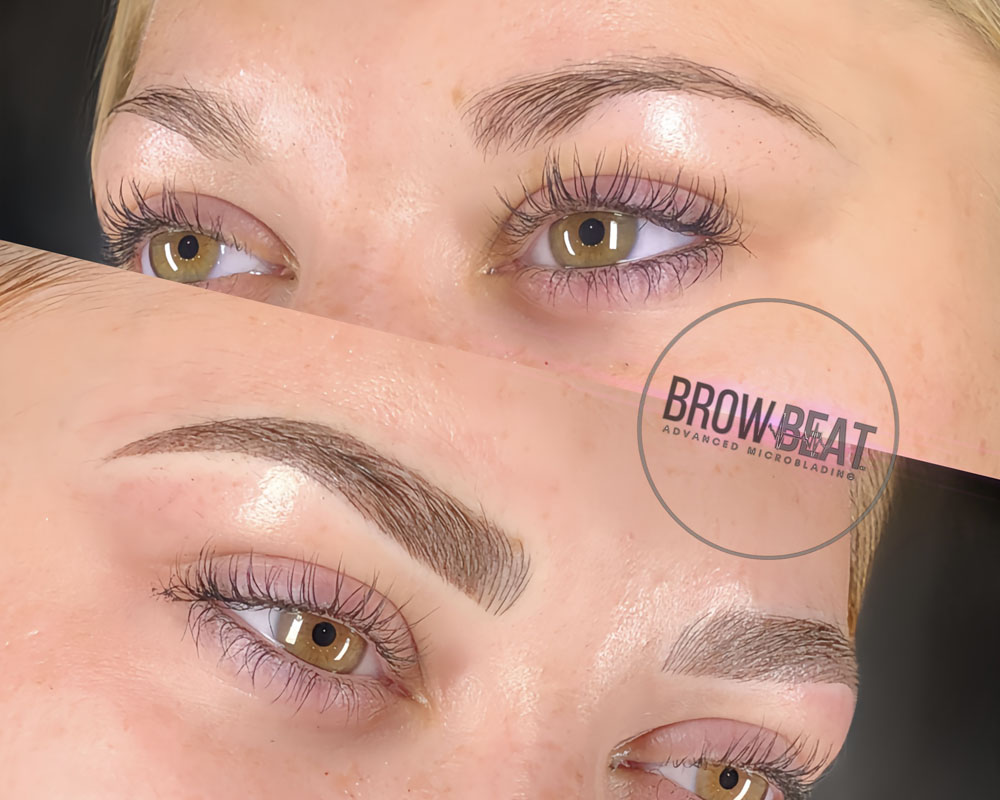
Inside BrowBeat’s combo brows certification students refine pigment layering techniques as part of the microblading, shading and combo brow program, learning how to maintain clarity while building density. This stage reinforces how stroke placement and pixel shading work together, ensuring hybrid brow technique training adapts naturally across versatile skin tones without creating flat or overly dark results,

darker
Hair
Dark brown pigment work within BrowBeat’s hybrid brow training Texas program focuses on controlled saturation and layering. As part of the microblading, ombré powder, and combo brows certification, students learn how to preserve stroke visibility while building structured shading depth.
melanin
Skin
High melanin skin training is an essential part of BrowBeat’s combo brows certification and broader microblading and shading training. Hybrid brow technique training emphasizes thoughtful color selection, ensuring healed results remain balanced. This advanced color education prepares artists to work confidently across diverse skin.
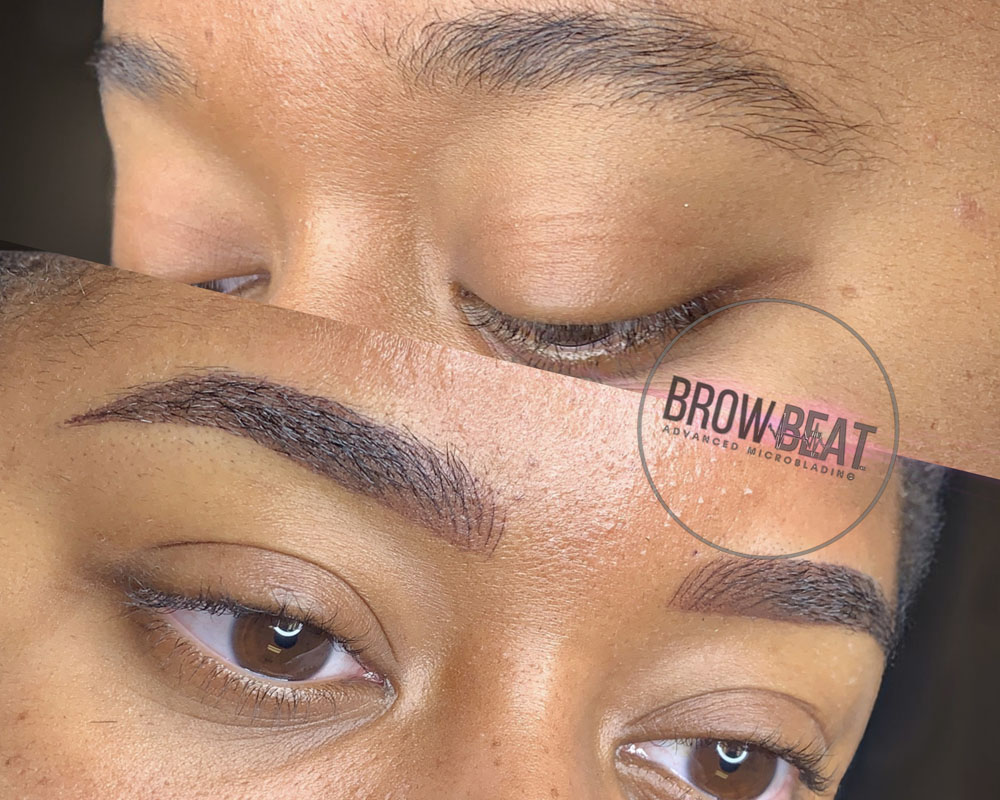
Combo Brows, Hybrid Brows and 3D Brows
Permanent makeup terminology can vary between artists, educators and different parts of the industry. Within BrowBeat’s advanced combo brows training, Combo Brows, Hybrid Brows and 3D Brows describe the same combined technique family: manual hair strokes together with machine shading in one finished brow. Understanding that terminology helps students make sense of what they may see online. A technique can be described with different names without representing a different fundamental skill.
BrowBeat teaches students to look beyond the buzzword and understand what is actually being performed.
Hair Strokes + Shading as One Finished Technique
The easiest way to distinguish the three primary brow techniques is by looking at what the artist is physically creating.
- Microblading uses manual hair strokes.
- Ombré Powder Brows use machine shading.
- Combo Brows integrate hair strokes and machine shading within a brow.
That final distinction is what gives Combo its own technical identity. The artist is not simply performing Microblading and then randomly adding some shading. The two components need to be planned so they belong together visually.
Why Combo Comes After the Foundational Brow Skills
The order of BrowBeat’s training allows students to build knowledge progressively.
Before learning what Combo Brows are, students have already been introduced to manual hair-stroke work and machine-shading work as separate skills. They understand that the tools are different, the movements are different and the visual purposes are different.
That foundation changes what needs to happen during the Combo portion.
Instead of spending the lesson asking, “What is a Microblading stroke?” or “How does a PMU machine create shading?” students can concentrate on the relationship between those skills. They are learning how to combine things they now recognize.
What Students Learn During the Combo Brow Portion
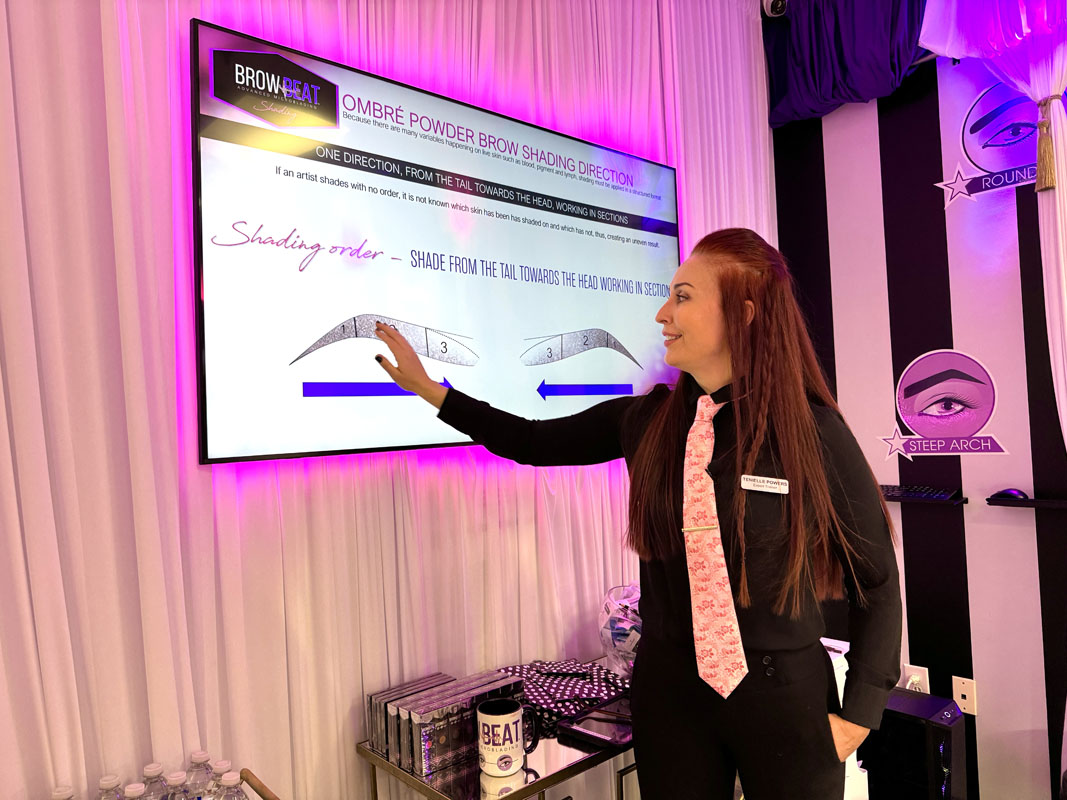
The dedicated Combo portion focuses on the workflow for bringing hair strokes and shading together. Students begin thinking about where the manual component should start and end, where machine shading belongs and how the two components relate within the overall brow.
They also begin understanding that the balance between strokes and shading affects the finished appearance. The objective is for the components to work as one design rather than look like two unrelated techniques placed on top of each other.
The Combo Portion Does Not Need to Reteach Two Days of Foundations
The dedicated Combo Brow section is approximately one to two hours within BrowBeat’s three-day certification, depending on the flow of the training.
That focused timeframe makes sense because the students are not beginning from zero at that point.
The foundations have already been established over three days. Students have spent the course learning the individual skills that make the combined technique possible.
The Combo portion can therefore concentrate on integration: where one component begins, where another takes over and how the student thinks through the workflow. Its value comes from connecting the previous learning rather than repeating it.
Combo Brow Training Connects Manual and Machine Skills
Combo Brows require students to understand two very different working systems.
Manual Microblading asks the artist to think about individual hair strokes, direction, spacing and pattern. Machine shading asks the artist to think about controlled coverage, pixels, density and transitions.
When those skills are combined, the artist needs to preserve the purpose of both. The strokes need to remain meaningful within the design, while the shading needs to support the brow rather than simply compete with them. That relationship is what turns two skills into a combined technique.

Why Learning a Combined Brow Technique Can Expand an Artist’s Options
Different brow techniques give an artist different ways to approach a desired result. An artist who understands manual hair strokes has one set of skills. An artist who understands machine shading has another. Understanding how those skills can also be integrated gives the artist an additional technical option.
This is especially useful because one technique does not need to be forced onto every brow simply because it is the only technique the artist knows.
BrowBeat’s broader brow education is designed to help students understand the differences between techniques so they can continue developing a more versatile skill set as their experience grows.
Combo Brow Training Is More Than “Microblading With a Little Shading”
The shorthand description of Combo Brows blending techniques training is hair strokes plus shading, but students still need to understand the relationship between those elements. The artist needs to know which areas are being treated as stroke areas, which areas require shading and how the transition between them contributes to the complete design.
If the two components are treated as unrelated procedures, the finished brow can lose the visual relationship that makes the combined technique useful.
BrowBeat therefore teaches Combo as a workflow, not simply as permission to add machine shading wherever space remains.
What Is the Difference Between Combo Brows and Microblading?
Microblading alone is a manual hair-stroke technique. Combo Brows include a manual hair-stroke component but add machine shading as an intentional part of the finished design.
The Microblading foundation remains important because the artist still needs to understand the strokes. But once machine shading is intentionally integrated with those strokes, the technique has moved into Combo Brow territory. Detailed Microblading stroke education remains its own learning area.
What Is the Difference Between Combo Brows and Ombré Powder Brows?
Ombré Powder Brows are machine-shaded brows without the manual hair-stroke integration that defines Combo. Combo Brows use machine shading too, but the shading needs to work in relationship with the manual strokes.
That changes the artist’s objective. Pure Powder Brow education focuses on constructing the shaded brow itself. Combo education focuses on how shading and strokes coexist within one finished technique.
Combo Brows Are Not the Same as the 3-in-1 Brow Certification
This terminology is especially important. Combo, Hybrid and 3D Brows refer to one combined technique: hair strokes plus shading.
BrowBeat’s 3-in-1 Brow Certification refers to the broader course structure: Microblading, Ombré/Powder Brows and Combo Brows taught as three distinct brow techniques.
A 3D Brow is therefore not another way of saying 3-in-1 Brow Certification.
One describes a technique. The other describes the broader certification in which that technique is taught.

Combo Brow Mapping and Design
Before hair strokes and shading can be integrated, the artist needs a plan for the brow. Combo-specific design considers the overall shape while also accounting for how the manual and machine components will fit within that design.
Detailed planning—including stroke zones, shading zones, proportions, symmetry and placement—belongs to BrowBeat’s dedicated Combo Brow mapping and design education.
Machine Shading Within Combo Brows
The shading component of a Combo Brow is created with the PMU machine. Students need enough machine understanding to add shading without losing sight of the hair-stroke component that makes the technique a Combo Brow.
Detailed movement, machine control, speed, pressure, depth and shading execution introduces that skill without attempting to reteach the machine lesson.
How Hair Strokes and Shading Are Integrated
Knowing how to create hair strokes and knowing how to shade are prerequisites within the learning sequence, but knowing both does not automatically explain how to combine them. Integration requires its own workflow.
Students need to understand where the stroke component belongs, where the shading component belongs and how those areas transition through the brow.
BrowBeat’s Combo technique education goes deeper into that stroke-to-shading relationship.
Can Beginners Learn Combo Brows at BrowBeat?
Yes. BrowBeat’s three-day foundational brow certification has no previous PMU prerequisite. That does not mean a beginner is immediately asked to perform a combined technique without preparation.
The structure of the certification is what makes Combo accessible to a new student. They first build understanding of the individual skills and reach the combined technique after those foundations have been introduced.
Detailed questions about starting with no experience, difficulty and readiness belong to BrowBeat’s Beginner’s Guide to Combo Brow Training.
Combo Brow Certification in Dallas, Texas
BrowBeat teaches Combo/Hybrid/3D Brow technique as part of its in-person three-day brow certification in Dallas, Texas. Students learn the underlying manual and machine foundations during the broader certification and then learn how those skills come together within the Combo Brow workflow.
For someone searching for Combo Brow certification, Hybrid Brow training or 3D Brow education in Dallas, the important distinction is that BrowBeat provides this education within the complete brow certification rather than as an isolated standalone Combo class.
What Does Combo Brow Certification Mean at BrowBeat?
BrowBeat uses certification to acknowledge completion of the education and the steps taught within the course. The certificate reflects the training the student has completed. It should not be confused with years of professional experience, a government-issued license or universal legal authorization to perform permanent makeup in every jurisdiction.
Technical skill continues developing through practice after training. The purpose of certification is to establish and document the educational foundation the student has completed.
Combo Brow Training Is One Part of a Larger Brow Education
Combo Brows make the most sense within BrowBeat’s curriculum because students reach them after learning the two component skills.
Microblading gives the student the manual hair-stroke foundation. Ombré Powder Brow education gives the student the machine-shading foundation. Combo then teaches how those skills relate when they are intentionally brought together.
That progression is why the dedicated Combo portion can remain focused. Students are not starting over. They are connecting what they have already learned.
Explore BrowBeat’s Complete Brow Certification
BrowBeat’s Combo/Hybrid/3D Brow education is included within the three-day brow certification rather than offered as a separate standalone Combo course.
The broader certification teaches Microblading, Ombré/Powder Brows and Combo Brows as three distinct techniques, giving students experience with manual hair strokes, machine shading and the workflow for combining the two.

Learn the Foundations, Then Learn How They Work Together
Combo Brow education is most useful when the student understands what is actually being combined.
BrowBeat’s three-day certification first gives students a foundation in manual hair strokes and machine shading. The dedicated Combo portion then connects those skills through a focused workflow that teaches students where the components belong and how they relate within one finished brow.
That is why Combo does not need to become another multi-day course inside the course. The foundational learning has already happened. The new lesson is integration.
For students who want the complete training program, BrowBeat’s broader 3-in-1 Brow Certification teaches Microblading, Ombré/Powder Brows and Combo Brows as three distinct techniques within one structured program.
Frequently Asked Questions About Combo / Hybrid / 3D Brow Certification
What are Combo Brows?
Combo Brows combine manual hair strokes with machine shading within one finished brow. The hair-stroke component comes from Microblading technique, while the shaded component is created with a PMU machine.
What are Hybrid Brows?
Within BrowBeat’s training program, Hybrid Brows are part of the same combined-technique family as Combo Brows: manual hair strokes integrated with machine shading.
What are 3D Brows?
BrowBeat uses 3D Brows to describe the same combined hair-stroke and shading technique family as Combo and Hybrid Brows. Terminology can vary across the PMU industry, so BrowBeat teaches students to understand what the technique actually contains rather than relying on the name alone.
Are Combo Brows and Hybrid Brows the same?
Within BrowBeat’s curriculum, yes. Both terms describe a finished brow that intentionally combines manual hair strokes with machine shading.
Are Combo Brows and 3D Brows the same?
Within BrowBeat’s curriculum, they belong to the same combined-technique family. A 3D Brow should not, however, be confused with BrowBeat’s 3-in-1 Brow Certification.
Are 3D Brows the same as 3-in-1 Brow Certification?
No. This distinction is important. A 3D Brow is one combined brow technique using hair strokes and shading. BrowBeat’s 3-in-1 Brow Certification is the broader course that teaches three distinct techniques: Microblading, Ombré/Powder Brows and Combo Brows.
Does BrowBeat offer a standalone Combo Brow course?
No. Combo Brow education is taught as part of BrowBeat’s three-day brow certification rather than as a separate standalone Combo course.
Why isn't Combo Brow training a separate BrowBeat course?
Students reach Combo after learning the two foundational skills that make the technique possible. They have already been introduced to manual Microblading hair strokes and Ombré Powder Brow machine shading. The dedicated Combo portion can therefore concentrate on how those skills are integrated rather than teaching both foundations again.
What do students learn during Combo Brow training?
Students learn the workflow for bringing manual hair strokes and machine shading together within one finished brow. This includes understanding where the components belong, where one begins or ends and how they relate visually as a combined technique.
Are Combo Brows the same as Powder Brows?
No. Powder Brows are created through machine shading without the manual hair-stroke integration that defines Combo Brows. Combo uses both manual strokes and machine shading.
How do hair strokes and shading work together in Combo Brows?
The two components need to be planned and integrated so they belong to one finished brow. Detailed stroke placement, shading placement, balance and transitions belong to BrowBeat’s dedicated Combo Brow technique education.
Does Combo Brow training include machine shading?
Yes. Machine shading is one of the two components of the technique. Detailed machine movement and control are taught through the machine-shading foundation and can then be applied within the combined technique.
Does Combo Brow training include mapping?
Yes, mapping is taught as part of the full three-day certification. Students learn mapping for microblading, ombre powder brows and combo brows. So the design work supports all three techniques.
Can a complete beginner learn Combo Brows?
Yes. BrowBeat’s three-day foundational brow certification has no previous PMU prerequisite. Beginners are not immediately thrown into the combined technique. The course establishes the underlying skills before students reach the Combo portion.
Do I need previous Microblading experience before taking BrowBeat training?
No. Previous Microblading experience is not required before entering BrowBeat’s foundational three-day brow certification. The manual hair-stroke foundation is taught as part of the broader course.
Do I need previous machine-shading experience?
No. Students are introduced to the PMU machine and machine-shading foundation during the broader certification before those skills are applied to Combo Brows.
Does learning Combo Brows mean I have to use strokes and shading on every client?
No. Learning multiple brow techniques gives an artist more options; it does not mean every brow should receive every technique. Microblading, Ombré Powder Brows and Combo Brows remain distinct approaches.
Why can learning Combo Brows be useful for a developing brow artist?
Combo adds another way to think about brow design by teaching the artist how manual and machine-based skills can work together. That broader technical understanding can give a developing artist more options instead of relying on one technique for every brow.
Do students learn Microblading before learning Combo Brows?
Within BrowBeat’s three-day certification, students are introduced to the manual hair-stroke foundation before reaching the Combo portion. This gives them context for the stroke component they will later combine with shading.
Do students learn Powder Brow shading before Combo Brows?
Yes. Students are introduced to the PMU machine and Ombré Powder Brow shading before learning the Combo workflow. This gives them a machine-shading foundation before they are asked to integrate shading with hair strokes.
Do Combo Brows use a PMU machine?
Yes. The shading portion of BrowBeat’s Combo Brow technique uses the PMU machine. The hair-stroke portion is manual.
Do Combo Brows include Microblading?
Combo Brows include a manual hair-stroke component based on the Microblading skills students learn during the broader brow certification. Machine shading is then intentionally integrated with those strokes.
Are Combo Brows just Microblading with extra shading?
That description captures the two components but misses an important part of the technique. BrowBeat teaches students to understand how the stroke and shading components relate within the design rather than simply adding shading wherever space remains.
Does BrowBeat provide a Combo Brow certification?
Combo Brow education and certification are included within BrowBeat’s three-day brow certification. BrowBeat does not market the Combo portion as a separate standalone course.
Does a Combo Brow certificate mean I am licensed?
No. A training certificate acknowledges education completed through the course. It should not be treated as the same thing as a government-issued tattoo license.
How much does Combo Brow training cost?
Because BrowBeat does not sell Combo as an isolated course, its education is part of the broader brow certification investment. Detailed training-cost and value information belongs to BrowBeat’s Combo Brow course cost and pricing guide.
Where can I learn Combo Brows in Dallas, Texas?
BrowBeat teaches Combo/Hybrid/3D Brow technique within its in-person three-day brow certification in Dallas, Texas. The Combo portion builds on the manual hair-stroke and machine-shading foundations taught earlier in the certification.