LIP BLUSHING TRAINING TEXAS
Lip Blushing is often described as adding semi-permanent color to the lips. Professionally, there is much more happening.
Before an artist chooses a pigment or turns on a PMU machine, they need to understand the lip in front of them. Every natural lip has its own shape, proportion, border, symmetry, tissue characteristics and existing color. Those differences influence the way the artist plans the procedure, thinks about color and eventually executes the work.
That is why BrowBeat Certification teaches Lip Blushing as a complete decision-making process rather than one machine movement or one formula.
Our in-person Lip Blushing certification training in Dallas, Texas combines traditional Lip Blushing education with Dark Lip Neutralization. Students learn why lighter natural lips and darker, melanin-rich lips do not always begin with the same color problem—and why a professional artist needs to recognize the difference. The thinking starts before the procedure.
Look at the lip. Understand what you are seeing. Make the decision. Then execute. That approach runs through the entire course.
What Is Lip Blushing Training?
Lip Blushing training teaches permanent makeup students how to assess, plan and perform cosmetic lip pigmentation using a PMU machine.
The procedure is known by several names. You may see Lip Blush, Lip Blushing, cosmetic lip tattooing, semi-permanent lip color, permanent lip makeup, semi-permanent lip makeup or lip pigmentation used when discussing this area of permanent makeup.
Students searching for lip tattoo training, cosmetic lip tattoo certification, permanent lip makeup training or professional lip pigmentation education are often researching the same broader professional skill family.
BrowBeat uses Lip Blushing as the primary terminology. Whatever terminology brought a student to the subject, professional training needs to go much deeper than learning how to deposit color into the lips.
The artist needs to understand a sequence of connected decisions:
- What is the natural lip shape?
- How are the upper and lower lips proportioned?
- Where is the natural vermilion border?
- What does the Cupid’s bow look like on this individual?
- What natural color is already present?
- What color direction does the client want?
- Does the lip require traditional Lip Blushing or specialized Dark Lip Neutralization?
- How should the design be mapped before machine work begins?
- How should pigment be implanted with control?
- How much saturation supports the intended result?
- What should the artist be thinking about beyond the freshly completed color?
Those skills are connected, but they are not interchangeable.
- Mapping plans the working area.
- Color education determines the pigment direction.
- Machine technique controls physical implantation.
- Dark Lip Neutralization introduces a separate corrective color problem for darker and melanin-rich lips.
Professional Lip Blushing education needs to help students understand where each decision begins and ends.

really
Is
Lip blushing training Texas begins with clarity. This isn’t traditional body tattooing. In our semi permanent lip color course, we break down the difference between cosmetic pigmentation and ink saturation, helping artists understand why lip tattoo training Dallas requires precision, restraint, and design control. Before tools ever touch skin, foundation knowledge sets the tone for professional results.
before
Pigment
Not all skin behaves the same — and lips are different from the rest of the face. In lip tattoo training Dallas, we study skin thickness and how pigment interacts with delicate lip tissue. This section of our lip blushing training Texas builds awareness first, because safe, refined work begins with understanding anatomy and tissue response.


lip
Shape
Before shading begins, structure must be defined. Lip blushing training in Texas includes drafting the vermillion border, respecting natural anatomy, and understanding proportion. In lip tattoo training Dallas, artists practice lip mapping on raised silicone before transitioning forward. Structure first. Color second. Discipline always.
color
Theory
In our semi-permanent lip color course, color theory is not abstract. Artists study warm versus cool reds, pigment balance and color blending. Lip pigmentation training includes how to prevent over-saturation and how to build dimension gradually. Beautiful, healed lips are intentional.


shading
Motion
Lip blush classes near me often skip technique refinement. We don’t. Artists learn controlled sweeping motions, machine angle discipline, and consistent pixel placement. Lip blushing certification Texas teaches shading as a controlled build — not a rush to saturation. This is where softness is created.
lip blushing
Training
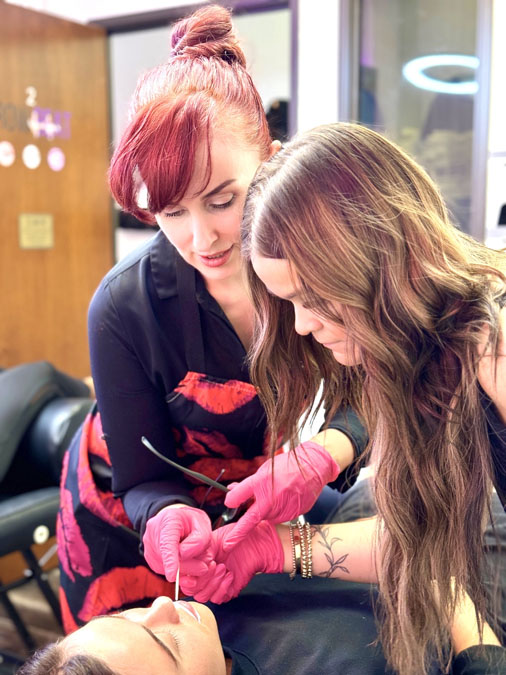
Lip blushing training at BrowBeat is fully trainer-led. This is not self-guided content. Every module inside our semi-permanent lip color course is demonstrated, explained, and supervised in real time. Lip tattoo training Dallas is structured so artists never guess their way through technique — they build skill through guided progression and direct instruction.

lip shading
Simulations
Lip blush classes near me often move too quickly into full procedures. In our semi-permanent lip color course, shading begins on silicone simulations under instructor supervision. Lip tattoo training Dallas includes correction of hand speed, pressure, and machine angle before advancing to more complex layering.
real
Time
Trainer-led lip blushing certification Texas means feedback happens immediately. Lip pigmentation training includes hands-on correction of shading flow, and density control. Inside this semi-permanent lip color course, artists adjust technique while learning.


certification
Texas
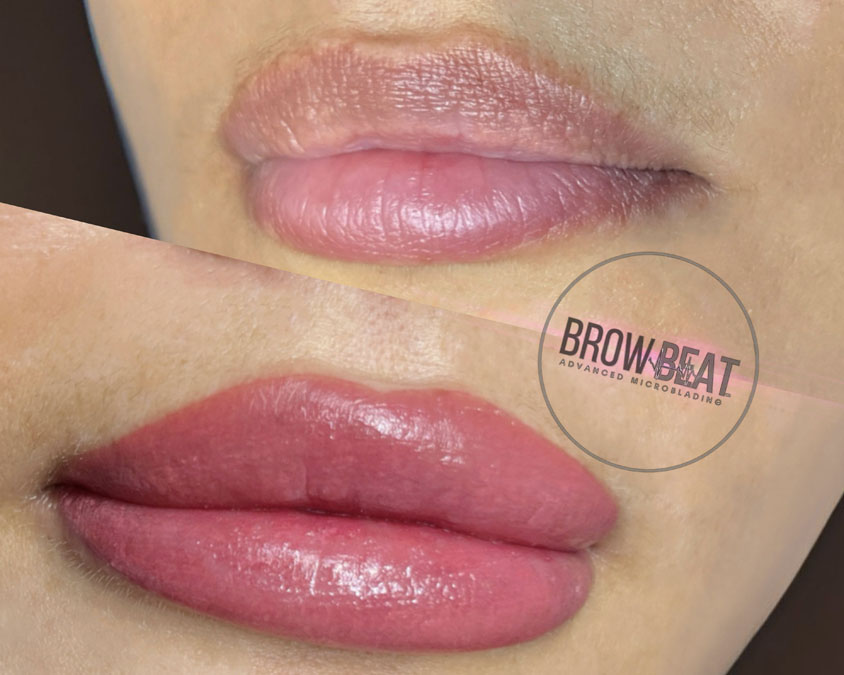
This Fitzpatrick 1–2 example reflects clean structure and controlled saturation taught inside our lip blushing certification Texas program. In lip tattoo training Dallas, students learn disciplined application methods within a semi-permanent lip color course designed to create smooth, even coverage. Lip pigmentation training focuses on consistency, shape and maintaining lip integrity throughout the service.
lip
Color
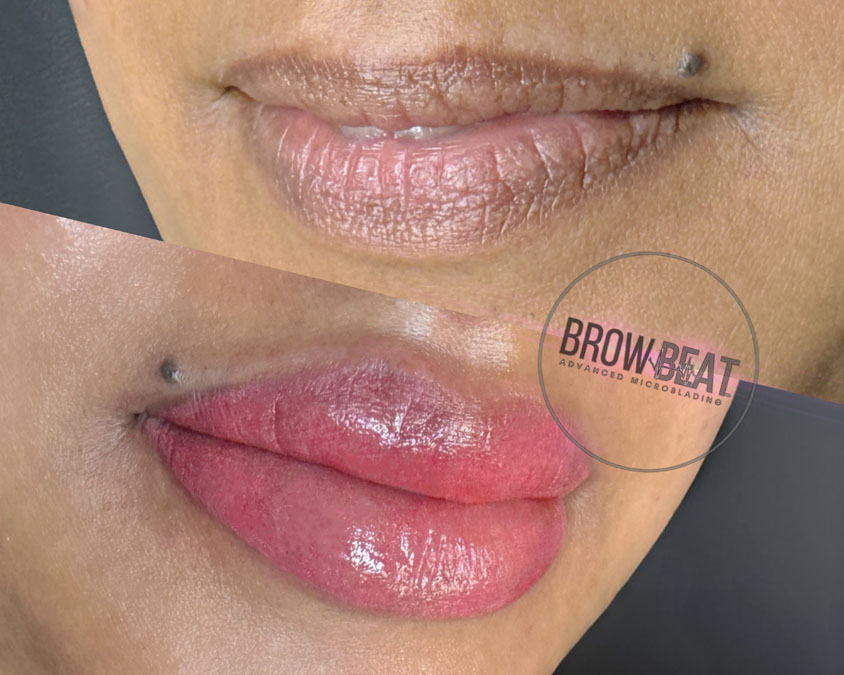
This Fitzpatrick 2–3 result demonstrates balanced lip structure and controlled layering covered in our lip blushing certification Texas curriculum. During lip tattoo training Dallas, application order and machine handling are taught step by step inside the semi-permanent lip color course. Lip pigmentation training reinforces disciplined passes and organized workflow for reliable, even outcomes.
lip tattoo
Training
This Fitzpatrick 3–4 example shows smooth distribution and consistent coverage achieved through structured methods taught in our lip blushing certification Texas program. Lip tattoo training Dallas emphasizes layering discipline and proper machine control inside the semi-permanent lip color course. Lip pigmentation training supports clear treatment order and steady execution from outline through saturation.
Dark lip
Neutralization
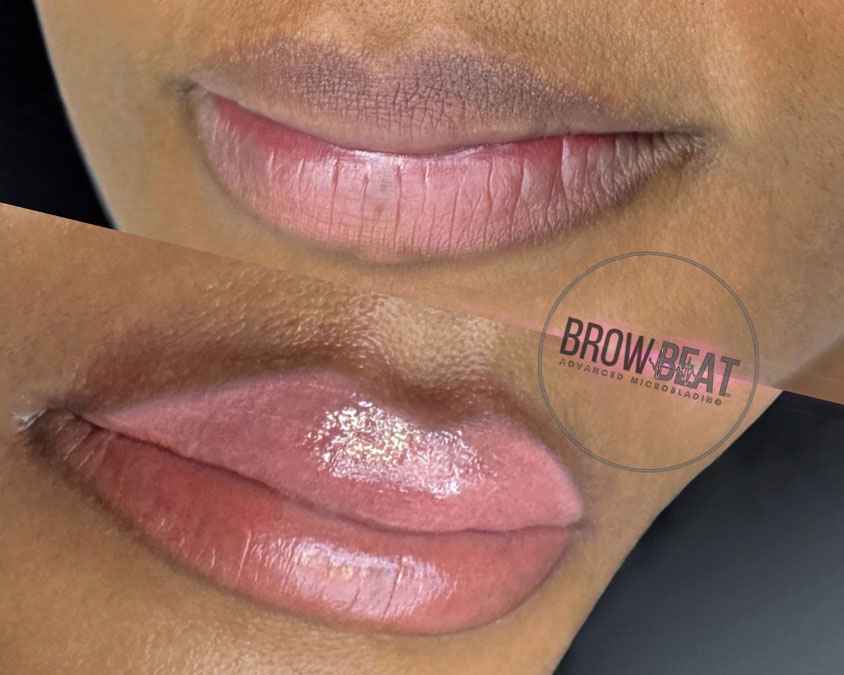
This Fitzpatrick 5–6 dark lip neutralization example reflects structured layering and thoughtful pigment selection suited for high melanin lips. Inside lip blushing certification Texas, lip tattoo training Dallas includes equalization techniques within the semi-permanent lip color course.
BrowBeat’s 2-Day Lip Blushing & Dark Lip Neutralization Training
BrowBeat Certification teaches Lip Blushing and Dark Lip Neutralization through a two-day, in-person training program in Dallas. The course is structured around something artists see constantly in the real world: natural lip color varies enormously.
One client can have naturally pale pink lips. Another can have greater warmth. Another can have cooler undertones. Another can have darker, melanin-rich lip color that requires the artist to think about corrective color before thinking about a final Lip Blush shade.
Those clients should not automatically receive the same pigment strategy simply because they all booked a lip procedure. For that reason, the education is divided into two connected areas.
Day 1: Lip Blushing for Fitzpatrick 1–3
Day 1 focuses on Lip Blushing education for Fitzpatrick skin types 1–3. Students begin developing the foundational reasoning behind a Lip Blush procedure: observing the natural lip, planning the design, understanding color and learning how pigment is introduced through controlled PMU machine work. The natural lip is the starting point. The artist does not begin with a predetermined lip template or automatically choose a favorite pigment. They look.
- What shape is present?
- What is the relationship between the upper and lower lip?
- How defined is the border?
- What existing color is present?
- What is the client actually asking for?
Some clients want noticeable lip color. Many want something much quieter: Healthier-looking, balanced lips with a natural “I woke up like this” effect. Those are different visual goals. The student needs to understand the goal before deciding how to move toward it.
Day 2: Dark Lip Neutralization for Fitzpatrick 4–6
Day 2 moves into Dark Lip Neutralization education for Fitzpatrick skin types 4–6. This is not simply Lip Blushing with a different bottle of pigment. Dark and melanin-rich lips introduce a different color problem. The artist needs to pay much closer attention to the existing lip color and understand what that starting color means before choosing a corrective pigment direction. That changes the reasoning.
With general Lip Blushing, the artist is considering the desired color in relation to the natural base. With Dark Lip Neutralization, the artist first needs to understand the existing melanin-rich color and determine an appropriate corrective strategy.
Those two color decisions belong together within a complete lip education, but they should never be collapsed into one universal formula.
Our Dark Lip Neutralization Training guide explores melanin-color assessment, Fitzpatrick 4–6, corrective pigment selection, technique strategy and healed-color thinking in greater depth.
What Does a 2-in-1 Lip Blushing Certification Course Include?
BrowBeat’s program brings Lip Blushing and Dark Lip Neutralization together within one professional training course. You may see this type of education described as a 2-in-1 Lip Blushing certification, 2-in-1 lip training, combined Lip Blush and neutralization training, cosmetic lip tattoo training, semi-permanent lip color training or professional lip pigmentation education. The terminology changes. The purpose of the training matters more.
A complete lip program should help the student understand the full journey from assessment to execution. That includes learning how to look at the natural lips, plan the shape, recognize existing color, understand desired color, develop pigment judgment and begin controlling the PMU machine.
Students also need to recognize when ordinary Lip Blush color selection is no longer the correct framework and Dark Lip Neutralization becomes the more appropriate area of study.
This is why BrowBeat teaches the two areas together while still keeping the reasoning distinct. The 2-in-1 structure is not two names for the same technique.
It is an opportunity to understand two different lip-color situations inside one broader professional education.
Why We Teach Lip Blushing and Dark Lip Neutralization Together
An artist entering the permanent makeup industry should expect variety. Real clients do not arrive with identical natural lips. Teaching only one narrow presentation gives the student an incomplete picture. That does not mean every student needs to memorize dozens of formulas for dozens of lip types.
It means they need a stronger way of thinking. Both Lip Blushing and Dark Lip Neutralization require assessment.
- Both require mapping.
- Both require color knowledge.
- Both require controlled machine technique.
- Both require the artist to think about the eventual healed appearance instead of judging the work only while the pigment is fresh.

Professional Lip Blushing Education Is More Than Watching a Procedure
Watching an experienced artist perform Lip Blushing and knowing how to perform Lip Blushing are not the same thing. A demonstration allows a student to see the procedure. Professional training needs to help the student understand what they are seeing.
- Why was that shape chosen?
- Why does that pigment direction make sense?
- Why does one area require a different working position?
- Why is the artist stopping to evaluate coverage?
- Why would a darker lip require a different color strategy?
Those questions are where education begins to separate from imitation.
BrowBeat’s approach is instructor-led and hands-on because intellectual understanding and physical execution develop together. Students need opportunities to slow skills down, isolate them and build familiarity before expecting mapping, color, machine control and workflow to happen simultaneously.
The aim is not to make Lip Blushing look effortless. The aim is to make the process understandable.
Learning to Read the Lip Before You Work on It
Before pigment selection, machine settings, passes or saturation, there is a natural lip in front of the artist. That lip gives you information. The Cupid’s bow can be pronounced or soft. The upper and lower lips can have very different proportions.
One side can sit slightly differently from the other. The vermilion border can be clear in one area and less distinct in another. Natural color can be relatively consistent or visibly different across the lips. These are not details to rush past. They are part of the assessment.
Students learn to stop looking at a lip as a blank area waiting for pigment and start looking at the anatomy and color that are already present. That observation creates the foundation for the decisions that follow.
Lip Mapping: Planning Before Pigment Is Implanted
Lip mapping turns assessment into a visible working plan. Students need to understand natural shape, proportion, symmetry, the Cupid’s bow, the relationship between the upper and lower lip and the natural vermilion border. Mapping is not about drawing the same ideal lip on every person. It is about creating a design that makes sense for the anatomy in front of the artist.
This also gives the student an opportunity to evaluate the design before machine work begins. The artist can look at the pre-draw, assess the complete shape and make changes while they are still planning. Mapping answers: Where do I intend to work? Machine technique later answers: How am I going to work there?
For detailed education on shape assessment, symmetry, proportions, Cupid’s bow, vermilion-border planning and pre-draw, visit our Lip Mapping Training guide.
Understanding Lip Pigments and Color
Color is personal. One client can arrive with a favorite lipstick because that color has felt like “her” for years. Another does not want a lipstick effect at all. She wants her lips to look naturally healthy and polished without anyone immediately noticing permanent makeup. The artist needs to understand both the person and the color.
Professional pigment education therefore goes beyond pointing students toward a pigment line. The student needs to understand how color works.
- What color is naturally present in the lips?
- What direction does the client want?
- How do those two colors relate?
- How does a color become lighter, deeper or more muted?
- What changes when pigments are mixed?
- What should the artist be thinking about when planning toward a healed result?
BrowBeat teaches students to develop a structured way of seeing color rather than relying exclusively on pigment names or memorized mixtures.
For deeper education on natural lip color assessment, tint, tone and shade, pigment selection, mixing, color intensity and healed-color planning, visit our Lip Pigment & Color Training guide.

The PMU Machine Turns the Plan Into Physical Work
Once the artist has assessed the lip, established the map and decided on a color direction, the next challenge is physical execution. Lip Blushing is performed with a PMU machine. The student needs to learn how machine position, hand movement, speed, pressure, depth, passes and cartridge choice work together to influence pigment implantation. These are physical skills.
Knowing where pigment belongs does not automatically mean the artist can implant it consistently. Knowing the desired color does not automatically create even saturation. This is why machine education needs its own focused practice and technical reasoning.
For detailed education on machine position, movement, hand speed, pressure, depth, passes, workflow, cartridges and saturation mechanics, visit our Machine Technique Training for Lip Blushing.
Saturation Is a Decision, Not a Race for More Color
Students often associate saturation with getting more pigment into the lips. That is too simplistic. Saturation needs to support the intended result.
- Some clients want a soft wash of color.
- Some want more visible color presence.
- Some designs carry stronger color in one area and a softer transition in another.
The artist first needs to understand the visual goal. Then machine technique determines how controlled coverage is physically built. More passes do not automatically mean better Lip Blushing. More pressure does not automatically mean better retention.
And stronger freshly implanted color does not automatically mean a better healed result. The student needs to learn to build deliberately rather than chase intensity.
Dark Lip Neutralization Requires Different Color Reasoning
Dark Lip Neutralization begins with the color already present in a darker or melanin-rich lip. The artist cannot jump directly to the final shade they would like to see. First they need to assess the existing color. Melanin-rich lips can present with combinations of brown, purple, blue, grey, pink and other visible tones.
That starting point changes the pigment decision. This is where general Lip Blush pigment education and Dark Lip Neutralization separate. Desired Lip Blush color is one color problem. Corrective color for a dark or melanin-rich lip is another. Both belong inside professional lip education. They should not be treated as interchangeable.
Lip Neutralization and Lip Blushing Are Related—but Not the Same Thing
Lip Blushing and Dark Lip Neutralization use many of the same foundational skills.
- The artist still needs to assess the lip.
- They still need a plan.
- They still need machine control.
- They still need to think beyond fresh color toward healing.
- The distinction is the color problem being solved.
Traditional Lip Blushing generally focuses on enhancing the natural lips toward a desired color direction. Dark Lip Neutralization begins with a corrective assessment of existing darker or melanin-rich color. You may also encounter the term Dark Lip Equalization. BrowBeat Certification uses Dark Lip Neutralization as the primary terminology for this area of education.
What Students Learn in Lip Blushing Certification Training
Professional Lip Blushing education is not a collection of disconnected modules. The skills form a sequence.
- The artist observes the lip.
- They assess the natural shape.
- They assess the existing color.
- They identify whether they are looking at a traditional Lip Blush situation or a Dark Lip Neutralization situation.
- They plan the design.
- They determine the appropriate color direction.
- They then need the physical machine control to execute that plan.
This sequence teaches students to connect decisions rather than memorize isolated instructions. The broader goal is to develop an artist who can think through the lip in front of them.
How BrowBeat Approaches Hands-On Lip Blushing Education
There is a difference between knowing what a technique should look like and being able to physically execute it. A student can understand the idea of even saturation and still need substantial practice controlling their hand. They can understand symmetry and still need practice translating what they see into a clean pre-draw. They can understand color theory and still need experience comparing and mixing colors before those decisions become familiar.
Structured practice gives students an opportunity to isolate those skills. The purpose is not simply to complete an exercise and move on. It is to begin developing repeatable habits. Slow the skill down. Understand what you are trying to accomplish. Practice it. Evaluate what happened. Adjust. Then begin combining that skill with the others. That is how professional ability develops.
Students also practice on silicone lip headbands, giving them a lip-shaped practice surface where they can work on positioning, movement, coverage and controlled machine technique before bringing the individual skills together.

Is Lip Blushing Training Suitable for Beginners?
Yes. BrowBeat’s Lip Blushing certification does not require previous PMU experience.
That does not mean a beginner skips the fundamentals. It means the fundamentals become even more important.
A new student needs to learn assessment, mapping, color reasoning and machine control from the ground up rather than being expected to imitate a completed procedure without understanding the decisions behind it.
An experienced PMU artist adding lips to an existing skill set enters with a different background, but still needs to learn the specific reasoning and physical skills involved in Lip Blushing. For students starting from the beginning, our Beginner’s Guide to Lip Blushing Training explores our program in greater detail.
Choosing a Lip Blushing Course, Class or Certification Program
Students searching for professional Lip Blushing education will see it described in different ways: a Lip Blushing course, Lip Blush class, certification program, permanent makeup school, academy, professional training course or practical PMU education.
The label matters less than what the education actually teaches. When comparing Lip Blushing courses or classes, look beyond a list of topic names. Ask how those topics are taught.
Does the program teach the student to assess the natural lip before choosing pigment? Does it explain why mapping and machine technique are separate skills Does it teach color as something the student needs to understand rather than simply showing a pigment chart? Does the training acknowledge different natural lip presentations?
Does it separate ordinary Lip Blush color selection from Dark Lip Neutralization? Does machine education explain what the artist’s movement is actually doing Does the student practice the underlying skills rather than only watch them? Those questions reveal much more about a professional Lip Blushing training program than whether the provider calls itself a course, class, academy, school or institute.
Why In-Person Lip Blushing Training Matters
Lip Blushing contains both conceptual and physical skills.
- Color theory can be explained.
- Mapping principles can be explained.
- Machine mechanics can be explained.
But the student’s own hand still needs to learn what control feels like. In-person, instructor-led training gives students an environment in which those physical skills can be observed, practiced and corrected while they are developing.
This is especially valuable when a student does not yet recognize what is changing in their own movement. The machine angle drifts. The hand accelerates. Pressure changes. The student becomes focused on one small area and loses sight of the complete lip. Those are not problems solved by memorizing more terminology. They require awareness and practice.
That is the purpose of hands-on professional training.
Lip Blushing Training in Dallas, Texas
BrowBeat Certification provides in-person Lip Blushing and Dark Lip Neutralization training in Dallas, Texas. The Dallas location serves students throughout Dallas–Fort Worth and students traveling from other areas of Texas for concentrated permanent makeup training and PMU courses.
For someone searching for Lip Blushing certification, Lip Blush classes or Lip Blush training near them in North Texas, BrowBeat provides an in-person training option rather than an online-only learning format. Location is important when choosing practical training, but location alone does not determine the quality of the education.
Students should still evaluate what the curriculum actually teaches, how technical concepts are broken down, how different natural lip presentations are addressed and whether the training develops reasoning alongside physical technique.

Professional Lip Blushing Training Should Teach a Process You Can Reuse
A professional course does more than give students instructions for one set of lips.
The next client will look different.
Their natural color will be different.
Their anatomy will be different.
Their personal style will be different.
The amount of color they want will be different.
Their tissue will be different.
That is why BrowBeat does not build Lip Blushing education around one formula.
The reusable skill is the process:
Assess what is there.
Understand the goal.
Make the plan.
Choose the appropriate color direction.
Execute with control.
Evaluate what is happening.
That process gives the student a way to think when the next lip looks nothing like the example they practiced before it.
Explore the Lip Blushing Training Course Cost
Explore the dedicated Lip Blushing training-cost guide for questions specifically about course pricing and how professional Lip Blush education costs are evaluated.
Learn Lip Blushing as a Complete Process
Lip Blushing is not one isolated technique. It is a sequence of professional decisions.
- Look at the natural lip.
- Understand the anatomy.
- Understand the starting color.
- Listen to what the client wants.
- Recognize when the color problem changes.
- Create the plan.
- Choose the color direction.
- Then execute the work with control.
That is the approach behind BrowBeat Certification. We want students to understand the procedure well enough to know why they are making each decision, not simply memorize a sequence and repeat it on every person.
Lip Blushing Certification & Training FAQs
What is Lip Blushing certification training?
Lip Blushing certification training teaches the professional assessment, planning, color and machine skills involved in cosmetic lip pigmentation. BrowBeat’s program connects Lip Blushing with Dark Lip Neutralization so students learn to recognize different natural lip presentations rather than approaching every lip with one formula.
What is a 2-in-1 Lip Blushing certification course?
A 2-in-1 Lip Blushing certification course combines Lip Blushing education with Dark Lip Neutralization training within one program. BrowBeat’s two-day course teaches Lip Blushing for Fitzpatrick 1–3 and Dark Lip Neutralization for Fitzpatrick 4–6.
Does BrowBeat teach Lip Blushing and Dark Lip Neutralization together?
Yes. BrowBeat Certification teaches both within its two-day in-person lip program. Students learn their shared foundations while also understanding why Dark Lip Neutralization requires different color reasoning.
What is the difference between Lip Blushing and Dark Lip Neutralization training?
Lip Blushing education focuses on enhancing the natural lips toward a desired color direction. Dark Lip Neutralization begins with corrective assessment of darker or melanin-rich existing lip color before the artist determines the appropriate pigment direction.
Why does BrowBeat cover Fitzpatrick 1–6 in its lip course?
Natural lip color varies significantly across skin types. BrowBeat separates Lip Blushing education for Fitzpatrick 1–3 from Dark Lip Neutralization for Fitzpatrick 4–6 so students learn why different starting colors require different reasoning.
Is Dark Lip Neutralization the same as Dark Lip Equalization?
Dark Lip Equalization is secondary terminology used within the permanent makeup industry for work on darker natural lips. BrowBeat Certification uses Dark Lip Neutralization as the primary term.
Is Lip Blushing the same as cosmetic lip tattooing?
Lip Blushing is a form of cosmetic lip tattooing within permanent makeup. Related search terms include semi-permanent lip color, permanent lip makeup, cosmetic lip pigmentation and lip tattooing.
Is Lip Blushing training also called lip tattoo or lip pigmentation training?
Yes. Students researching professional lip education can encounter terms such as lip tattoo training, cosmetic lip tattoo certification, semi-permanent lip color training, permanent lip makeup training and lip pigmentation education. BrowBeat uses Lip Blushing as its primary terminology.
What do students learn in professional Lip Blushing training?
Students learn to assess the natural lip, plan the design, understand existing and desired color, make pigment decisions and develop controlled PMU machine technique. BrowBeat teaches these skills as connected decisions rather than isolated steps.
Does Lip Blushing training include lip mapping?
Yes. Lip mapping establishes the shape and working plan before pigment implantation.
Does Lip Blushing training include color theory and pigment mixing?
Yes. BrowBeat teaches students to understand color rather than simply memorize a pigment line. Lip Blush color education includes natural-color assessment, tint, tone and shade, pigment selection and mixing.
Does Lip Blushing training include PMU machine technique?
Yes. Lip Blushing requires controlled machine work. Movement, hand speed, machine position, pressure, depth, passes, workflow, cartridges and saturation mechanics are developed as technical skills.
Does the Lip Blushing course include needle and cartridge education?
Yes. Needle and cartridge education forms part of machine-based permanent makeup training because the cartridge works together with machine control and the implantation technique being performed.
Why does healed lip color matter in Lip Blushing training?
Freshly implanted pigment is not the final visual result. Students need to think toward the healed appearance when assessing natural lip color and making pigment decisions rather than judging color only at the end of the procedure.
Is Lip Blushing only about putting color into the lips?
No. Pigment implantation is only one part of Lip Blushing. The artist first assesses the natural lip, plans the shape, evaluates color, determines a pigment direction and then uses controlled machine technique to execute the plan.
Can someone with no PMU experience take BrowBeat’s Lip Blushing training?
Yes. BrowBeat’s Lip Blushing certification does not require previous PMU experience. New students still need to develop the foundational assessment, mapping, color and machine skills behind the procedure.
Is BrowBeat Lip Blushing training taught in person?
Yes. BrowBeat Certification teaches Lip Blushing and Dark Lip Neutralization in person in Dallas, Texas through instructor-led education and structured practical training.
How long is BrowBeat’s Lip Blushing and Dark Lip Neutralization course?
BrowBeat’s Lip Blushing and Dark Lip Neutralization program is a two-day in-person course. Day 1 focuses on Lip Blushing for Fitzpatrick 1–3 and Day 2 focuses on Dark Lip Neutralization for Fitzpatrick 4–6.
Where can I take Lip Blushing training in Texas?
BrowBeat Certification provides in-person Lip Blushing and Dark Lip Neutralization training in Dallas, Texas for students seeking professional permanent makeup education.
What should I look for in a Lip Blushing course or certification program?
Look for training that teaches students how to assess different natural lips, plan shape, understand color, develop machine control and recognize when Dark Lip Neutralization requires a different strategy. Strong professional education teaches why decisions are made instead of giving students one formula to repeat.
Does completing Lip Blushing certification automatically give me a Texas state license?
No. A training certificate and a government license are not the same thing. Completing professional Lip Blushing training does not automatically create a Texas state license or satisfy every legal requirement for performing permanent makeup.